Here’s a quickie post. More like a vid-blog or whatever it’s called 🙂
http://instagram.com/p/gpAwYiA5UD/


Here’s a quickie post. More like a vid-blog or whatever it’s called 🙂
http://instagram.com/p/gpAwYiA5UD/


Who leaves Mongolia without feasting on their Mongolian Barbecue? Stuff your bowl with meats & veggies, make your own sauce concoction, and then leave it to this Mongolian to cook it for you on this round hot rock table.
http://www.youtube.com/watch?v=UJZr-D3-42A&feature=youtu.be
But I must say Korean food is something else. We hit the ground running by choosing a bibimbap meal on our KAL flight. Well…… Let’s just say we can’t wait. Of course the inflight meal ain’t the real deal, but it’s a good start. So, here’s how we indulged ourselves in the 2 nights we stopped over in Seoul. Call us gluttons! GWIYOMI……… I’m happy!

Ginseng Chicken from YongYang…………for ENERGY!

That’s our lunch being cooked for us.

Korean Seafood Paella? Looks like it, but spicier!

Never ever miss this!

Korean Street Food is LOVE!
Food tripping in Manila? We’ve tried some restaurants and takeout counters and came up with this list!
GREENBELT/GLORIETTA AREA
Spectrum In Raffles-Fairmont Hotel
Lobby of Makati Shangrila Hotel
Toast Box
Heaven & Eggs in Glorietta 4
ROCKWELL
Morelli’s Gelato in Power Plant Mall
Cucina Victoria in Power Plant Mall
THE FORT
Going Mad For Garlic….. anytime!
Shi Lin (Chinese, what else?) At The Fort
Cabalen (Pinoy Buffet) in Market, Market
AROUND MAKATI AREA
BLACKBIRD (formerly Nielson Tower)
Romulo Cafe in Jupiter Street (Pinoy With A Twist)
Pino or Pipino? Carnivores Vs Vegetarians?
Build and Design Your Own Burger
Build and Design Your Own Pizza Pie
Shinjuku in Little Tokyo off Pasay Road
XO 46 in Salcedo Village (Spanish-Filipino Cuisine)
Coffee and Saints (Don Bosco Church, Makati)
The Plantation in Legazpi Village
Sophie’s Mom in San Antonio Village, Makati
Mochiko in Malunggay Street, Makati
As Korean As DONU Grill in Polaris
MALL OF ASIA Area
Cafe Adriatico or Abe’s in Mall of Asia
Sebastian’s Artisanal Ice Cream
SUBURBIAN MANILA
OLD MANILA/CHINATOWN
Binondo: Happy & Delicious Kitchen
Binondo: Dong-Bei Dumpling House
ELSEWHERE IN MANILA
Casa Roces Near Malacañan Palace
Papa Diddi in Maginhawa Street
Cafe Publico in Greenhills’ Promenade
Krazy Garlic in Greenhill’s Promenade
TAKEOUTS
Best Mango Torte STILL from CUERVA’s
Ivatan cuisine is as fresh and healthy as it gets. Most visitors would be eager to feast on freshly-caught lobsters and the coconut crabs (called “tatus”) indigenous to the place, but there’s really more beyond these coveted seafoods.
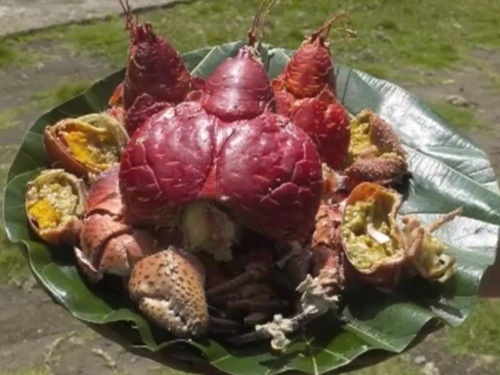
coconut crabs are called “tatus”
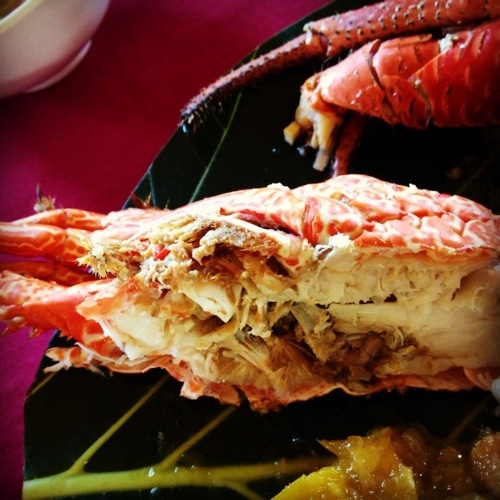
lobster galore1
Priced at 600 pesos a kilo (US$15/kg), I can eat those lobsters daily! As it turned out though, there were more of the other dishes which were repeatedly served during our stay in Batanes. Not that I don’t like them, but a little variety could have helped. Like I would have welcomed fish sinigang, calamares and fish kilawin while I was there. 😉
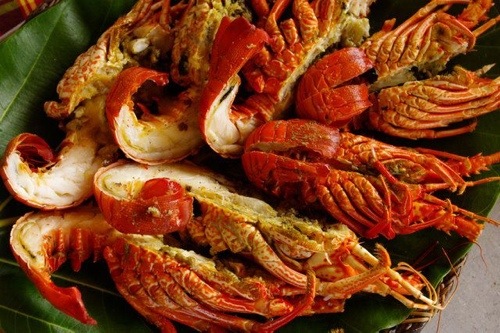
More LOBSTERS!
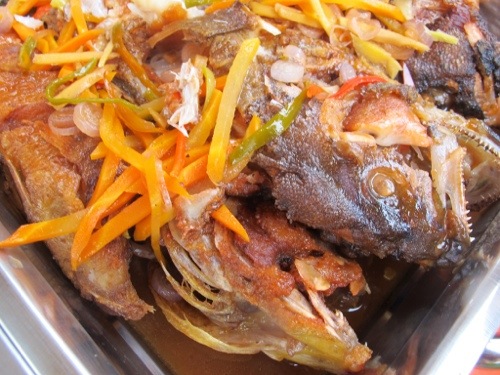
AND FISH. Grilled, fried or sweet and sour? I like mine sinigang!
But I do miss the lumot (seaweed) soup, pako (fiddlehead fern) salad, “Venes” or dried gabi (like “laing” but not really) and Uvud balls (minced banana pith cooked with fish flakes and minced pork). The last one seems to be the national dish of Batanes 😉 along with the luñis — the Ivatan adobo cooked in salt rather than vinegar and soy sauce — as they were served in nearly all buffet meals we’ve had during our stay.

Pako Salad. Made from fiddlehead fern.

uvud ng sarap!
When we visited the village of Savidug (named after a tree otherwise called “talisay” elsewhere) in Sabtang Island, our guide pointed out a Kabaya (breadfruit) tree to us. The Kabaya leaves are used as plates and may even be folded to scoop soup! Ingenuity at its best. Makes for a great picnic!
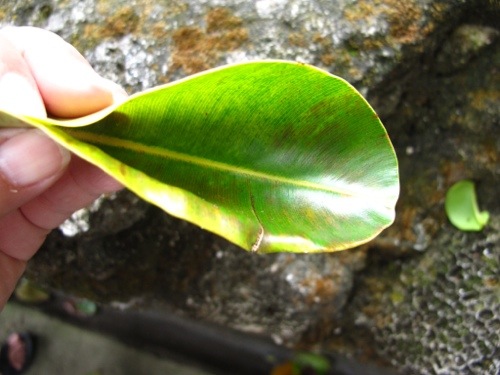
Now, that’s a spoon!

Good for scooping!
I didn’t see any rice paddies in Batanes. Nor fruit trees other than bananas. For sure, there are sweet potatoes and yam. We were served rice with turmeric, freshly harvested coconuts and the sweetest camote (sweet potato). There aren’t too many dessert choices and while I enjoyed the camote cue and “bukayo”, I’d soon grow tired of it if I had it all too often. For sure, I’d know what to bring the next time I visit Batanes!
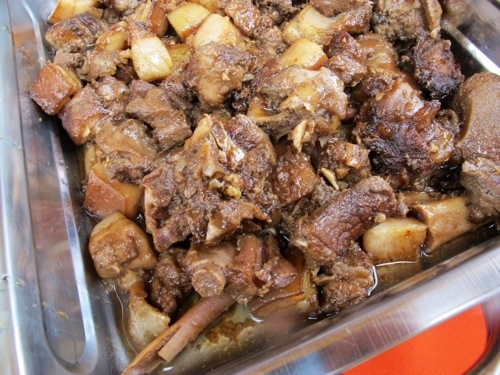
“Lunis” or ivatan adobo.
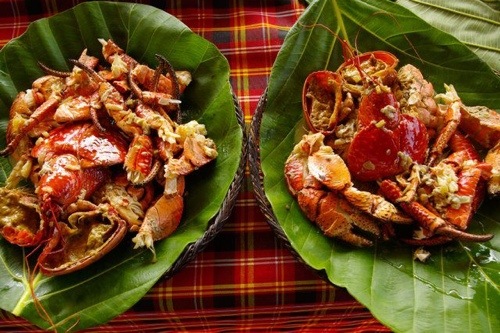
Do we have to make a choice?
(Thank you, Chikie and Pinky for some of the food photos!)

CPR. Naaah, not the medical/first-aid procedure. Long before initials became the norm in addressing bosses, the entire Philippine nation had CPR. CARLOS Peña ROMULO. My generation still remember those history quizzes back in Grade School where United Nations, Gen. MacArthur’s landing at Leyte and liberation were associated with CPR. As when I remember my father’s generation refer to him as Mr. United Nations. Always, with Filipino pride.

Sourced from the Net. This photo inspired the bronze statues representing the Leyte Landing of General Douglas MacArthur, then President Sergio Osmena, then Brig. Gen. Carlos P. Romulo , etc.
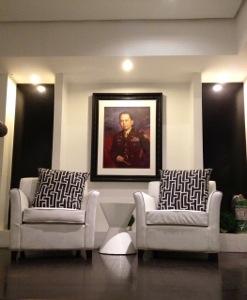
From the staircase to the private function room (good for 80 pax) on the second floor, this portrait of CPR would greet the visitor.
Mr. United Nations, impressive orator, diplomat, soldier, Filipino patriot, journalist and author. An achiever at a very young age, he was no ordinary teenager. Wet behind the ears, he was already a reporter at age 16, a newspaper editor by age 20, and a publisher by age 32. He is also the co-founder of the Boy Scouts of the Philippines. During the Japanese Occupation, he made sure the Philippines was not forgotten, chronicling the plight of Filipino fighters, his voice heard by as many Americans while he agonized just thinking of his family back in the Philippines. But more than all these, his legacy extends to this Filipino restaurant — Romulo’s Cafe.
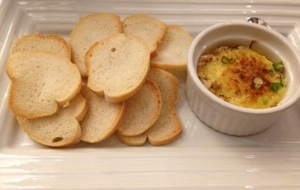
Bangus Pate. Bangus is milkfish, flaked and made into a pate that are served as appetizers with Crostinis.

This Tuna Sisig is ideal for vegetarians and vegans.
You can start and end with the appetizers and NOT feel cheated. The Bangus Paté and Tuna Sisig are must-try appetizers. No pork in your Sisig? No liver pâté? I’m telling you. You won’t miss your pork and duck liver. Filipino ingenuity at work here.
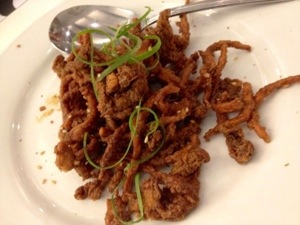
Crispy Squid. Oh this is a favorite!
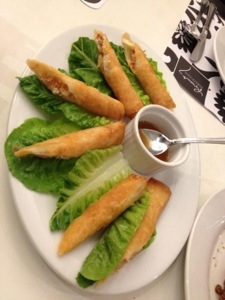
Fish Rolls
And there’s the crunchy squid and fish rolls. I can down these appetizers with a cup of steamed rice and wear a smile all night. All 4 appetizers so savory, and healthy. No guilt pangs. YET. 😉
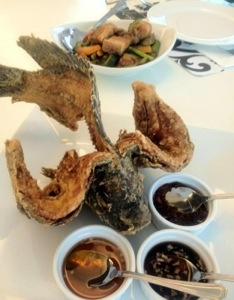
Fried Tilapia

Pinakbet with Bagnet. A Northern Philippines (Ilocano) dish.
We TRIED staying healthy, but not for long. The deep-fried, splayed Tilapia served with 3 sauce dips is both a gustatory and aesthetic delight. The BAGNET in the Pinakbet stole the scene from the shrimps adorning the veggie dish. Too tempting. It broke all resolve to have a Meatless Friday — of course, others were dead set early on to break the rule 😉 — and so came the Crispy Pata and the Lengua .

Can’t stay away from meat? Try the Crispy Pata.
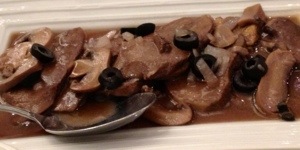
Lengua. (Ox Tongue)
Good company, good food, good service and a place so charming. The high ceiling, black-and-white motif, and tastefully-designed interiors all combine perfectly to highlight the framed photos hanging on the walls. Each one a lesson in history. CPR giving a speech — this little man standing tall amidst prominent Americans and other foreigners in the audience. CPR in a family photo, in earlier times and late in his years. CPR doting on his grandchildren. What a legacy!

Suman Con Latik. A very Filipino snack food with a twist!

Framed photos such as these are each a lesson in history. CPR is very much a part of the Philippines’ wartime and post war history.

A doting grandpa, more than anything else.
Many would remember it as that restaurant where Pinoy, Chinoy, and Tisoy cuisines merged, and which became a landmark off Echague Street. While it has since moved to 750 Florentino Torres near C.M.Recto and Soler Streets, the aura remains the same. It helps that the furniture exudes the same illustrado character, where an Amorsolo-ish painting hangs on one side of the wall and where menu offerings are written in chalk on boards hanging on another side.
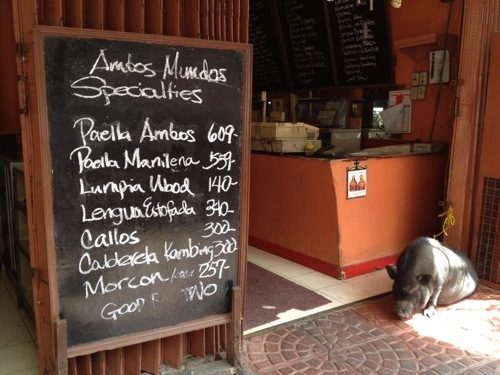
And there’s that lone boar tied to the door…………. Could that be “Liempo” or “Pork Chop”?
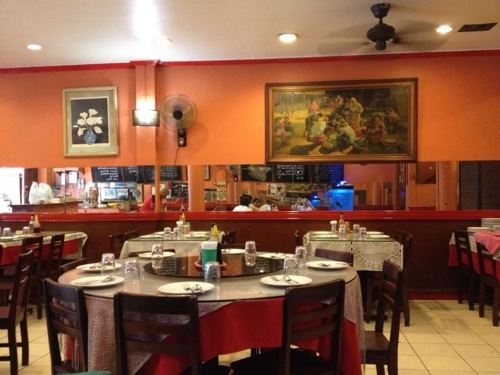
Ambos Mundos. Claims to be the oldest resto in the Philippines. 1888
The “best of both worlds”. East and West? Ambos Mundos. I can imagine men in tailored suits (yes, they really dressed up back when Recto Avenue was still called Azcarraga) dining here. Perhaps feasting on either Paella Ambos or Morisqueta Tostada. Or would it be Lengua or Buntot Estofada? Many Filipinos think of Callos and Morcon as “fiesta fare” — special dishes served whenever there is reason or an occasion to celebrate. In the same breadth, Filipinos likewise drool over their favorite local food, and by that, I mean favorite local Filipino and Chinese food. Crispy Pata, Bulalo, Lumpia Ubod, Pancit Bijon, Asado, etcetera!
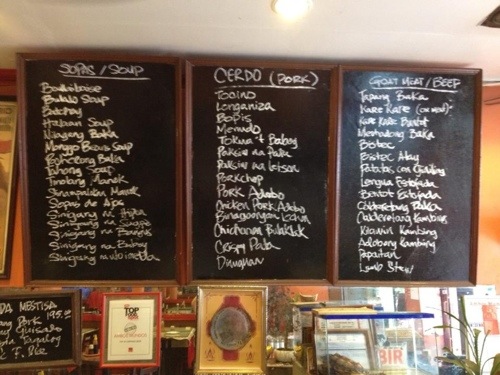
That menu is a real fusion of Chinoy, Pinoy and Tisoy Cuisines.
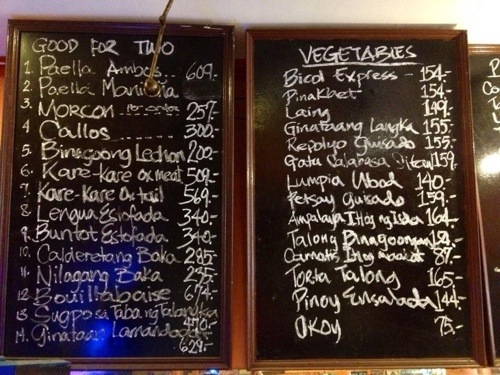
Chinoy or Pinoy or Tisoy Cuisine in Ambos Mundos. 1888
Is it really the oldest restaurant in the country? Both Ambos Mundos and Panciteria Toho Antigua claim to be the oldest, having operated since 1888. Who’s to tell? Both were my childhood favorites, by the way. But where Toho appears like many other old Chinese restaurants, Ambos Mundos has an altogether different charm. Very old world. Complete with pot-bellied black pigs tied to its front doors! (A recent addition, I suspect) Some keep pet dogs. Or pet kittens. But pet boars? We’re told they’re there for good luck. There must be a grain of truth in that. After all, they’ve been around since 1888!
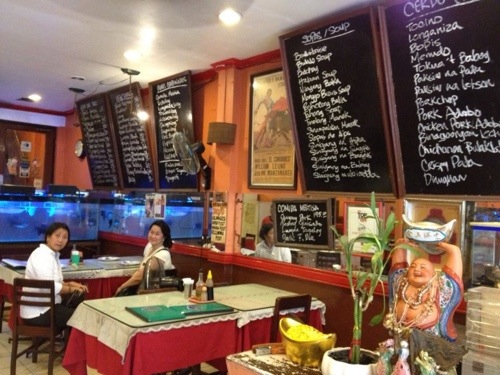
My 2 amigas eagerly wait for our order of Morisqueta Tostada, Lengua Estofado and Patatas con Giniling.
See you again, “Liempo” and “Pork Chop”! We weren’t very happy with the Morisqueta Tostada, Lengua Estofado and Patatas con Giniling that we ordered — not as good as I remember 😉 — but we’re willing to try the other dishes next time we visit. 😉 OINK OINK
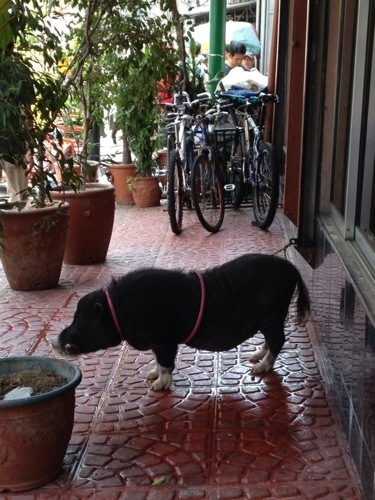
Another set of pet boars just across the street in Wah Sun, same owners. A Gaudinez married into the Leung Family who owns this Chinese resto since 1955.

They say you can order from either/both menus of Ambos Mundos and Wah Sun across the street. Same owners.
Addendum: This is even more interesting. Thanks to Teresa Gaudinez-Martinez, I now have a chance to straighten out some “kinks” and misinformation in this blog. Foremost is that THIS IS NOT THE AUTHENTIC AMBOS MUNDOS RESTAURANT. “Both Worlds” (Ambos Mundos) refer to Spanish and Filipino cuisines. NEVER INCLUDED CHINESE CUISINE. Huh? And there was NEVER A PET BOAR outside the restaurant. Huh again! Teresa, I have read all your blogs and sympathize with your legal woes. Obviously, there’s a long story fraught with family, legal, proprietary rights issues here. Thank you for taking the time to make the corrections. To our readers, here’s the link to Teresa’s Ambos Mundos blogs.
Other Asian countries have their sour broth equivalents, but our very own “sinigang” stands on its own in all its “Filipino-ness”. Those who’ve left the country to work abroad invariably served their own versions of sinigang using ingredients from their new place of residence and that old reliable sachet of sinigang sour broth powder. Yes, we all travel with our sinigang, don’t we? But nothing beats home-cooked sinigang using fresh ingredients from home. And true, making sour broth (tamarind or kamias or miso or guava) from scratch never fails to win applause. So….. Have your guests savor a home-cooked sinigang! It should rank up there along with “adobo” in must-try dishes.

Prawns cooked in sour broth.

Adobo
Adobo Republic. Need I say more? Every Filipino meat lover digs his adobo — in any “version”. But wait, adobo need not be limited to pork or chicken. There’s my favorite adobong pusit! Have your guest try that. A legacy from Spain? Maybe. But we have “Filipinized” it and took “en su tinta” real seriously. Squid cooked in its ink in all that vinegary goodness!

Chipirones En Su Tinta ? The local version is called Adobong Pusit.

Of course, we want to introduce our “bagoong” (shrimp paste) to our guests. What better way than to pair it with the coveted “Kare Kare”? The ground rice and peanuts making up the sauce renders a very Oriental flavor. Our Malay ancestry reveals itself in this dish, made more special by the aromatic bagoong. Green mangoes too, please. And while others may claim Filipinos rarely serve salads, try our “Lato” (seagrapes) and our “pako” (fiddlehead fern) salads. Drop some slices of salted duck eggs, onions and tomatoes, if you like. Pops in your mouth. Yum!

Seagrapes. Called “lato” is good with slices of tomatoes, radish and onions.

Pako Salad. Fiddlehead Fern Salad.
You can’t go wrong with seafoods too — prawn, lobster, crab, oyster, mussel, scallop and fish. Steamed, grilled or fried. Keep it simple. And fresh!
Balikbayans (literally “balik” means return; “bayan” means country) and foreign guests should share the same list. After all, who better to promote the Philippines abroad other than our very own “kababayans” (fellow countrymen). The balikbayans or returning/holidaying countrymen have conjured up images of local foods they must try/taste long before their arrival. You see, food images can either excite you or leave you in despair.

Rice Cakes with Dessicated Coconut, locally called “bibingka”.

Puto Bumbong.
I have several circles of friends — from childhood, school, office as well as those I’ve met and kept in my travels. Invariably, balikbayans hanker for the same food list. Deprive them and they’d have a bad holiday. As for the foreign guests, why force them to eat “balut” (duck embryo) when many Filipinos feel grossed out with such? There are many Pinoy dishes without the necessary Fear Factor-ish controversy. So, indulge them with:
#1: Bibingka and Puto Bumbong
I always bring my guests to Via Mare for their bibingka and puto bumbong fix. We are rice eaters like many others in Asia. So it comes as no surprise to find the equivalent of suman, puto and kutsinta in other parts of Asia. But i found none similar to our bibingka and puto bumbong. If there are, I have not seen nor tried them. So, how about introducing these rice-based eats to our guests?

Puto, Kutsinta and Suman

Mangoes — green and ripe, Chico, Durian, and other local fruits.
#2 Local Fruits: Manila Mangoes, Durian, Marang, Chico, Dalandan, Balimbing, Coconuts
Remember how we drool just thinking of cherries, persimmons, dragon fruits, naranjas, grapes, etc? Carnivores and vegans alike would most certainly be interested in our local fruits. No “eww factor” and it won’t cost you big time! And how about sweetened and candied fruits? I can think of our dried mangoes, condol and pineapples.

Halo Halo from Razon’s.
#3 Halo Halo
Halo Halo is not exclusive to the Philippines. Fruits with ice shavings can likewise be found in Japan, Vietnam, and elsewhere. But ours is unique because of its toppings.
Halo-Halo combines many of our sweetened fruits along with the very local yam (Ube) and Leche flan. Now, wouldn’t these choices be lots better than the “balut”? (By the way, they also have “balut” in Cambodia but locals there would not have it at the top of the list of must-try dishes.) Halo Halo sells for as low as 20 pesos (San Andres Market), maybe lower in the provinces. A humongous serving can be had in Manila Peninsula, but it will cost you. Me? I’m quite happy with Digman’s halo halo or the finer ice shavings and simpler (aka fewer but yummy ingredients) halo halo from Razon’s. Many local eateries also offer this as “merienda” (snacks) or as dessert.

Pancit Luglog
#4 Pancit Luglog or Pancit Palabok
Noodles. Italian pasta, Chinese Pancit, Korean Chap Chae, Japanese soba. All noodles.
What have we got that’s different from the rest? Palabok or Luglug, or even Pancit Malabon. The sauce base is different. Color is different. Toppings are different, especially if you load up with crushed chicharon. And don’t you just love how the sliced, boiled eggs sitting side by side with the squids, oysters and squid rings take center stage?
[The list continues….. Watch this page]



 Check Out My Other Blogsite Too!


