
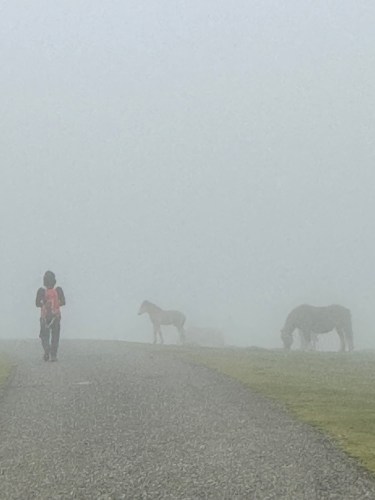
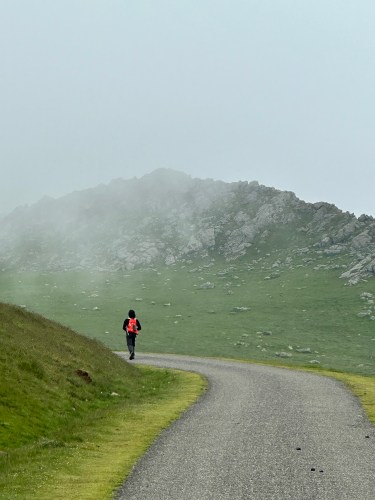
The first 20 kilometers or so was a gruelling uphill climb. Up until the Refugio Orisson, and further up to La Vierge (12 kms) where we arranged to be picked up by our mountain shuttle service. Further up is the Cross Thibault. I have great respect for those who hiked the entire 25 (or 27.5?) kms from SJPP to Roncesvalles in a single day. Man, that was hard! We broke the stage over 2 days and it still was challenging. For some, 25 or 27.5 kilometers may not seem so daunting. I’ve walked far longer in earlier Caminos but gaining over 1,300 meters elevation spells a major difference! The last time I did this was in 2017 but I took the Valcarlos route because Orisson was all mist and the center closed the route for the pilgrims. This time, I wanted to do the Napoleon Route which passes Orisson and Borda. The claim that this stretch is the most difficult because of the ascent is very true. Can’t disagree with that. It helped that the Pyrenees is simply so lovely and the mountain scenery in all its misty beauty distracted us from the rhythm of painful strides as muscles here and there ached. Beautiful meadows and farms and looking back, breathtaking vistas of the valley. Plus the wildlife, counting sheep, wild horses and cattle with mountain bells strung around their necks. I only started worrying when we strayed off the mountain roads and walked on cliffside rocky inclines. Too careful I’d step on and dislodge some stones or slip over some rolling rocks, my cliffside glimpses somewhat affected my sense of balance. And confidence. But we made it. Struggling, but not miserable. We persevered.
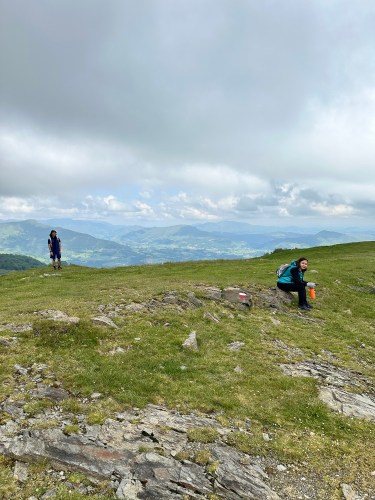
From what I’ve read, many pilgrims miss the La Vierge — a spot where a statue of The Virgin stands — and the border between France and Spain as one crosses the Pyrenees. This is Navarre. We were mindful to keep this in mind. We also took note of the highest point — this is Col Lepoeder. No way one would miss this. It’s that high point from where it’s nearly all downhill for 5 kilometers or so. It is also the spot where one decides to go left into the beech forests (one of Europe’s largest) or right via “abandoned” country roads. Either way you end up in Roncesvalles. Reportedly, “left is death” and “right is life”. You bet we headed right. And even then, I have committed the numbers 112 into my memory. That’s the European emergency numbers. Like 911. About 3 kilometers down the country roads, one glimpses the rooftop of the grand looking monastery of Orreaga. That’s Roncesvalles in Navarra. A big sigh at this point. The struggle is about to end. The very welcoming hospitaleros in the historic monastery stamped our pilgrim’s passport and promptly led us in to book our beds. But alas, our mountain shuttle was there to ferry us back to Saint Jean Pied de Port for our 3rd straight night. We boarded our van like little children, eager to reach our crib and put up our aching legs before a hot shower. How sweet to get this over and done with. How fulfilling that we persevered and completed the first stage of Camino Frances. Hopefully, my companions will find themselves back on the mountain and forest paths to complete their pilgrimage walk.





 lifeisacelebration