Category: Philippine Travels


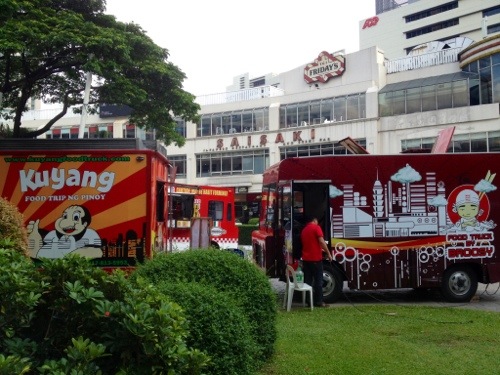
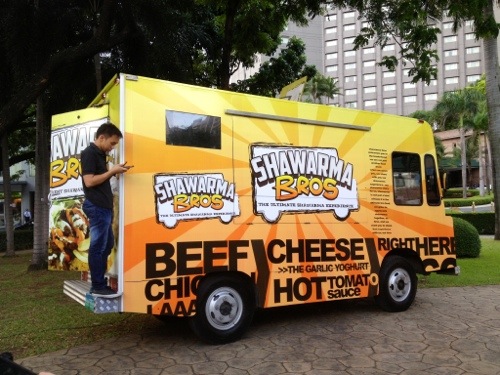
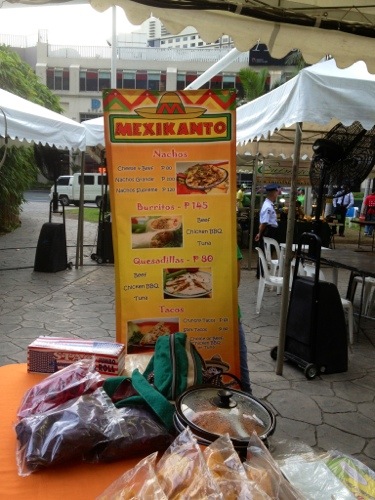
Here’s a quick one. We meant to be dropped off in Glorietta when we were pleasantly surprised with the tents being set up and food trucks parked around that tiny park fronting Glorietta and Makati Shangrila Hotel.

20130711-165816.jpg

20130711-165916.jpg

There were burgers, fish & chips, arroz caldo, bbq’s, ice cream, tacos, roast chicken, mac and cheese, kakanin like rice cakes, and so much more!

20130711-170113.jpg

How exciting to find these food trucks here. As soon as my apos and I got off the car, we lost no time checking out the many stalls. So many choices. And lots of new food dishes to try. We’re waiting for Truck Bun to get ready — planning on trying the Japa-dog, whatever that is. Also Jasper’s Chicken where we can actually sit inside the van! (The Chicken Karaage with Sour cream and their “wet sauce” was good!) Then finish off with Merry Moo’s ice cream. Or you can cross the street towards Family Mart to buy their P25 green tea soft-serve ice cream in the comforts of an air-conditioned space with tidy restroom. Hmmmm. Nice Thursday afternoon.
20130711-170515.jpg

20130711-170547.jpg

20130711-170644.jpg


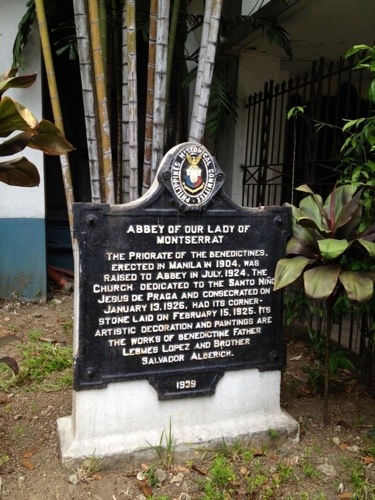
A week after I visited a monastery run by Benedictine Monks down South, I was reminded of my Visita Iglesia back in April earlier this year. Among the 7 churches and chapels I visited, the most striking in my book was the Abbey of Our Lady of Montserrat, more popularly called San Beda Chapel. It is a gem waiting to be discovered and rediscovered…… in an area more remembered as the posh San Miguel district in Manila where the moneyed and high society used to lead elegant lifestyles by the banks of the then clean, oil spill-free Pasig River. Quite ironically, it is also known of late as the Mendiola site that bore witness to way too many rallies, even bloody protests, as rallyists marched towards Malacañang.


20130701-085345.jpg

Abbey of Our Lady of Montserrat


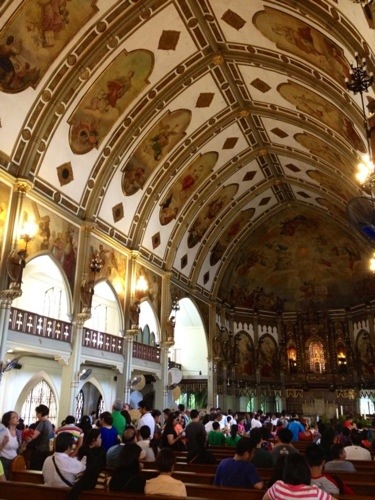
This neo-Gothic Chapel was designed by a Swedish architect by the name of George Asp. It would have looked even lovelier when it was consecrated in 1925, with those Sistine Chapel-like ceilings painted by artist-monk Fr. Lesmes Lopez, a Benedictine Monk. Awesome is an overused word, but yes, it is indeed awesome!


20130701-085505.jpg

You would have thought you’re somewhere in Europe. But naah, this is the San Beda Chapel right in Mendiola!


The stars in the galaxy must have conspired to spare this magnificent church from the destruction of the Second World War. Just a block away from Malacañan Palace by the Pasig River, both structures survived the carpet bombing during the Battle of Manila. Many of its historic counterparts in Intramuros were not as lucky. It surprises me though that not too many are even aware of the striking beauty of this college chapel. One look at the painting of the Apotheosis of the Most Holy Name of Jesus, the retablo and many bronze angels holding lamps to illumine the chapel in a “Rennaissance” kind of way, and you’re transported out of the slums, dirt, grime, chaos of Manila. I can imagine the old rich and elite hearing Sunday masses in this lovely college chapel back then. Can you?


20130701-085724.jpg

20130701-085757.jpg

Photo Sourced from the Net


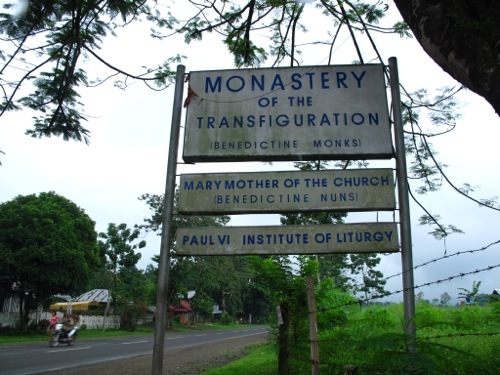
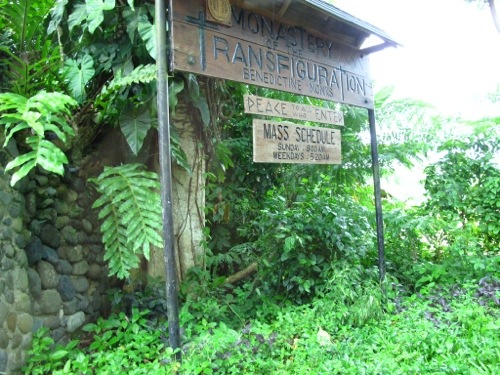
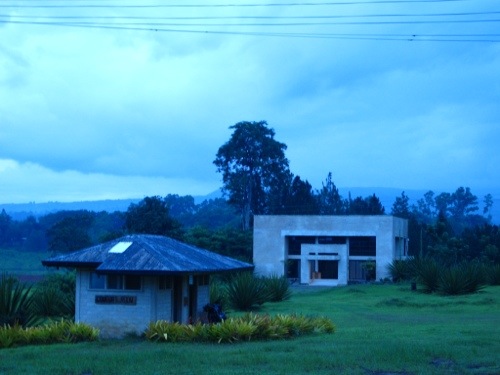
Nestled in the coffee-planted hills of Barangay San Jose, Malaybalay, Bukidnon is the Monastery of the Transfiguration run by Benedictine Monks. Not many know of this spiritual facility, but I’m sure many are familiar with the Monks’ Blend Coffee from this area. Seven times in a day, these monks sing hymns and pray in a place lush with greenery amidst slopes carpeted in various shades of green.


20130627-063617.jpg

20130627-063710.jpg

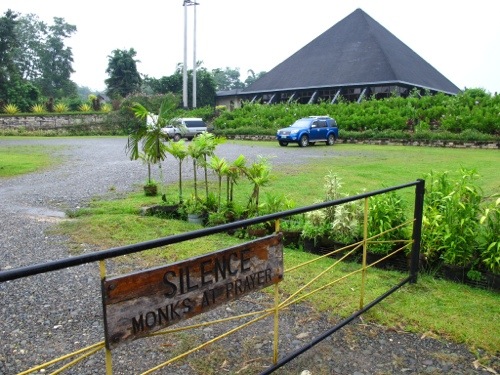
A gentle reminder to SHUT UP. Entrance to the Monastery of the Transfiguration in Barangay San Jose, Malaybalay, Bukidnon.


Here, monks, overcast skies and landscapes seem to work in perfect harmony. No, there are no duvets to cover and wrap tired bodies in the tiny, meticulously clean spartan rooms, but listening to the overriding sound of silence is good for tired souls. Yes, good even for the non-religious.


20130627-064257.jpg

20130627-064433.jpg

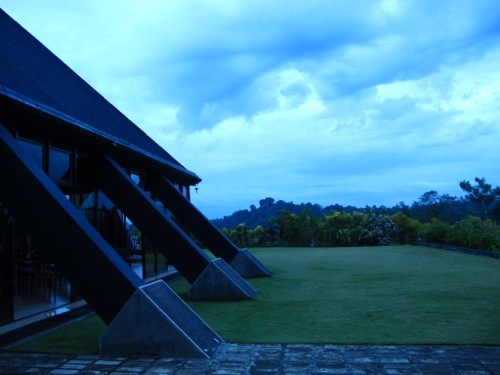
Sit on the grass and wait for either sunrise or sunset.


This is where one can restore one’s self back to sanity, unloading many of those cobwebs that claimed space in our urban mindsets. Eat, sleep, and be still. The monks pray seven times a day starting with the 3:40 am Matins. The retreatants are welcome to join them. In between the Matins, Morning Prayers and Mass, Vespers and Evening Prayers, you may pray the rosary while walking around the gardens and viewing the hills and perhaps one of the last surviving forested blocks in the entire archipelago. It felt so routinary and familiar to wake up slightly past 3 in the morning and walking out of your “cocoon” of a Guest House towards the Chapel. The bells warn you. The Monks singing in Latin soothe you. It felt so right. So harmonious. And so dark. Before long, varied hues of sunrise colors magically appear on the horizon. Other times, a fog may descend without warning. Literally like touching clouds as they pass by. Feel free to sit on the grass near the Chapel to wait for sunrise and sunset.


20130627-065912.jpg

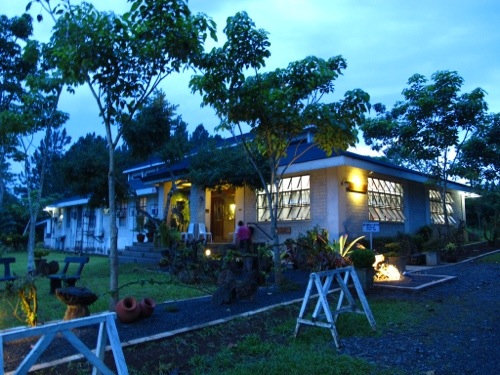
The Guest House. Monastery of the Transfiguration in Malaybalay, Bukidnon.

20130627-070127.jpg

Sunrise at the Monastery of the Transfiguration.


Every 2nd Sunday of the month, the growing popularity of the “Breakfast With The Monks” bring in as many as 300 traveling some distance from Iligan City (3 hour drive), Davao (5 hours) and Cagayan de Oro (2 hours). We missed this, but we had the most charming experience of chatting up 2 monks who may have abandoned their vow of silence while we were there 🙂 Fr. Col and Fr. Elias engaged us in a chat about gardens, joked with us, ate with us. I love how Fr. Elias would laugh with us then bring us back to some life philosophy inspired by the Good Book. We share the same mantra about “celebrating life” but I have tons to learn in the area of detachment. 😦


20130627-071648.jpg

Soon after the Morning Mass. Monastery of the Transfiguration in Malaybalay.

20130627-071918.jpg

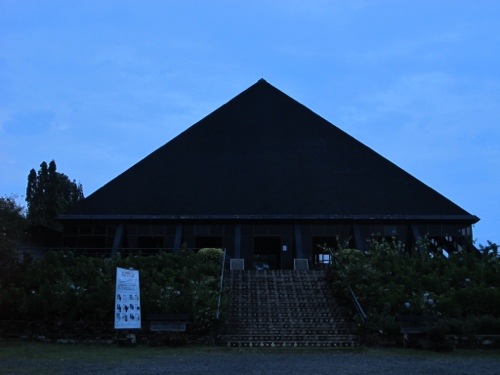
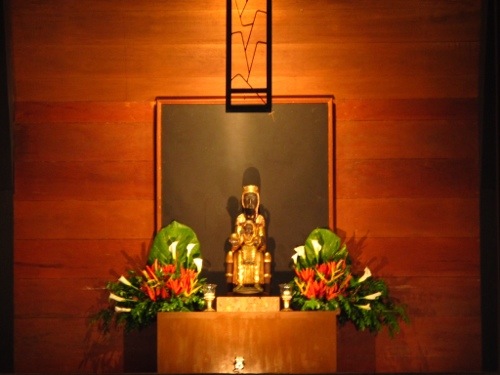
Our Lady of Montserrat.


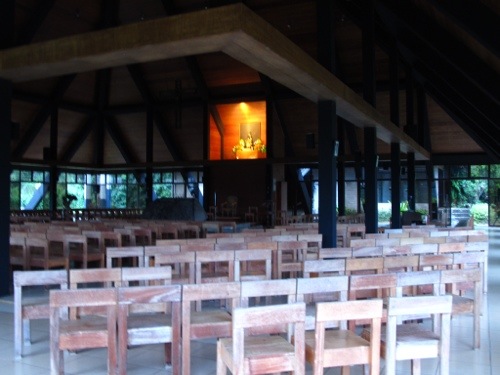
The pyramid-inspired architecture by the late National Artist Leandro Locsin is a masterpiece to have combined the conflicting elements of simplicity and grandeur. Inside is a large cross hanging above the altar which simply consists of a huge rock. Behind it and illumined by a lone spotlight is the statue of Our Lady of Montserrat donated by the Benedictine Monks of Montserrat near Barcelona, Spain. You can view the Virgin and Child up close by scaling a few steps behind the rock altar.


20130627-080116.jpg

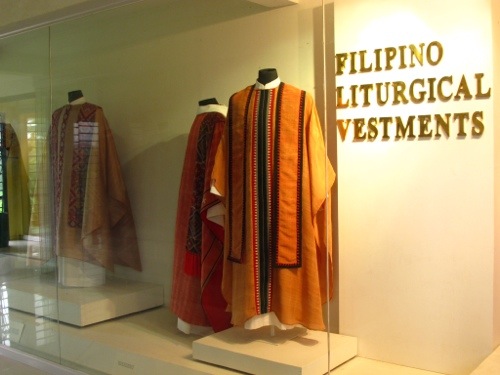
Museum of Liturgical Vestments. Monastery of the Transfiguration. Malaybalay, Bukidnon.

20130627-080200.jpg

The Museum of Liturgical Vestments. Lovingly set up and created by Dom Martin aka Gang Gomez.


Within the Monastery compound is the Museum of Vestments. Dom Martin aka Gang Gomez (yes, that fashion designer and icon) truly made an admirable collection of vestments inspired by tribal designs and indigenous materials. Be sure to drop in, along with a visit to the Store where you can buy peanuts and coffee grown by the Monks. St. Benedict medallions and icons are likewise available here.


20130627-081008.jpg

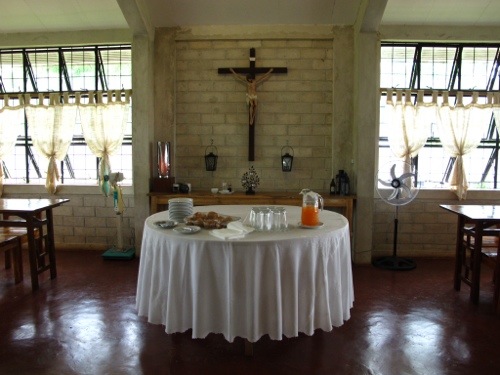
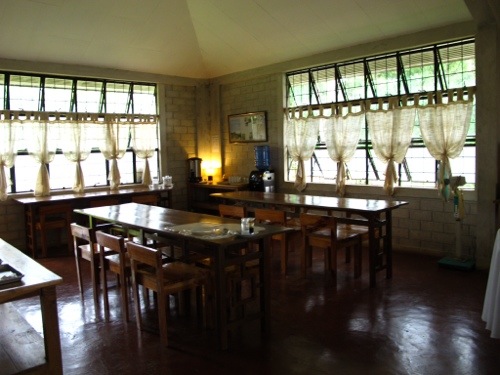
The Refectory at the Guest House. Monastery of the Transfiguration. Malaybalay.

20130627-081055.jpg

Keep your tables neat and clean. Glasses, utensils, food scraps in one corner of the Refectory.


Or…….. You can always head back to the Guest House for your snacks of coffee ( Monks’ Blend, of course) and muffins. Breakfast, lunch and dinner are simple affairs. I love how each diner leaves the dining table clean by putting away all glasses, utensils and food scraps after each meal. Dining in silence? Possible. Unless you chat up a monk. 😉 But if you’re not up for a stroll ( i wasn’t after the 3:40 am Matins), it maybe a better idea to crawl back to your tiny, semi-hard, good-for-the-back bed for a power nap before the next prayer and feeding times. Goodnight!

20130627-082012.jpg

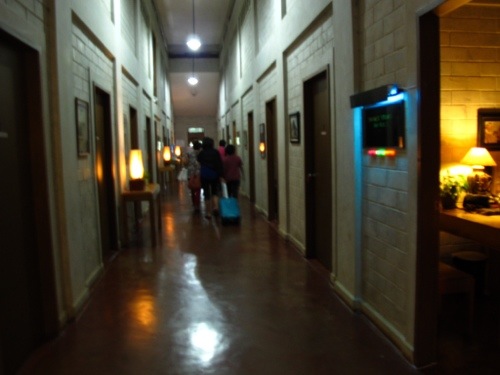
The Corridor to the spartan rooms. Monastery of the Transfiguration. Malaybalay.

20130627-082053.jpg

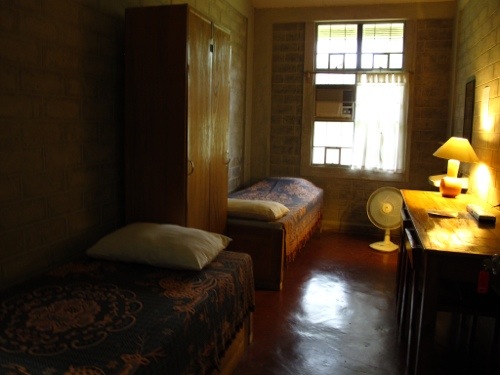
The Spartan Room. Monastery of the Transfiguration. Malaybalay. Bukidnon.


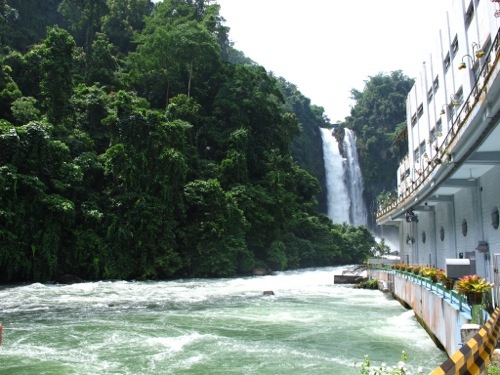
If Loch Ness has its monster, Lake Lanao had its Omaca-An. Emphasis on “had”. Monster gone. Omaca-An was no match to Rajah Indarapatra who went in search of his slain brother Rajah Solaiman, earlier defeated by the same giant man-eating monster. The legend goes that Rajah Indarapatra swam everyday for many years in the waters of Lake Lanao in search for his brother’s ring, but failed. In his search, he gathered many stones stretching some distance which later formed the Agus River, the only outlet of Lake Lanao. The same river dropped down a deep ravine which is now Maria Cristina Falls.


20130624-134004.jpg

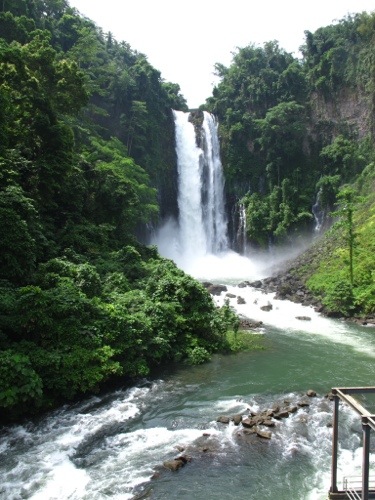
The Majestic Maria Cristina Falls. Iligan City.


Now, why name the Falls Maria Cristina in a region that’s predominantly Muslim at the time? Maria Cristina are really 2 persons. Two maidens living near the Falls, in love with the same man. The sisters loved each other very much and their beauty attracted many Datus and Sultans including the son of a Sultan who happened to love BOTH maidens. For this man’s indecision (or infidelity?), each of the 2 sisters sacrificed their lives by jumping from the top of the Falls. Maria, the younger went first. When Cristina learned of her beloved younger sister’s suicide, she likewise threw herself down the ravine. Both maidens gone. And the Sultan’s son? He never married. He buried their bodies under the Falls and named the Falls in honor of the 2 loving sisters he loved and cherished.


20130624-135359.jpg


The legend about the name Maria Cristina I’ve heard before. Now I’m told there’s another legend from the Maranaw folklore. And this has nothing to do with romance. Rather, it may have something to do with Divine intervention. The legend begins with a mythical hero named Prince Bantugan. The Prince intended to visit the Maranaws with the intention of conquering this tribe. He thus ordered his men to find the biggest and longest tree, and to fashion a big boat out of it. The floating vessel was named Rinamuntao Mapalao, designed with a prow looking like the mouth of a crocodile. Stocked with food, ammunition, and the bravest warriors, the boat sailed with Prince Bantugan along the Agus River, reaching Maria Cristina in 2 days.


20130624-140609.jpg


When word reached the Maranaws that Prince Bantugan and his warriors have arrived, they gathered for prayer and “sent a storm and an earthquake”. The gods or “tonongs” allegedly heard their prayers upon which Agus River swirled, overflowed and flooded the entire area. Right where the Rinamuntao Mapalao was anchored, the river opened up and swallowed the big boat along with its warriors. The crevice created the ravine over which the Falls cascaded down. According to this legend, the Prince, the warriors and the boat are still within the area, to “rise” only near the end of the world. Meanwhile, the Prince and his army of brave warriors are “enchanted” and exist around the foot of the Falls. Hmmmmm. Quite a story, don’t you think?


20130624-141618.jpg

20130624-142036.jpg


Nayong Pilipino translates to Filipino Village. This theme park near the Diosdado Macapagal International Airport sits in a 45-acre park within the Expo Pilipino Complex. Sorely in need of funding, I lament that it is not as “representative of the best in the country”nor as widely promoted as our other tourist spots.


20130430-125454.jpg

Nayong Pilipino (Filipino Village) in Clark Expo Zone

20130430-125606.jpg

The Barasoian Church where sunday masses are held 10 am .


I couldn’t remember the last time I visited Nayong Pilipino. And I’m referring to the old site near the Manila International Airport. Having a tourist site with replicas and miniatures of famous Philippine landmarks is a good idea. Locating it near an international airport serves travelers well, especially those with an extended layover. I am assuming THAT idea is intended to promote the country and perhaps encourage foreigners to explore more of the Philippines. As for the locals, I remember the old Nayong Pilipino as a must-experience for grade schoolers to introduce them to the beauty, history and geography of our country.


20130430-130534.jpg

Si Malakas at si Maganda (The Strong and the Beautiful)

20130430-130714.jpg

The Colonial Plaza includes the Rizal Shrine, Emilio Aguinaldo Shrine and the Apolinario Mabini Shrine.


I have a circle of visiting foreign bloggers who breeze through Manila on their way to the beach destinations in the Visayas and Palawan, OR to the rice terraces and colonial/heritage towns up North. Cebu and Bohol are popular destinations to view Magellan’s Cross, Tarsiers, and Chocolate Hills. Gaining popularity of late is Donsol for the whale shark adventures and while there, who’d dare miss our majestic Mayon Volcano?


20130430-131524.jpg

Typical Filipino huts line the perimeter towards the Nayong Pilipino .entrance.

20130430-131710.jpg

A representative Kalinga Village (Northern Philippines)


I am not confident this theme park highlights the best our country offers. I understand there’s a shuttle service from nearby SM Clark but if there was, ALL my foreigner-friends who flew in via Clark missed it. A free shuttle from the airport itself would have served the purpose better. (If there is, it should be promoted so as NOT to be missed!) Surely, extended layovers are better spent here rather than in the malls or duty-free shops.


20130430-133454.jpg

Replica of the Rice Terraces of Banaue in Northern Philippines. With real rice planted!

20130430-133529.jpg

On a hot and humid day, the shade from these trees are heaven-sent!


We went on a hot, humid day. Walking around without a hat or umbrella is guaranteed to give one a migraine. Luckily, we came prepared. But there were not enough markers and signs to tell the story, history and culture of the different regions represented here. I am not sure if there is a schedule of guided tours. I wish there is. And I hope they have good guides.


20130430-134211.jpg

An Ifugao House

20130430-134238.jpg

An Ifugao Village


I understand there is the issue of funding. The time I went, there were hardly any visitors. Now, those P100 admission fees from MORE visitors could augment the needed funding. A better-stocked cafeteria may likewise be a good source of revenues. So how about bringing in more visitors by offering free shuttle services on FIXED SCHEDULES from the Clark airport?


20130430-134950.jpg

Barasoian Church replica.

20130430-135005.jpg


How often do we entertain foreign guests and balikbayan (returning Filipinos) family and friends?


I’ve done quite a few — from long weekend trips in mountain villages up North or to some beach destinations down South to whole day together-ness via roadtrips north or south of Manila. And for the briefest encounters……. There’s THE DRILL. A glimpse into over 300 years under Spanish rule (Fort Santiago y Intramuros) + the heart and core of Chinatown (a.k.a. Binondo Walk cum Foodtrip) + end-of-day relaxation along Manila Bay interspersed with brief food tripping episodes.


20130418-121619.jpg

Rizal Park

20130418-121744.jpg

Fort Santiago in Intramuros, Manila


By itself, the Rizal Park-Intramuros-National Museum can take a whole day already. But who wants to do long walks at 39 Celsius in humid April? I say the Museum can wait and the Park can easily be a “drive-thru”. We were first driven to Fort Santiago (entrance: 75 pesos, 50 pesos for students) passing Rizal Park (Dr. Rizal is the national hero), and then walked from Fort Santiago towards San Agustin Church, the oldest surviving church in this predominantly Catholic country. If there’s time, you can visit the Museum housed in the Convent adjoining the Church or visit Casa Manila (showcasing Filipino-Spanish lifestyle) just off the church corner. Or you can choose to sit on a horse-drawn carriage (the cheaper calesa or the pricey caruaje) sightseeing for the next hour or two. The choices depend on how much time you have. In some instances, I totally skipped Fort Santiago and instead visited Baluarte de San Diego. More trees there. Ergo, more shade!


20130418-132828.jpg

The National Art Gallery which used to be Legislative Building

20130418-133034.jpg

Baluarte de San Diego in Intramuros, Manila


From Intramuros, you can either take a cab or a jeepney or drive past the Museum and City Hall across Jones Bridge overlooking the lovely Postal Office to reach Binondo. Hungry or not, a Binondo Walk is never complete without dropping in on those “hole in the wall” spots. My personal favorites are Po Heng Lumpia House and Dong Bei Dumpling House. Need I tell you what they serve?


20130418-134252.jpg

Chinese Lumpia (Vegetable Roll) from the best : Po Heng Lumpia House in Binondo, Manila.

20130418-134323.jpg

Dumplings or Sio-Mai. Freshly Made!

20130418-214156.jpg

Kutchay Siomai or Dumplings with Chives Fillings. Only from that hole-in-the-wall, Dong Bei Dumpling House in Binondo, Manila.


Finally done with Hispanic Philippines (Intramuros) and Chinoy Philippines (Binondo Chinatown)? Maybe it’s time for a cup of Cappuccino in Harbour Square within the reclaimed area housing the Cultural Center of the Philippines, Folk Arts Theatre and Philippine International Convention Center. It’s your modern Philippines complete with junk food outlets lining the Bay. Grab a bite here, if you like. Many choices across a wide price range. This is also a superb place to unwind or chill while waiting for the famous Manila Bay Sunset.


20130418-135913.jpg

Manila Bay, viewed from Harbour Square in the CCP Complex near Cultural Center of the Philippines.

20130418-140005.jpg

Roxas Boulevard near Manila Bay. At Twilight.


Juan Luna’s obra maestra, the SPOLIARIUM , greets you as soon as you step into the Hall of Masters in the National Art Gallery. I have visited it quite a few times, appreciating how this painting brought and still bring so much pride to us Filipinos.

Browsing through my favorite Facebook pages, I was struck to find this photo of how the obra maestra looked in 1958. The National Museum offers this information and I do not wish to add nor subtract from it:


“Spoliarium (1958): Photo shows the Juan Luna masterpiece “Spoliarium” on display at the lobby of the Department of Foreign Affairs building on Padre Faura St. (now the Department of Justice building) where it was mounted on a wooden frame after it was shipped to the Philippines as a gift by the Franco Government in Spain that year. Unfortunately, because of its size, the painting was sliced into three pieces before it was crated and brought to the country. (The slices in the painting can be seen here) The Spoliarium was later restored by artist Antonio Dumlao before it was unveiled again in 1962. The painting remained at the DFA before it was transferred to the National Museum where it can be seen today.


The Spoliarium was entry by Luna to the Exposición Nacional de Bellas Artes in 1884 in Madrid, where it garnered the first gold medal (out of three). In 1886, it was sold to the Diputación Provincial de Barcelona for 20,000 pesetas. It measures 4.22 meters x 7.675 meters, and considered as the largest painting in the Philippines. (Thank you, Vic Torres, for the photo and the annotation.)”


20130407-090705.jpg

Sourced from the Net

(Source: National Art Gallery)


It almost breaks your heart to see even just a photo of a visibly “split up” SPOLIARIUM. Thanks to Antonio Dumlao, we are now privileged to view this obra maestra in all its glory. But pray tell, who is ANTONIO DUMLAO?


20130407-090900.jpg

Spoliarium at the Hall of Masters. National Art Gallery. Manila


More Internet surfing and more heartbreaks which can only be appeased by my sharing these with you.


First off, Antonio Dumlao was an accomplished artist. He was commissioned to give a “facelift” to the Juan Luna obra maestra in 1960 despite the fact that he was never trained in restoration work. In fact, he never had any formal education in the arts. He quit the same year he enrolled to study fine arts in the University of the Philippines. With or without formal education, Dumlao was a gifted artist. He was a muralist, a portrait canvas artist, a sculptor and a stained glass innovator. For many years, he served as Art Director of San Miguel Corporation and developed a friendship with his top art patron, Don Andres Soriano, through whom he met Don Manuel Elizalde, another art patron.


20130407-111309.jpg

Antonio Dumlao. (Photo sourced from the Net)

(Photo sourced from the Net)


DUMLAO was friends with Fernando Amorsolo, a contemporary, who has great admiration and respect for his work. Ironically, not much is known about DUMLAO. Nor about his deep friendship with his childhood friend from Intramuros days, Vicente Manansala. When Dumlao had a stroke in 1979, his daughter recounted how “Mang Enteng” flew to his father’s bedside. Genuine friends, indeed. Two years after that visit, Manansala had a heart attack and died before Dumlao, who died in 1983.


20130407-113012.jpg

Ina ng Lahi. Photo sourced from the Net.

(Sourced from the Net: “Ina Ng Lahi”. UP Vargas Museum. Filipiniana Collection.)


20130407-113119.jpg

Not just a painter or muralist. He works on stained glass too!
Photo Sourced from the Net.

(Sourced from the Net: “Sarimanok” Stained Glass. Far eastern University)


Imagine how this gifted muralist restored Luna’s Spoliarium! Makes me wonder how much of the mural is Luna’s and how much was Dumlao’s. I know, that’s NOT fair to say. Forgive this non-artist, layman’s random thought. One thing’s for sure though. This Luna fan is now officially a Dumlao fan too. His other stained glass works are still in Malacañang and in the Mosque in Quiapo. Now, this requires a visit! Join me?


What makes a good tour guide? I’ve met quite a few and can easily pick out those who stand out in my list. Them whose credo is to make every traveler or tourist enjoy his trip. Them who treat their job like their religion. With passion. With devotion. In the same vein, I can just as easily weed out the wrong types. Them who spit out names, dates and other historical facts almost mechanically, at times not minding whether or not you caught the trail of the pseudo-history lesson. I’m sure you know the types.


In my experience, I never really found the perfect tour guide. But each experience is rendered unique because of some “connection”. I’ve kept in touch with a few. I’ve even dedicated some blogs to “honor” them. Here’s a short list. 🙂


Randy, the Butanding Whisperer (Donsol, Sorsogon)

20130403-204916.jpg

Randy. The Butanding Whisperer.
Donsol, Sorsogon.


To this day, Randy still sends me text messages in his “jejemon” style which gives me tremendous headaches! I am still able to refer to Randy some of my friends eager for a Butanding experience. My grandchildren still remember him fondly.


Rusty, The Last Caretaker of Syquia Mansion (Vigan)

20130403-205211.jpg

Syquia Mansion in Vigan, Ilocos Sur. Don’t miss this!


I wonder how Rusty is. I failed to take a photo of him. Does he have his “apprentice” to train now? Has Rusty retired already?


Rogers With An “S” (Batanes)

20130403-210143.jpg

He punctuates his sentences with “I Love You”. And yes, take that seriously!


He punctuates his sentences  with “I love you’s” and his face has a perennial smile sure to infect each person he meets. Rogers — yes, with an “S” — is not young, but his energy and passion is forever on overdrive. Where does he get all the energy? Must be the Batanes air!


Cemetery Guides, anyone? (LA LOMA, NORTH & CHINESE CEMETERIES)


20130403-213319.jpg

La Loma Cemetery. Who would have thought this makes for an outstanding guided tour? In the league of New Orleans and Paris!


I joined a tour organized by the Museum Foundation of the Philippines and was only too happy to have the brilliant Architect Manuel Noche and the hilarious, ever-energetic Ivan Man Dy walk us through history as we walked around the mounds and mausoleums, some of which are as high as 3 storeys. I’m telling ya….. this guided tour is certainly worth the buckets of sweat that humid day!


Juan Luna Shrine: So, Who Shot The Patriot’s Wife? (Badoc, Ilocos Norte)


20130403-213722.jpg

The Juan Luna Shrine in Badoc, Ilocos Norte. Drop by on your drive from Laoag to Vigan. It’s the last town of Ilocos Norte on your way to Ilocos Sur.


Bet some of you didn’t know that. Yes, Juan Luna shot his own wife. I’d love to retell the story but that nameless guide in the Luna Shrine can’t be beaten in his craft. It was this man who inspired my grandchildren to always ask for a Tour Guide when we’re traveling. And they do listen….. In a way that makes me real jealous.


Mount Pinatubo: An Ex-Marine For A Guide and A Native Aeta for a Driver


Who would have thought I’d do this at my age? I was determined, but it sure was motivating that the trek was made shorter! I came in my old pair of comfy rubber shoes, then left with a pair of slippers. My guide’s daughter needed a pair and so mine — though used — must have made a good present.


20130403-225619.jpg

Our Pinatubo Guides!


THANKS TO THESE TOUR GUIDES —- my trips to these places are made truly memorable. There are DIY (Do It Yourself) Trips, and there are those where the experience is enhanced by how a local’s perspective is drawn much differently from what the travel books say. Priceless. Much.


Ivatan cuisine is as fresh and healthy as it gets. Most visitors would be eager to feast on freshly-caught lobsters and the coconut crabs (called “tatus”) indigenous to the place, but there’s really more beyond these coveted seafoods.

20130402-080215.jpg

coconut crabs are called “tatus”

20130402-080256.jpg

lobster galore1

Priced at 600 pesos a kilo (US$15/kg), I can eat those lobsters daily! As it turned out though, there were more of the other dishes which were repeatedly served during our stay in Batanes. Not that I don’t like them, but a little variety could have helped. Like I would have welcomed fish sinigang, calamares and fish kilawin while I was there. 😉

20130402-081052.jpg

More LOBSTERS!

20130402-081142.jpg

AND FISH. Grilled, fried or sweet and sour? I like mine sinigang!

But I do miss the lumot (seaweed) soup, pako (fiddlehead fern) salad, “Venes” or dried gabi (like “laing” but not really) and Uvud balls (minced banana pith cooked with fish flakes and minced pork). The last one seems to be the national dish of Batanes 😉 along with the luñis — the Ivatan adobo cooked in salt rather than vinegar and soy sauce — as they were served in nearly all buffet meals we’ve had during our stay.

20130402-081657.jpg

Pako Salad. Made from fiddlehead fern.

20130402-081948.jpg

uvud ng sarap!

When we visited the village of Savidug (named after a tree otherwise called “talisay” elsewhere) in Sabtang Island, our guide pointed out a Kabaya (breadfruit) tree to us. The Kabaya leaves are used as plates and may even be folded to scoop soup! Ingenuity at its best. Makes for a great picnic!

20130402-082536.jpg

Now, that’s a spoon!

20130402-082813.jpg

Good for scooping!

I didn’t see any rice paddies in Batanes. Nor fruit trees other than bananas. For sure, there are sweet potatoes and yam. We were served rice with turmeric, freshly harvested coconuts and the sweetest camote (sweet potato). There aren’t too many dessert choices and while I enjoyed the camote cue and “bukayo”, I’d soon grow tired of it if I had it all too often. For sure, I’d know what to bring the next time I visit Batanes!

20130402-111606.jpg

“Lunis” or ivatan adobo.

20130402-113723.jpg

Do we have to make a choice?

(Thank you, Chikie and Pinky for some of the food photos!)

20130402-113854.jpg


Love it. Got it! Rogers (yes, with an S) is such an adorable tour guide. We had him for 4 days and there was simply no chance of any mind-numbing boredom with this Ivatan. Before this trip, I only have 2 personal friends who are Ivatans. Rogers makes 3. Dan, his assistant, makes 4.

20130321-073412.jpg

Rogers With An “S”. That’s what he’s called!


Rogers loves punctuating his statements with “Got it?” that we all too soon adopted it as the group’s tag line. When anyone asks anything even vaguely hinting of a complaint (like why can’t we buy coconut crabs to take home?), Rogers is quick to plead to spare him of any misdirected protest (“Please don’t get mad at me…..”) and accordingly ends his statement with “I love you”. Once, there was this Caucasian who approached him and I overheard Rogers bidding him farewell and the perfunctory “I love you, Sir”. I waited for the man’s reaction, but he must have gotten used to Rogers (as we were, after only 24 hours) that the mechanical endearment was accepted without much fanfare.


20130330-121205.jpg

And that’s Rogers’ able assistant……..DAN. No “S”


His assistant, Dan — that’s Dan in green shirt atop the jeepney! — is just as gracious but not given to the same endearments. I’d give him a few years before saying “I love you’s” without blushing. 😉 Much like Rogers, Dan is quite adept with cameras too. SLRs, P&S, iPhone or iPad cams. I learned they also serve as guides in many Photo Safaris and Photography Workshops conducted in Batanes. Rogers said they learned by listening to the lectures and simply watching the pros. No wonder they know the best angles and photo spots.


20130330-130514.jpg

Welcome to Batanes….. sung by these friendly Ivatan students.

20130330-130623.jpg

Choir of the San Carlos Borromeo Church in Mahatao singing ” We Welcome You to Batanes”. So heartwarming!


When we visited the San Carlos Borromeo Church in Mahatao, we spotted the Parish Priest standing by the 2nd floor window. He came down to welcome us just as the church choir sang a Welcome to Batanes song for us. Just as beautiful was the song number by Ivatan students who sang for us after our dinner at the Lighthouse overlooking Basco Bay. So heartwarming!


20130330-130911.jpg

The hardworking Ivatans in action. Sabtang Port.

20130330-131003.jpg

The Old Man and His Carabao. Sabtang Island, Batanes, Philippines.


Being in Batanes and with these hospitable Ivatans is a refreshing experience. From the hardworking men at the Sabtang Port to the old man with his carabao to the old lady by the road. Some of us even borrowed bicycles from smiling children who took our hands to touch their foreheads as a show of respect. It’s nice to be OLD here in Batanes where respect for elders is still fashionable!


20130330-134815.jpg

Buko or Young Coconuts For Sale.

20130330-135013.jpg

The Old Ivatan lady by the road. Sabtang Island, Batanes. Philippines.


Some skeptics think Honesty Cafe is really just all-hype. This untended store allows you to take whatever you like and simply deposit your payment in a box. Nothing can be simpler than that. I would love to retell this story to such skeptics about how one of us lost his room key, cell phone and eyeglasses in Rakuh a Payaman a.k.a. Marlboro Country. We already boarded our jeepney, well on our way to another destination, when my friend missed his stuff. Our Tour Guide Rogers directed his assistant Dan to take over while he mounted a bike to motor back to Marlboro Country. No luck. After all it was near sunset by then, so Rogers summoned some of his friends to continue the search as we were leaving early the next morning. No high hopes they’d be found.


20130330-140207.jpg

You make the Ivatans proud. And so with the rest of the Filipinos. Batanes. Philippines.


Hey, skeptics. See that photo above? Between Rogers and my friend Tony is this fine young Ivatan lad who found Tony’s cellphone, eyeglasses and room key. He motored all the way from Rakuh a Payaman to the airport where we were getting ready to board for our homeward flight. He was in a hurry to leave after returning Tony’s stuff that Rogers had to hold him for this posterity shot. Makes us all admire this young Ivatan, but truly, we weren’t surprised at all about Ivatan honesty and admirable character. How about you? Were you surprised? Love it? Got it?