We’ve covered Fukuoka in 2017 and 2022, both times in autumn. This spring, we enjoyed the Sakura season from Hiroshima, Miyajima (part of Hiroshima)and Fukuoka. Only 3 items in our agenda — cherry blossoms, food trip and shopping (for most). Our hotel in Fukuoka is right next to the Hakata Station where many shops and restos are, so that’s very convenient. I am not that keen on checking out more spots as I’m booked to be back later (and warmer) this year for some event. For now, let it be truly relaxing . And for more Sakura blooms, we trooped to Maizuru Park. We found many locals enjoying a picnic or just lazing around under the cherry blossoms. Hanami is taken quite seriously here and we’re glad to enjoy that with the locals here.
Maizuru Park
The park is built adjoining Ohori Park around the ruins of Fukuoka Castle. The castle used to be the largest castle in the Kyushu area (Edo Period 1603-1868) but only the walls and a few turrets remain. The story goes that the castle was best forgotten as a symbol of Japan’s feudal past. Just like Shukkeien Park in Hiroshima, Maizuru also has an art museum beside it.
Maizuru Park
After viewing all these hanami spots, we were only too glad we are experiencing the last few days of Sakura here. The crowds are mostly locals, much unlike the thick crowds to be found in the bigger cities like Tokyo, Kyoto and Osaka. The weather cooperated — mostly sunny days in Hiroshima and Fukuoka with temps tempered by our thick and warm clothes. As a big group DIY-ing it, we were surprised we never disbanded nor got separated riding buses, ferries and trams. Dining and shopping was never a problem as our hotels enjoyed a good location. After many trips to Japan, this is only my 2nd time to witness Cherry blossoms in full bloom. First time with the tourist crowds, this 2nd time with the locals. Certainly worth the trip!
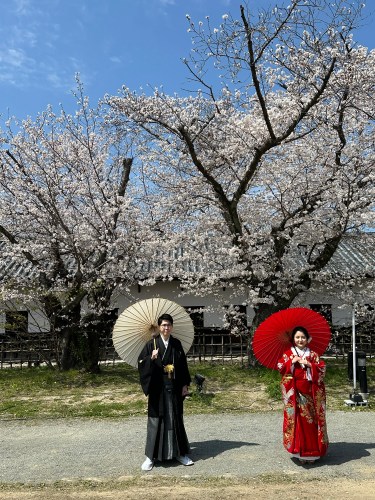
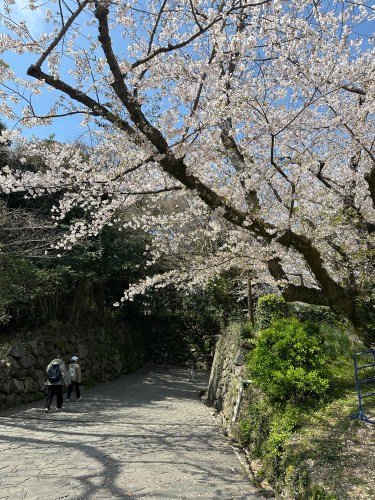
Third time is a charm. So they say. The first was in autumn, the next one in winter. This time in spring, in time for Sakura or hanami — a Japanese term meaning cherry blossoms viewing. At the time we planned this trip, we hardly planned around the Sakura season. But the timing’s perfect. And we made good on visiting 4 famous cherry blossoms viewing spots here in Hiroshima.
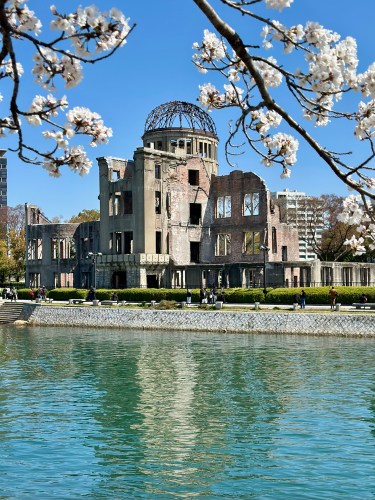
Hiroshima A Bomb Dome in Peace Memorial Park
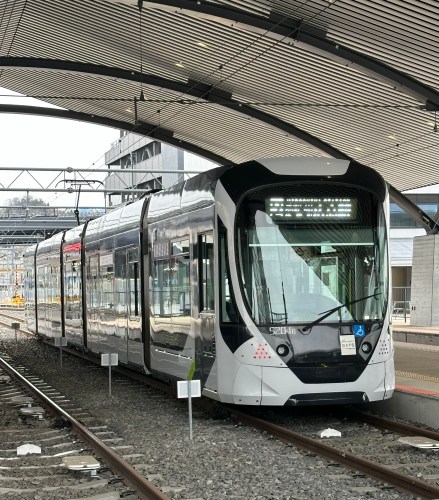
Amidst the grim reminders of the horrors of war, the white sakura blooms lining the river are truly beautiful. Motorboats plying the river, passing the Atomic Bomb Dome, give tourists a respite just viewing the cherry blossoms following a heart rending episode in the nearby war museum. A good walk from here, a wharf serves ferries taking in passengers from the Peace Park to Miyajima Island. Still part of Hiroshima, but the 40-minute ferry ride to the island offers more hanami with over a thousand cherry trees along the island’s walking paths towards the iconic floating Torii gate . Another option (which I took on earlier visits) is to take the 30 minute train to Miyajima-guchi and then hitch on the 10-minute ferry to the island. Yet another option is to ride the streetcar (in lieu of the train) all the way to Miyajima-guchi and take the 10-minute ferry. Cheaper, but a few minutes longer.
We took this streetcar after the ferry ride from Miyajima island to Miyajima- guchi Port. Either take this or the train back to Hiroshima.
Oh, let me just say that visiting Miyajima is always a good option sakura time or not. More so if you’re a big fan of oysters and eels. In this tiny island, you’d also be surprised to know that they have their own brewery. What to pair with your oysters and congee eels? There’s a choice of sake or beer. Good combo if you ask me. And then there are those maple-leaf shaped cakes with varied fillings — tried the red bean, matcha and chocolate. Good with Miyajima Coffee , or if you care for more sweets, an affogato from the same Miyajima Coffee Shop.
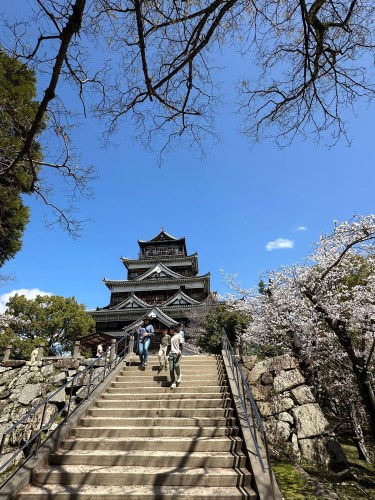
Hiroshima Castle
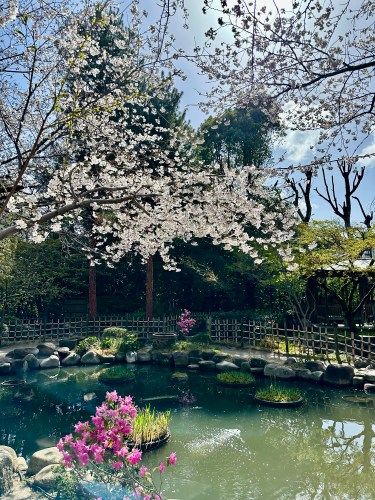
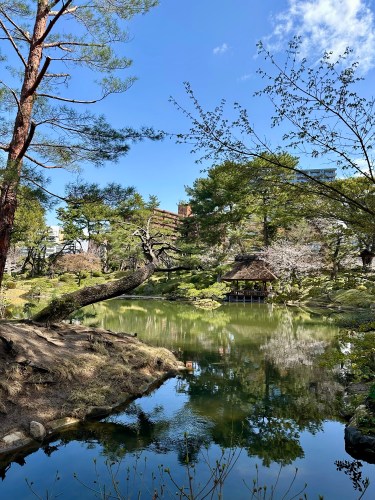
Back in Hiroshima city proper, one can visit Hiroshima Castle. You’d find less cherry trees here but if you’re visiting this reconstructed castle, those sakura blooms are a bonus during this time. And a short walk from here is the Shukkeien Park. There may be even less cherry blossom trees planted here but the entire landscape is sooo soothing to the eyes and calming to frayed nerves. The ponds, the bamboo trees, the tea garden, rock gardens, all add to the charm. Pink and white blossoms welcome visitors right by the entrance to the Park. I highly recommend this garden park especially if one has the luxury of spending 1-2 hours here. I notice there is an adjoining Museum and a lovely garden cafe too. It’s not a bad idea to spend an entire afternoon in this spot.
Shukkeien ParkShukkeien Park
So there. Four spots for your next hanami. Sayonara!
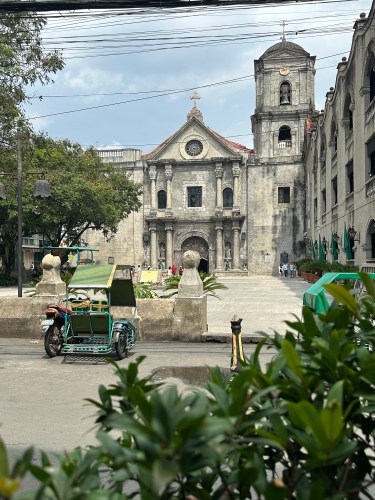
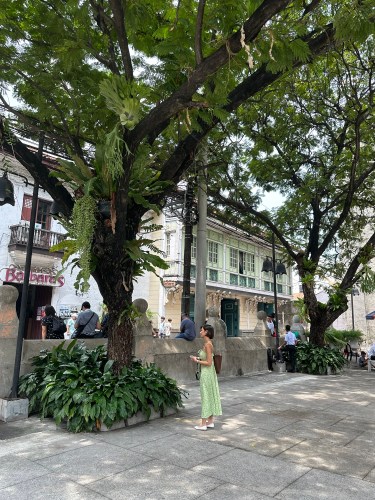
Intramuros comes to mind whenever we have foreign visitors to take around Manila. Over the years, I’ve lost count of foreign guests and “balikbayans” I’ve toured around the former walled city and nearby historical and cultural spots. But today is different. We have a free day and we’ve decided we’d check out the now pedestrian zone around Plaza San Luis Complex where you’d find San Agustin Church, Casa Manila, Casa Blanca, Barbara’s, Cafe Intramuros, Batala Bar, and not too far away, the Centro de Turismo and Museo de Intramuros. I’m only too happy to stroll along the cobblestoned General Luna Street devoid of motor vehicles and the ubiquitous pedicabs and tricycles. Now you’d find visitors on bamboo bikes, segways or horse-drawn calesas competing for space with the pedestrians. It even felt strange to find the San Agustin Church without cars crowding its beautiful frontage. Such scenes completely changed, nay transformed Intramuros. About time!
San Agustin ChurchAcross the Church is the Plaza San Luis Complex
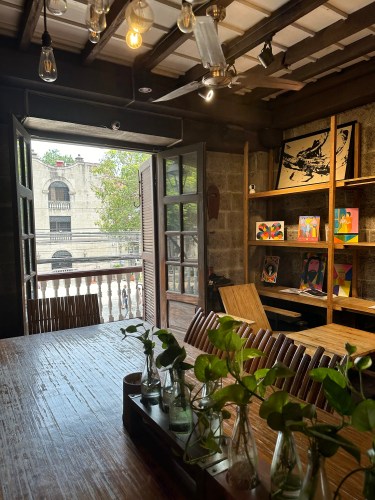
The coffee scene in Intramuros now counts Batala Bar and Cafe Intramuros alongside Barbara’s. We started our day with brunch in Batala Bar. From its windows, we have views either of the San Agustin Church or the Plaza and Casa Manila.There were not too many visitors but I need to mention that despite the summer heat, it was such a pleasant experience to go around the area. The service crew and the security staff are very friendly, accommodating and generous with their knowledge about the place. When people go out of their way to please, it is always a sign of good training and work ethics. 👍
Plaza San LuisView from Batala Bar
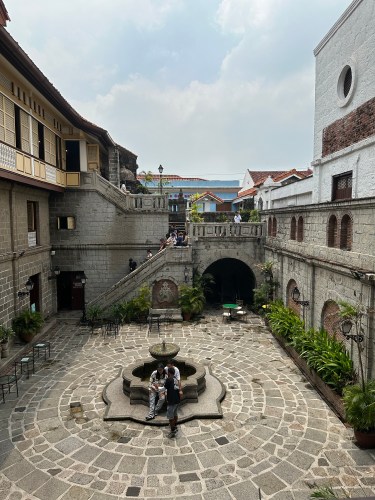
Casa Manila gives a glimpse into the lifestyle of the “illustrados” — Filipino families who enjoyed affluence during the Spanish times. The Casa or house is actually a mansion bearing the colonial style of architecture and taste — in stark contrast to the more modest “Bahay Kubo”. The antique furniture, wide windows, huge kitchen with antique cauldrons is a trip down memory lane. Like as far back as the 1850’s. Easily, one can spend an hour here. Around the Casa, one is never short on dining options.The cafes and restaurants are to be found just as soon as one exits Casa Manila via the staircase from the kitchen spilling into the plaza with the fountainat the center. There are also souvenir shops though I think they can improve in this department.
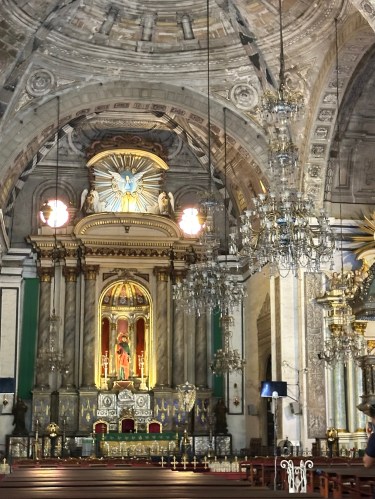
Inside San Agustin Church Inside Casa Manila
The Centro de Turismo is under renovation so we spent an hour or so instead in the Intramuros Museum. Housed in what was then the San Ignacio Church and Convent, it is a treasure trove of historical and religious artifacts. For sure, the Intramuros Admin did a terrific job on this project. A half day itinerary for tourists may include visits to San Agustin Church and its Convent cum Museum, Casa Manila, followed by lunch in any of the cafes and restaurants within the Plaza San Luis. And there’s also Ristorante Delle Mitre across the street where there’s a good assortment of desserts and baked goods.
Museo de IntramurosInside Museo de Intramuros
Now if you still have energy and time left,you can always proceed to Manila Cathedral and Fort Santiago. We did, but not so much to tour around but to check out Papa Kape inside Fort Santiago. We heard so much about their Black Gulaman Americano Coffee and the Tahoat Coffee — a concoction that blends “taho” and oat milk cafe. Both iced, we enjoyed our bev as well as the resident cats within the cafe. Not a bad day to spend like “local tourists” in our own city!
Mr. Cat sleeping on the best seat of the house. Tahoat and Black Gulaman Coffee best served “iced”. Papa Kape
We hit the ground running upon touchdown. Our OZ family and Thai in-laws were waiting to fetch us as soon as we landed in Phuket. Lunch in Nam Yoi in Phuket Town was the best we’ve had, nvm that it’s spicy. Serving local cuisine, sans airconditioning but truly yum even for those who aren’t fans of red chillies. Nothing a pitcher of water can’t remedy. Felt like that meal totally cleared my sinuses. 😝
My Little Boy Blue Two branches of our OZ family + Thai inlaws
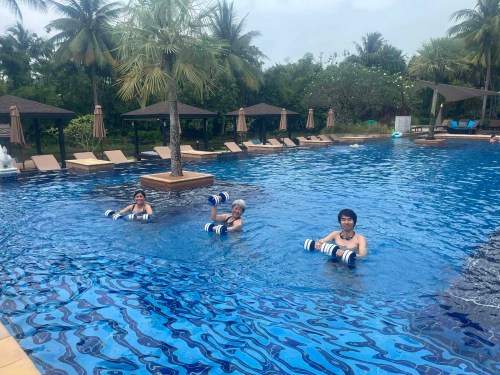
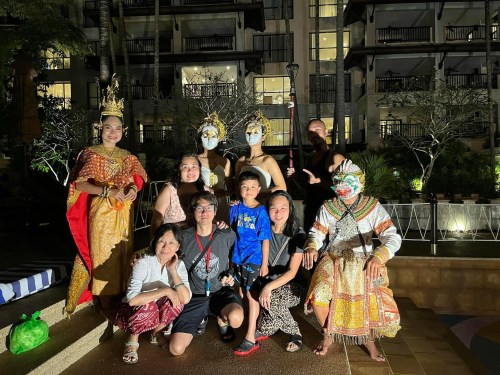
We decided to cancel one day trip and simply settle in at the vacation resort we were staying in for a day and a half. Enjoyed the Mai Khao Beach but spent more time at the resort’s pool starting with aqua aerobics for the adults and enjoying a pizza lunch at one of the cabanas. The Marriott Play Lounge was an excellent spot for both adults and kids to enjoy snooker, mahjong or simply watching soccer games on a wide screen. The afternoon siesta prepped us for the Fire Fest at the poolside by sundown. I enjoyed it from our room balcony while the rest went down for a closer look. Then, we walked towards the adjacent Turtle Village for dinner and some ice cream. Turned out to be an early celebration of my birthday a good 2 weeks away. It was a day well spent at the resort. Much to do within the complex and some really good restaurants and shops a short distance away. There were even buggies to drive us to other Marriott and Anantara hotels and resorts. But no luck swimming at the beach because the red flag is up as the waves and currents were strong.
No need to step out of the resort hotel. Aqua aerobics to start the dayPizza lunch at the Cabana
This trip was planned for my OZ family and their Thai family. At the last minute, a niece and her hubby decided to join the trip from Sydney to the shores of Phuket. At an even later minute, my sobrina and I opted to join the beach holiday even for just a few days. I’m glad we did. Some spur-of-the-moment decisions are tops especially when it means spending time with family to create happy memories. Opportunities best not wasted. The only thing firm about this trip was the reservations at the resort. All else were firmed up as we went along. Everything turned out near-perfect. Even when we grew exhausted to step out for dinner and settled for meals from the nearby convenience store. The villa kitchenette went busy as we prepared sandwiches and fruit and salad platters while the washing machine was spinning and the coffee machine dripping.
Fire Dance PerformersMarriott Vacation ClubSomeone’s jumping with joy!
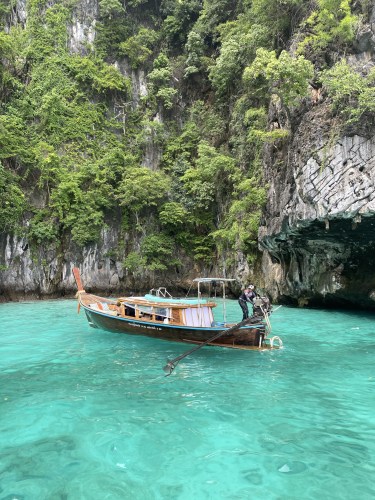
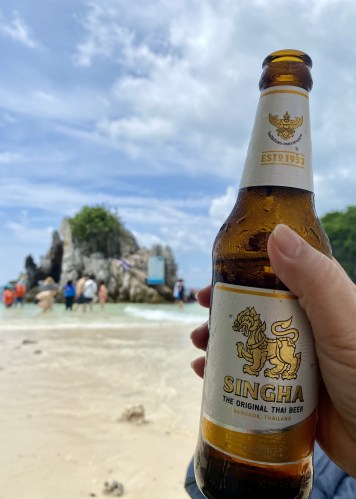
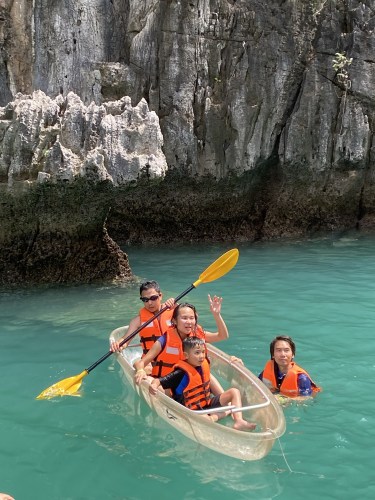
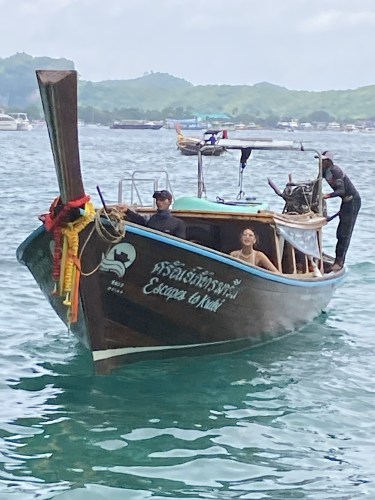
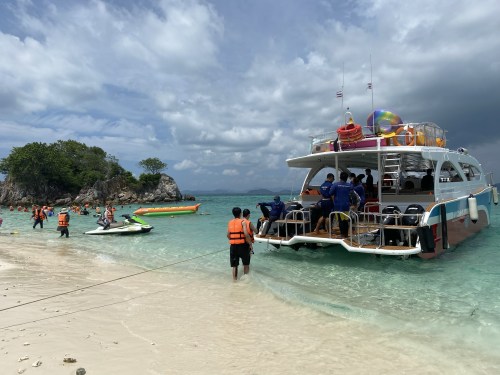
Our catamaran took us on a day trip of Phi Phi and the nearby islands including Maya Beach which was featured in the Leo Di Caprio movie “The Beach” . My second time here. It was a long day of swimming, snorkeling, kayaking, paddle boarding, beer-drinking and beach bumming. Life is a beach indeed. The little boy in our family was most active in all departments except in the beer-drinking. Gave us a scare one moment when we couldn’t find him for some 2 minutes. Turned out someone from the boat crew took him snorkeling a little away from the bunch to a spot with better fish-viewing. The boatman was actually quite impressed with our little man’s swimming and zest for water adventures. Still, we got worried for some moments.
Such clear, turquoise water!From Country to Country. From Beer to Beer.
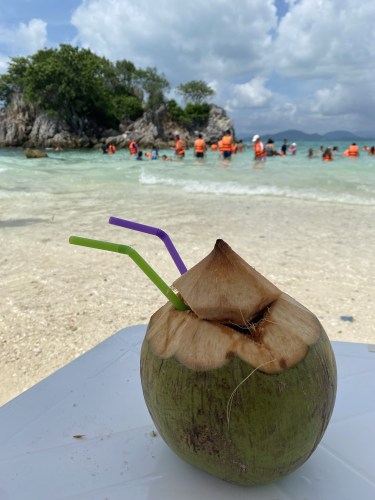
It was a long day. We started at 9am and called it a day around 5pm. In and out of water, hopping from island to island, capped by a rocky boat ride on our way back to pier. It was exhausting but so much fun. Family bonding to the core. I couldn’t remember how many island stops we made. There were at least 5. The high temps didn’t even deter us from basking under the sun with a bottle of cold beer or cantaloupe juice in hand. Every so often, the boat crew would serve us slices of sweet pineapple and watermelon. There was also an endless stock of cold drinks from coconut water, cantaloupe, orange and pineapple juice. Lunch was delicious too, buffet-served in a restaurant in one of the islands.
First of Many DipsKayaking Family
Family trips are my thing. Staying together 24/7, sharing all meals, enjoying the same outdoor activities and conversations running from the most mundane to random topics like travel blunders and celebrity crushes. This is where and when you get your updates on most everyone especially the younger members of the family. Growing up, their dreams and perspectives are ever changing and the family trips help us keep apprised on their goings-on and evolving characters. As a child, I still recall our fond memories of the family beach outings, picnics, concerts, reunions, sports activities and special dinners and stuff.
Life is a beach!Water Taxi
Koh Phi Phi is a good island/boat destination but it has also become so popular it seems to have transformed into a party island. Last time I was here was 10 years ago in 2013. Even then, it was kind of busy. I am glad we chose to stay in the quiet part of Phuket. Mai Khao is isolated from the more popular beach resorts and an hour’s drive from the resort town of Patong. Judging by the crowds in the street markets, local beaches and the boat traffic between the nearby islands, the Phuket evenings must be so vibrant and festive, if not noisy. All told, the memories we created here should serve the “little boy” well into adulthood. Likewise with the adults, while smarting from the fatigued muscles gained from all those dips in the water and the tans on their skins! Life is indeed a celebration. 🎉
One rough homebound ride in this CatamaranOne framed souvenir photo for each member of family.
On my first visit here years ago, I was with friends and the trip was really a spur-of-the-moment thing. We were invited to spend 3 nights in the island and all we wanted to do then was to enjoy the island life. The sun. The sand. The speedboat. The beer. The spicy food. The fruits. Oh, the fruits! At the time, Phuket was simply a tropical holiday destination for us. Island-hopping seemed like a must-do in this corner of the world. A beach holiday, if you will.
Sino-Portuguese Architecture Sunday Street Market
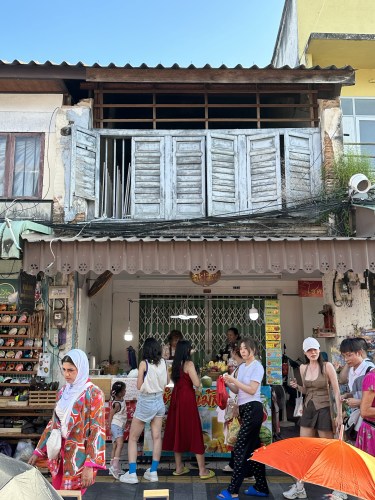
We arrived here in Phuket on a Sunday so we didn’t waste time and checked out the Old Phuket Town Market. The Sunday Street Market was teeming with tourists eager to try local snacks, especially the local fruits, as well as shop for local clothes and souvenir items. Trendy, cheap and vibrant. I love the houses lining the Thalang Street here. The Sino-Portuguese architecture with bright lights and street performances by musical groups give the street market a festive atmosphere. Tons of photo opportunities. Lotsa shopping options. No wonder it’s a popular attraction among the tourists. It’s also a welcome break after some trips to nearby islands for those beach adventures.
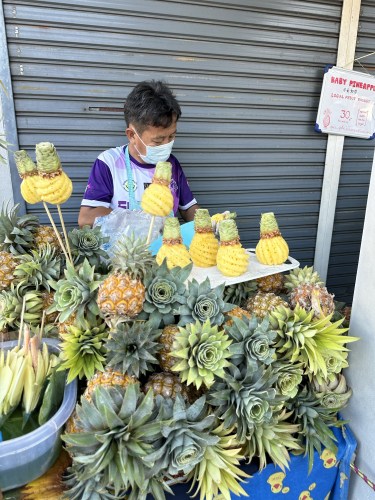
Thalang Street Market in Old Phuket TownMicro-Pineapples. Really Sweet.
Thalang Street is right smack in the center of the historical part of town. The Old Phuket Town. All of 360 meters, it is open only on Sundays from 4pm to 10pm. The shophouses beautifully display the Chinese and Portuguese influences. Reminded me of the Peranakan influence expressed in the Penang architecture in Malaysia. Shops on the ground floor, living quarters on the upper floor. If there was time, it would have been interesting to explore beyond this street market to see the Peranakan heritage houses and mansions as well as a couple of museums in the old town.
More shophouses. There was a park at the end of the street market with shade trees and less crowd.
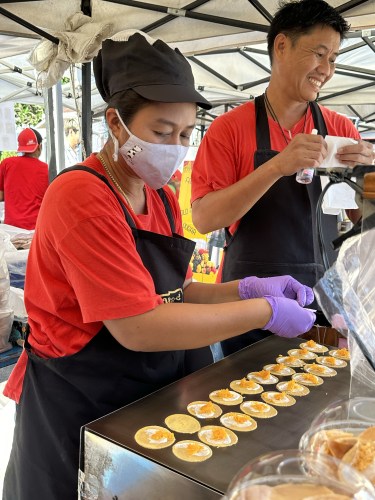
Before coming here, we had a good lunch elsewhere. If not for sated cravings and full bellies, we would have given in to all those tempting street food. Pork barbecue for 20 baht a stick? A pack of pineapple minis for 60 baht? I found packed meals for less than 100 baht here. Prices were reasonable and I saw many locals buying street food to take away. Beats cooking dinner, I guess. Or one may opt to “eat in” or eat while walking the street market while listening to the blaring music from street buskers. As it turned out, we managed to buy more food to stock the refs in our hotel room. We had way too many of those micro pineapples to eat for the entire 4 days and 3 nights we stayed in Phuket. 🍍🍍🍍🍍🍍🍍🍍🍍🍍🍍
Local Lunch. So Thai. So yum. They’re like mini crepes that’s crispy. .
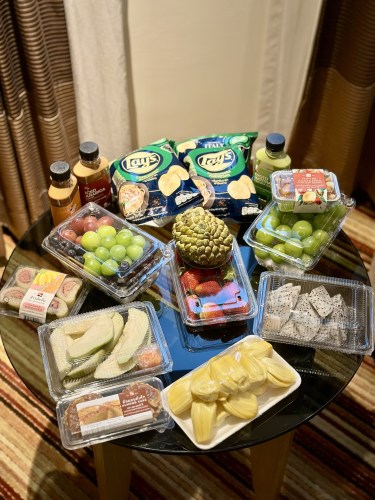
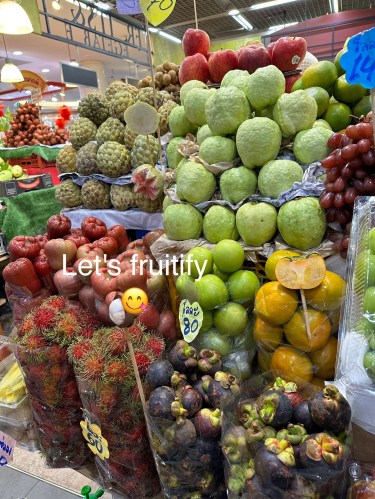
Whenever I get an invite from friends to go on a trip to Bangkok, it’s almost always a “food trip” or more aptly, a “fruit trip” in our minds. I’ve tried going in summer so there are more fruits in season, but the heat and humidity is nearly a curse so I promised myself I’d never go in summer. To welcome October, my niece and I flew into Bangkok on our way to catch a connecting flight to Phuket the next morning. Just time enough to check in our bags at an airport hotel and gorge ourselves on all the fruits we fancy (many we stuffed into our bags flying into Phuket) before calling it a day. Half of our OZ family is waiting for us in a beach resort in Phuket and we are dripping in so much excitement. My niece-in-law who is Thai, her family and ours, are waiting. But first, we “fruitify”. Got that word from my apo’s friend with whom my apo shared the fruit box I prepped whenever I fetched her from school then.
Custard or Sugar Apple, Strawberries, Guapple, Jackfruit, Grapes of all kinds and sizes, Watermelon, And More My All-Time Favourite along with Persimmons
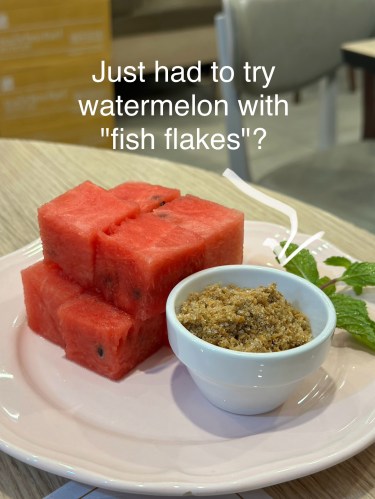
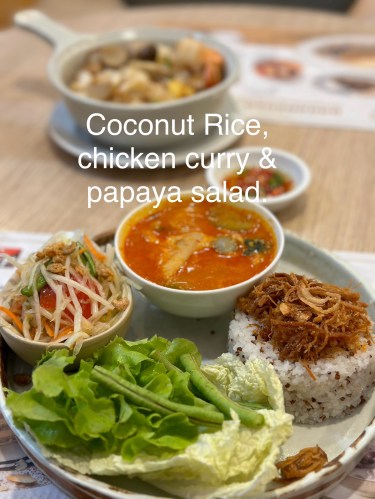
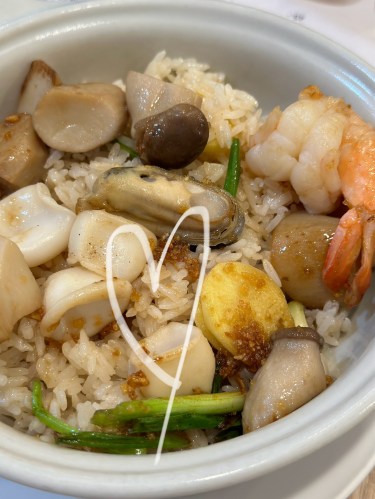
We also found the time — rather failed to resist — trying Thai curry and seafood pot rice in the mall a short cab ride from our airport hotel. (Incidentally, the spartan but spotty clean airport hotel is one I’d recommend. Nothing fancy but value-for-money for just a night to rest your bodies before an early morning flight. No rush means no anxieties!) Not to forget, have you tried fish flakes with your watermelon? Ours was served that way and it’s an interesting combo.
Watermelon with Fish FlakesFruits Galore
From Amari Don Muang Airport to Rangsit Future Park Mall is around 100-120 baht by taxi. There, you can buy as much fruit as you can HARDLY muster. I wanted to try all of them! And the food court offers both cheap and delish samples of Thai cuisine. We tried S&P, which had a good display of bread and pastries we could buy for next day’s breakfast in our room, but ended up sitting for a proper meal. Just be warned: my chicken curry was smoking hot. Even the papaya salad served with it was so spicy. But really good. I’m just warning you to have a glass — or a pitcher — of water ready. 😝
Chicken Curry with Coconut Rice and Papaya Salad Seafood Pot Rice from S&P
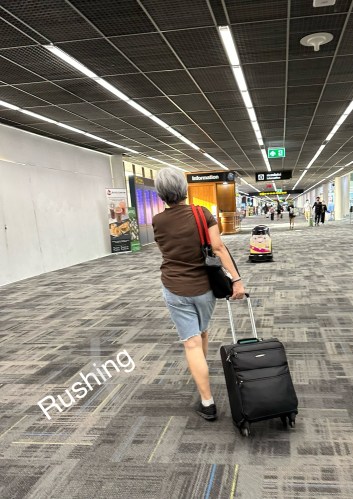
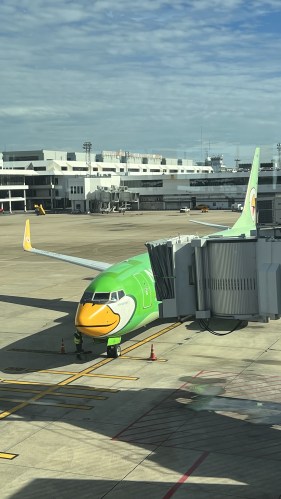
Bellies full, bodies rested, we walked from our airport hotel to Terminal 2 of the domestic airport. In under 15 minutes, we’ve checked in and walked with the robot-sweeper towards our gate. Did I tell you we had a cute-sy budget airplane flying into Phuket? Lookee…..
Vietnam is a fascinating state with an equally fascinating history, culture and cuisine. I’ve made at least 4 trips here and this fifth time around, ventured into the mountain areas up in Northwestern Vietnam. I have always enjoyed Vietnamese cuisine and thought I knew enough about it and wrongfully assumed Vietnamese cuisine up in the mountainous areas of Lao Cai are the familiar dishes I found in Ho Chi Minh, Hue, Hoi An, Danang and Hanoi.Wrong! Sa Pa cuisine is a culture in itself. Those hotpots and bamboo rice are no way familiar at all. Fish means either salmon or sturgeon. And meat can be beef, pork, buffalo, (black) chicken, horse or (brace yourself) dog meat. So we made sure we struck off horse and dog meat from the menu. Seriously. It is a vegan paradise though , with an assortment of vegetables and herbs served to us. And if you like fish stew, you’d enjoy these soupy dishes. After a few days, we grew tired of the local cuisine and went in search for Western dishes. Pizza, pasta, meatballs, steaks saved us. All’s well 😉
Sa Pa Cuisine
The French may have influenced gustatory arts in the more cosmopolitan areas but that influence may have fizzled out in the mountain areas of Northern Vietnam. Food was nothing “fancy” but served in great quantities, too much in fact. And I seriously missed my desserts 😞. It’s a good thing the coffee scene was soooo great and the coffee concoctions are truly more desserts than coffee in my book! (Tip: try the coffee shops — ate some real good apple crumble in Le Gecko) Best of all, the mountain sceneries & meet- ups with hill tribes are memorable experiences with all the local colors & flavors (pun intended).
Tribal Women and Bebes In Watercolour
Just click on the blog link below for more photos and details.
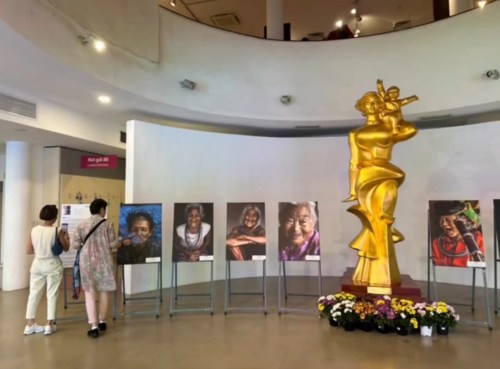
Not my first time here but I’m traveling with my Nieta who’s a first-timer in Hanoi. Had a list of touristy spots but she crafted her own itinerary which included a visit to Vietnamese Women’s Museum, another café crawl and some honky-tonk noodle joint. Not to forget, she wanted also to check out a rooftop bar with a city view and thankfully , our hotel in Hanoi has a really lovely SkyBar . Would have included a shopping adventure on our last day in Hanoi but there wasn’t enough time . After all, our trip was really focused on Sa Pa in Northwestern Vietnam and we just had to fly in and out of Hanoi. So we made good use of those 2 days in the capital. No war museums, no mausoleum, no prison visits, really nothing that we’d find depressing. Just all positive vibes!
Vietnamese Women’s MuseumVietnamese Women’s MuseumVietnamese Women’s Museum
First off my Nieta’s list is the Vietnamese Women’s Museum. Went there for 2 principal reasons: the permanent collection of women’s costumes is awesome AND we were also intrigued by gender issues within some mountain tribes we met when we visited Sapa. One of our guides there recounted how women in her tribe have no say in choosing their grooms. As early as age 15-16, a man can choose a girl to be his wife, “kidnap” her for 3 days, and then arrange their marriage. Bride kidnapping is a tribal custom still practiced in this day and age. How and why? Let me just say it’s utterly bizarre that the custom is still practiced now. But it’s a culture thing and so let’s skip the subject 🧐
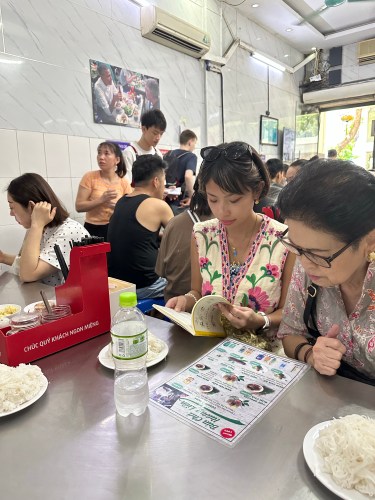
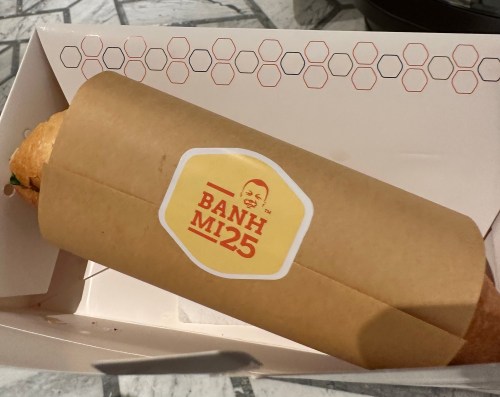
Bun Cha Huong LienThe best Banh Mi in town?
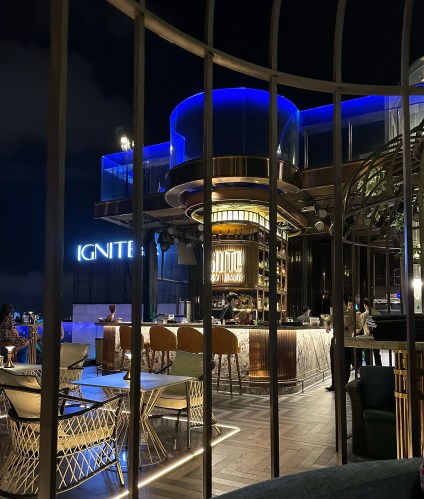
We also didn’t miss that Bun Cha noodle shop made popular by the show “Parts Unknown”. It’s a hole in the wall now listed in the Michelin Guide. Check out my earlier blog on this. Another popular spot is Banh Mi 25 in Hanoi’s Old Quarter. We grabbed a couple of banh mis to eat in our room but I must say the banh mis I’ve tried in Hoi An is a notch or so better. Just the same, Banh Mi 25 is reasonably good and value-for-money. Once you’ve had your fill, you should be ready for the nightlife. We’re not party people but we sure know how to enjoy a drink or two. Choosing to enjoy a nightcap in our hotel, we tried the Ignite Sky Bar’s cocktails. Strawberry Daiquiri, Mango Margarita, and more. Sunset and city views are perfect from this rooftop bar. La vie est Belle!
We are back in Hanoi and still seriously in search for the best egg coffee — and where else should we look but where it all started? First discovered, or rather concocted in 1925, when an ex-bartender of the famous 5-star Metropole Hotel thought of substituting fresh milk with egg to make Hanoi’s “cappuccino”. It was the perfect solution at a time when milk was a luxury and scarce. Only problem then was that it took an entire half hour to beat the high-quality free-range eggs to make a cup of egg coffee! Thankfully, the egg blenders have made this tedious process a thing of the past now. It can only be expected that the man — Nguyen Van Giang — who created and introduced the egg coffee runs the best egg coffee place in Hanoi. Still in the same unpretentious building and yes, still the same recipe but likely using egg blenders. For the life of me, I was kind of hesitant to try raw egg yolks in my coffee but Mr.Giang’s recipe reportedly uses only eggs from free-range hens fed on natural food! They say there’s a secret ingredient but I bet Mr. Giang shared that with his daughter who now runs the 2nd best egg coffee shop “Dinh Cafe”.
Egg Coffee. One with cinnamon. We took a Grab to reach Cafe Giang
Since we’ve already tried the iced coconut coffee of Cong Ca Phe when we were in Sapa, Northern Vietnam, we skipped their Hanoi outlet and instead booked another grab ride to arrive in the Hidden Gem Cafe. Truly hidden! The narrow alley snaked past a garage and two flights of stairs. But we’re so happy to be here. Amazing how the owner recycled so much stuff and seamlessly put them all together here. Here, we tried the sticky rice iced coffee, a good looking lemonade with blue tea and an iced coconut coffee. Their bahn mi and rolls may not be the best but they’d do if you’re hungry. It simply is exciting to be in this spot which we found bohemian and artsy. Just be sure you beat the crowds by coming real early or at odd hours. I’m sure it gets busy and because it’s not air conditioned, you may not get the spot we had where there’s a breeze to ward off the heat.
The Hidden Gem CafeLemonade with Blue Tea
This coffee place didn’t waste any walls nor corners. There was always something going on on some walls — a mural, a garden, something both artistic and odd. The 2 flights of stairs get you on the 3rd floor that’s more “al fresco”. Better than the 2nd floor which we found more stuffy.I am not sure we’d find this place on our own. Booking a grab ride was easy and real cheap! So install that app if you haven’t.
More Iced Coconut Coffee?Bahn Mi and Rolls at Hidden Gem Cafe
But in case you haven’t tried Iced Coconut Coffee — that modern-day concoction of coffee, coconut cream, milk and ice cream — there are several outlets of Cong Ca Phe in Hanoi. Choose one nearest you, and have that iced coconut coffee fix! This time, feel the communist vibe here with the cafe’s military-green walls, a server clad in military uniformand comm posters straight out of the 1970s to instill that vibe! Mind you, we had the best iced coconut coffee here. Oh, there’s the green rice coconut coffee too which I particularly liked. More like a dessert. Enjoy ☕️ 🧋




















 lifeisacelebration