Tag Archive: Manila


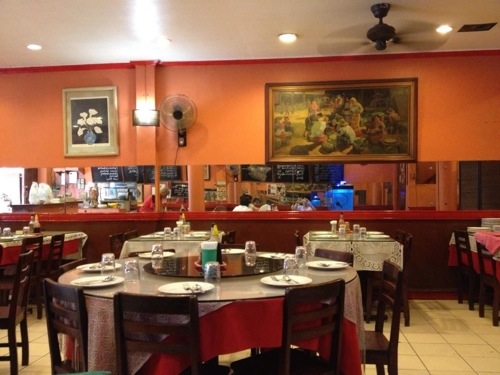
Many would remember it as that restaurant where Pinoy, Chinoy, and Tisoy cuisines merged, and which became a landmark off Echague Street. While it has since moved to 750 Florentino Torres near C.M.Recto and Soler Streets, the aura remains the same. It helps that the furniture exudes the same illustrado character, where an Amorsolo-ish painting hangs on one side of the wall Β and where menu offerings are written in chalk on boards hanging on another side.
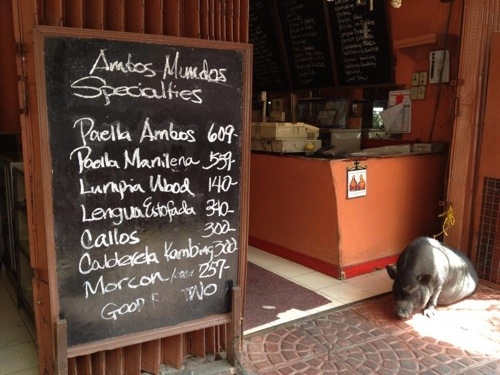


20130213-223320.jpg

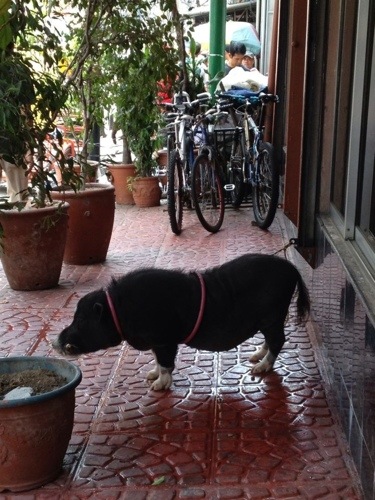
And there’s that lone boar tied to the door…………. Could that be “Liempo” or “Pork Chop”?
20130213-223403.jpg

Ambos Mundos. Claims to be the oldest resto in the Philippines. 1888


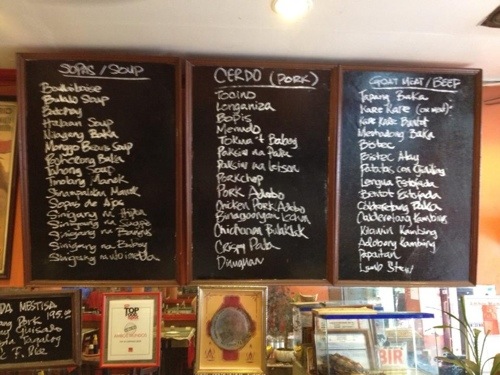
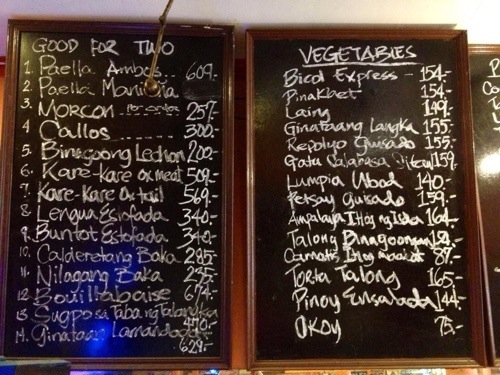
The “best of both worlds”. East and West? Ambos Mundos. I can imagine men in tailored suits (yes, they really dressed up back when Recto Avenue was still called Azcarraga) dining here. Perhaps feasting on either Paella Ambos or Morisqueta Tostada. Or would it be Lengua or Buntot Estofada? Many Filipinos think of Callos and Morcon as “fiesta fare” — special dishes served whenever there is reason or an occasion to celebrate. In the same breadth, Filipinos likewise drool over their favorite local food, and by that, I mean favorite local Filipino and Chinese food. Crispy Pata, Bulalo, Lumpia Ubod, Pancit Bijon, Asado, etcetera!


20130213-224331.jpg

That menu is a real fusion of Chinoy, Pinoy and Tisoy Cuisines.
20130213-224400.jpg

Chinoy or Pinoy or Tisoy Cuisine in Ambos Mundos. 1888


Is it really the oldest restaurant in the country?Β  Both Ambos Mundos and Panciteria Toho Antigua claim to be the oldest, having operated since 1888. Who’s to tell? Both were my childhood favorites, by the way. But where Toho appears like many other old Chinese restaurants, Ambos Mundos has an altogether different charm. Very old world. Complete with pot-bellied black pigs tied to its front doors! (A recent addition, I suspect) Some keep pet dogs. Or pet kittens. But pet boars? We’re told they’re there for good luck. There must be a grain of truth in that. After all, they’ve been around since 1888!


20130213-224647.jpg

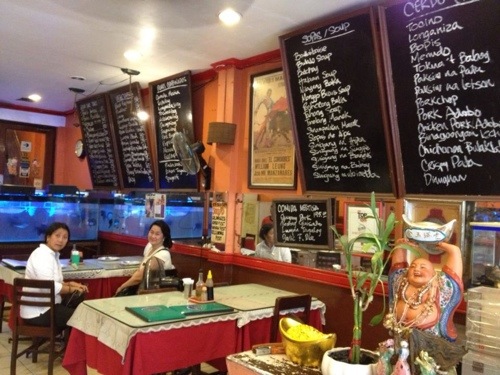
My 2 amigas eagerly wait for our order of Morisqueta Tostada, Lengua Estofado and Patatas con Giniling.


See you again, “Liempo” and “Pork Chop”! We weren’t very happy with the Morisqueta Tostada, Lengua Estofado and Patatas con Giniling that we ordered — not as good as I remember πŸ˜‰ — but we’re willing to try the other dishes next time we visit. πŸ˜‰ OINK OINK


20130213-224743.jpg

Another set of pet boars just across the street in Wah Sun, same owners. A Gaudinez married into the Leung Family who owns this Chinese resto since 1955.

20130213-225105.jpg

They say you can order from either/both menus of Ambos Mundos and Wah Sun across the street. Same owners.


Addendum: This is even more interesting. Thanks to Teresa Gaudinez-Martinez, I now have a chance to straighten out some “kinks” and misinformation in this blog. Foremost is that THIS IS NOT THE AUTHENTIC AMBOS MUNDOS RESTAURANT. “Both Worlds” (Ambos Mundos) refer to Spanish and Filipino cuisines. NEVER INCLUDED CHINESE CUISINE. Huh? And there was NEVER A PET BOAR outside the restaurant. Huh again! Teresa, I have read all your blogs and sympathize with your legal woes. Obviously, there’s a long story fraught with family, legal, proprietary rights issues here. Thank you for taking the time to make the corrections. To our readers, here’s the link to Teresa’s Ambos Mundos blogs.

Thought I’d line up my blogs on “walks and drives” around Manila for those who are interested. In many of these walks and drives, a good 4 hours may be enough. Likely less if you just want to concentrate on a certain area. You can walk around, hop on and off your car or some public transport, combine 2 trips and plan a good lunch in-between, or simply visit a Museum to linger for the next couple of hours. If you’re with children, I’d most certainly advise planning a good meal after 2 hours or so. Attention span and all, you know. A good meal never fails, and I’d usually have the first leg as the “more serious walk through history” and make sure the 2nd post-meal leg involves some window shopping (a.k.a. “Street desserts” and other sweet munchies) or less serious history stuff or simply more open spaces.


20130205-115756.jpg


HERITAGE SITES/HISTORICAL LANDMARKS

Quiapo!

Say Hello to “Mi Ultimo Adios”

San Agustin Church in Intramuros

Four Hours To Waste in Manila

Some Photographs From Manila

Universidad de Santo Tomas (UST)

Baluarte De San Diego in Intramuros

Paco Park


MUSEUMS

Dummy Goes To The National Museum

National Art Gallery: Searching For More Lunas

Up Close: Luna and Hidalgo

Hidalgo and Luna: Genius Has No Country


CEMETERY TOURS

A Preview of the Cemetery Tour: Wait Till The Shoe Lady Dies

The Old (and Dead) Rich of La Loma

A Nearly-Forgotten Panchong in North Cemetery


SUBURBIAN MANILA

Angono: Art Capital of thePhilippines

Silangan Gardens and Pinto Art Gallery

Antipolo’s Suman, Kasuy and Pan Lechon?


CHINATOWN & Other sites

A Walking Tour of Binondo

Binondo Walk With Kids

The Street Vendors Of Manila

Harbour Square in CCP Complex


Urban Escapades

Weekend At The Pen

HOTEL CELESTE: A Pleasant Staycation


PINOY DINING 101

Just How Do You Eat Alagao?

What To Feed Your Guests (Part 1)

What To Feed Your Guests (Part 2)

Vieux Chalet in Antipolo

Pinoy Ice Cream? Check This Out!


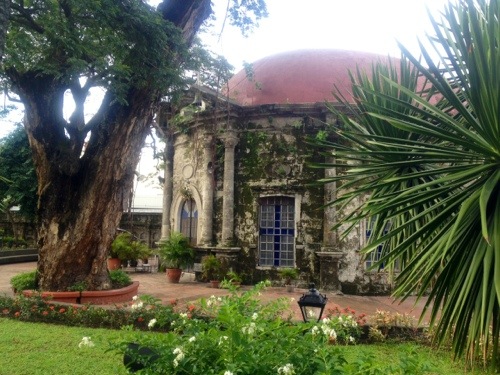
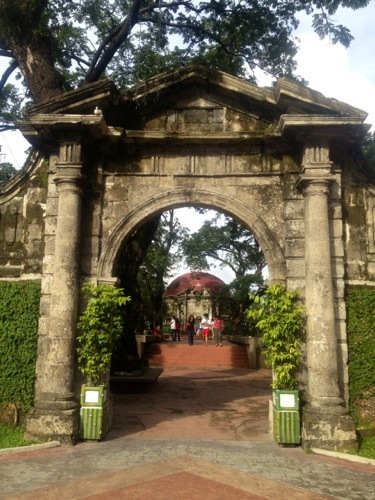
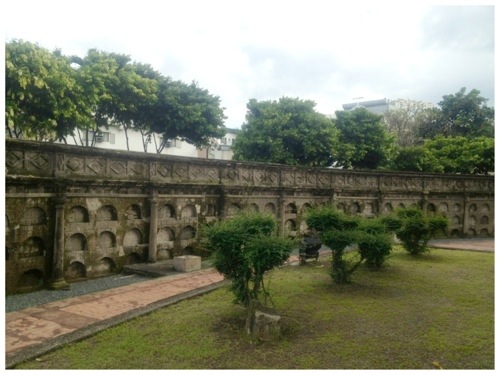
Another one of those afternoons. No cams. Not even a Point & Shoot. Just Siri and Me. Just another hour to “waste”. So here we are, revisiting Paco Park. That lovely, tiny, circular chapel. And the cemetery that could have, SHOULD HAVE earned more attention, respect and recognition other than as a popular wedding venue. 😦


20121028-163445.jpg


I confess to my own ignorance too. Not that I lacked interest. More like I truly feel there is something grievously wrong about how our history has been written and our own education and school system. Whatever I know of Philippine history, I gained from the books I bought and read. What I learned from school hardly went beyond Rizal’s martyrdom. Let’s admit this. Many history lessons stopped with Magellan’s death courtesy of Lapu-Lapu (so, what happened to Lapu Lapu after? Any guess?), or with Rizal’s martyrdom in Bagumbayan (where was our national hero interred following the 1896 execution?). Or how many Philippine heroes can you name and how much do we know of each? If we hardly know Rizal our national hero, I do not expect we can say much of Bonifacio, Mabini, Fathers Gomez, Burgos and Zamora.


20121028-164322.jpg

20121028-164349.jpg


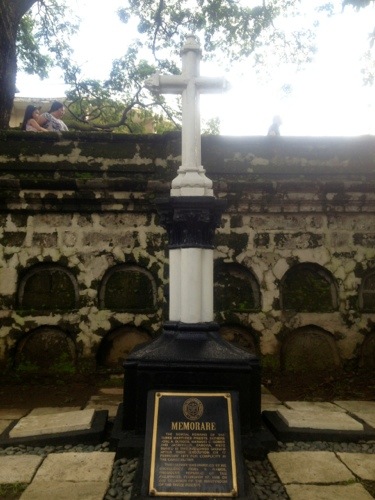
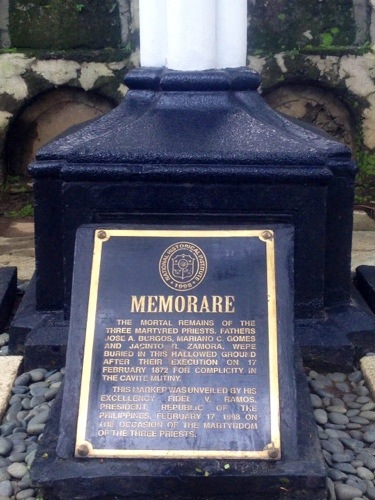
For some, if not many, it would come as a surprise that the 3 martyred priests are actually buried here. It may even surprise some that their execution in 1872 inspired our national hero to write El Filibusterismo.. Today, this marker may not spark as much enthusiasm and evoke much significance among many locals. How sad.


20121028-164826.jpg

20121028-164851.jpg


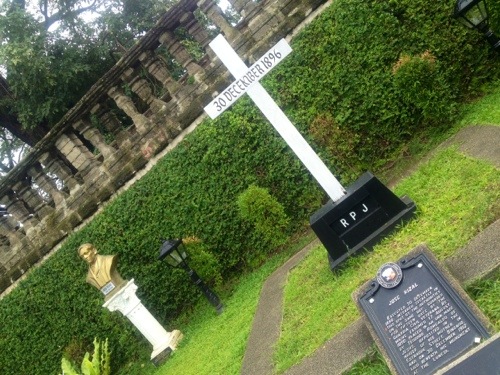
Circling the same Paco Park, a patch of land bears another marker. This is the very spot where our national hero was SECRETLY buried soon after the December 30, 1896 execution in Bagumbayan. Zoom in on that marker to know more! πŸ˜‰


20121028-165404.jpg


We didn’t plan on being here. We met for early lunch hoping to simply chat the afternoon away. But why not chat while driving around Intramuros, much like those joy rides we used to enjoy when we were kids?


20121028-151351.jpg


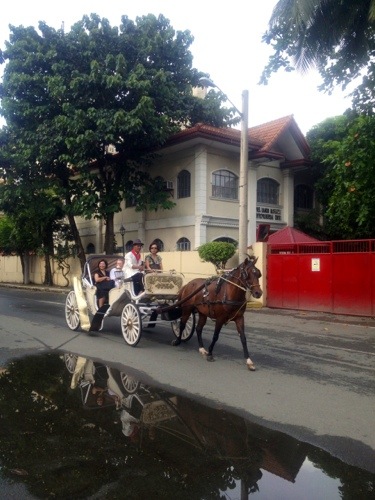
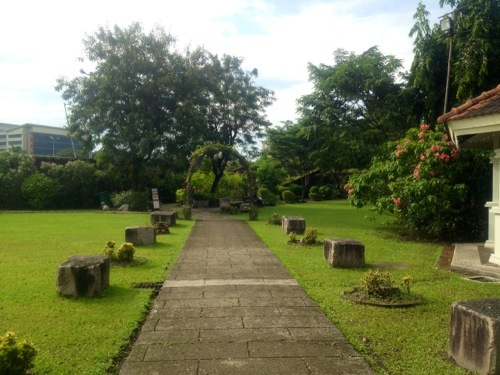
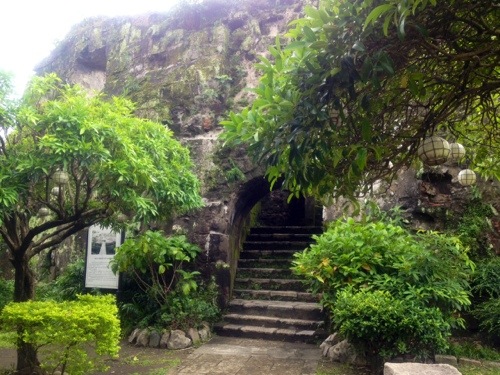
Then the calesa passed right in front of us. It’s 2 o’clock in the afternoon and those riders didn’t seem to mind the heat nor the sun. Well, it wasn’t particularly hot this afternoon. Pleasant enough to get off the car and walk into Baluarte de San Diego here in Intramuros. It’s a better option than the more open spaces in Fort Santiago. More shady trees too.


20121028-151843.jpg

20121028-151942.jpg


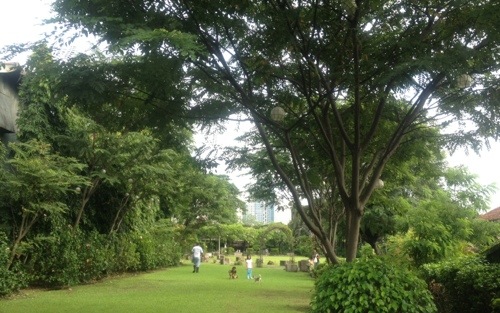
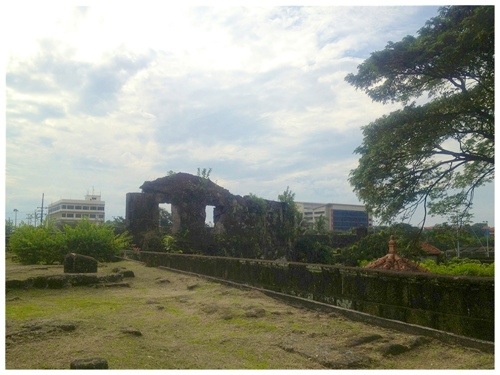
For only 75 pesos (less than US$2), one can get in to enjoy the “park with some history”. There were kids running around with their dog in the shady part of the Baluarte. Not many tourists. Many of them must be in Fort Santiago or San Agustin Church and Monastery. Yet this is one of the oldest stone fortifications in the whole length of the Intramuros walls.


20121028-152515.jpg

20121028-152544.jpg


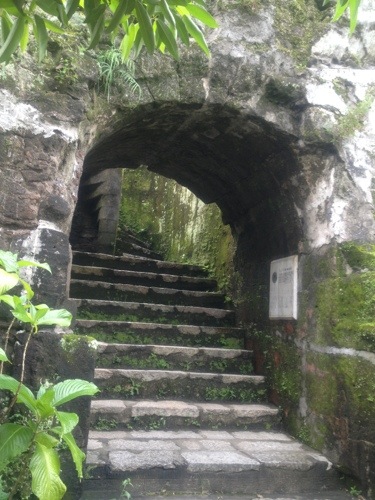
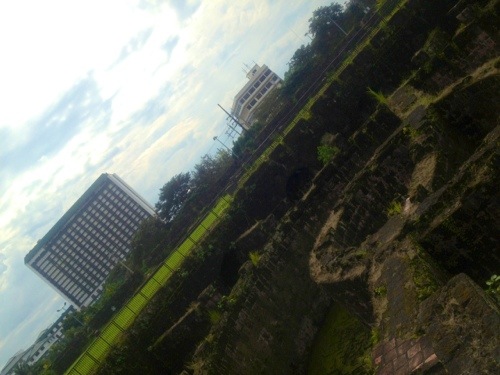
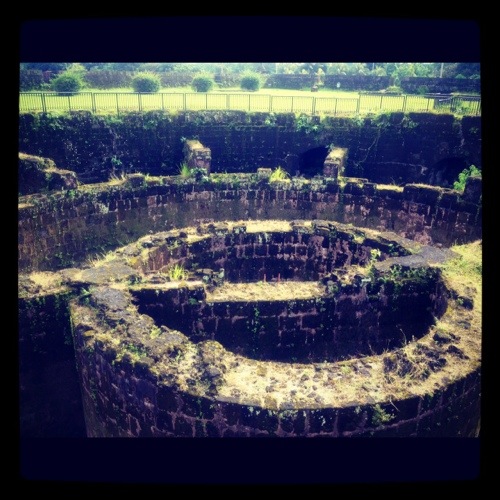
The old stone steps lead up to the walls from where one views this circular stone formation, the length of the walls, and the Manila Hotel and other modern skycrapers surrounding the walled city. I remember being here years back when I attended a wedding of a friend’s daughter where I stood as sponsor. I would have wanted to walk atop the walls, but my long gown got in the way πŸ™‚ Today, there is no such restriction.


20121028-153055.jpg

20121028-153120.jpg


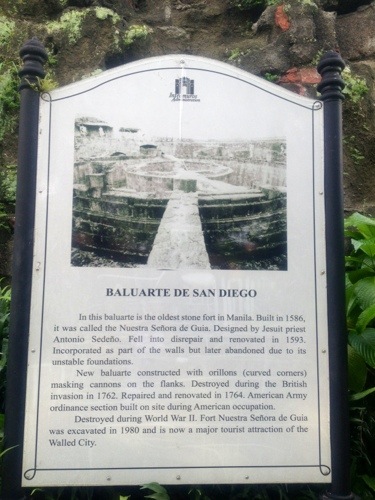
Will someone please tell me how these circular stone formations were used? Surely, the good Jesuit priest who designed it back in the 16th century had some purpose in mind. I mean, I do know they’re there to defend the walled city but my simple mind can’t understand the many circular formations. From what I gather, this part of the Walls went into disrepair and were in fact only rediscovered in the 70s. Forgive my ignorance, but I’m most certainly eager to know how that circular design work.


20121028-153733.jpg

20121028-153823.jpg

20121028-153851.jpg


These days, the Baluarte (Baluarte means bastion or fortification) is more popular as a wedding reception venue. I wish it could be more than that. The place has so much history and is, in fact, a lovely “park” which children would enjoy. The only drawback is it could be really hot during summer here. I sure hope the Intramuros Administration consider late afternoon and dusk tours here and around Intramuros. It will require some investment in good lighting and better security, but I’m sure tourists and even locals would enjoy the place better as the day approaches sunset and at night. Play some good music too (like in Paco Chapel and Cemetery) and you’d turn the Baluarte more magical!


20121028-160741.jpg

20121028-160827.jpg

20121028-163359.jpg


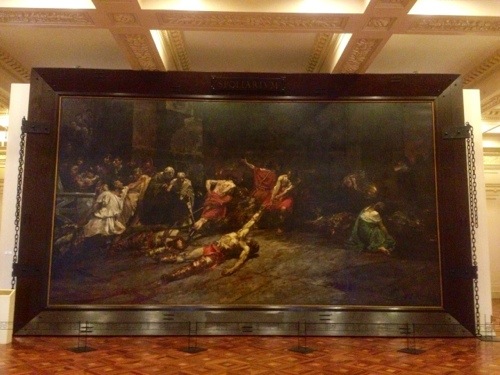
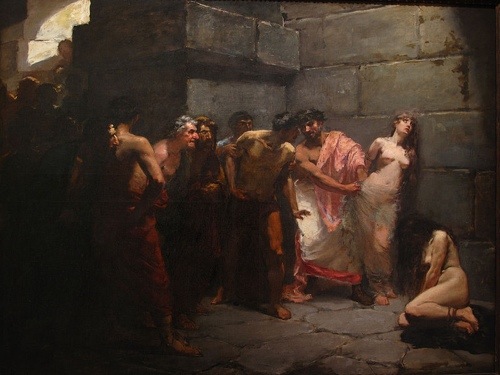
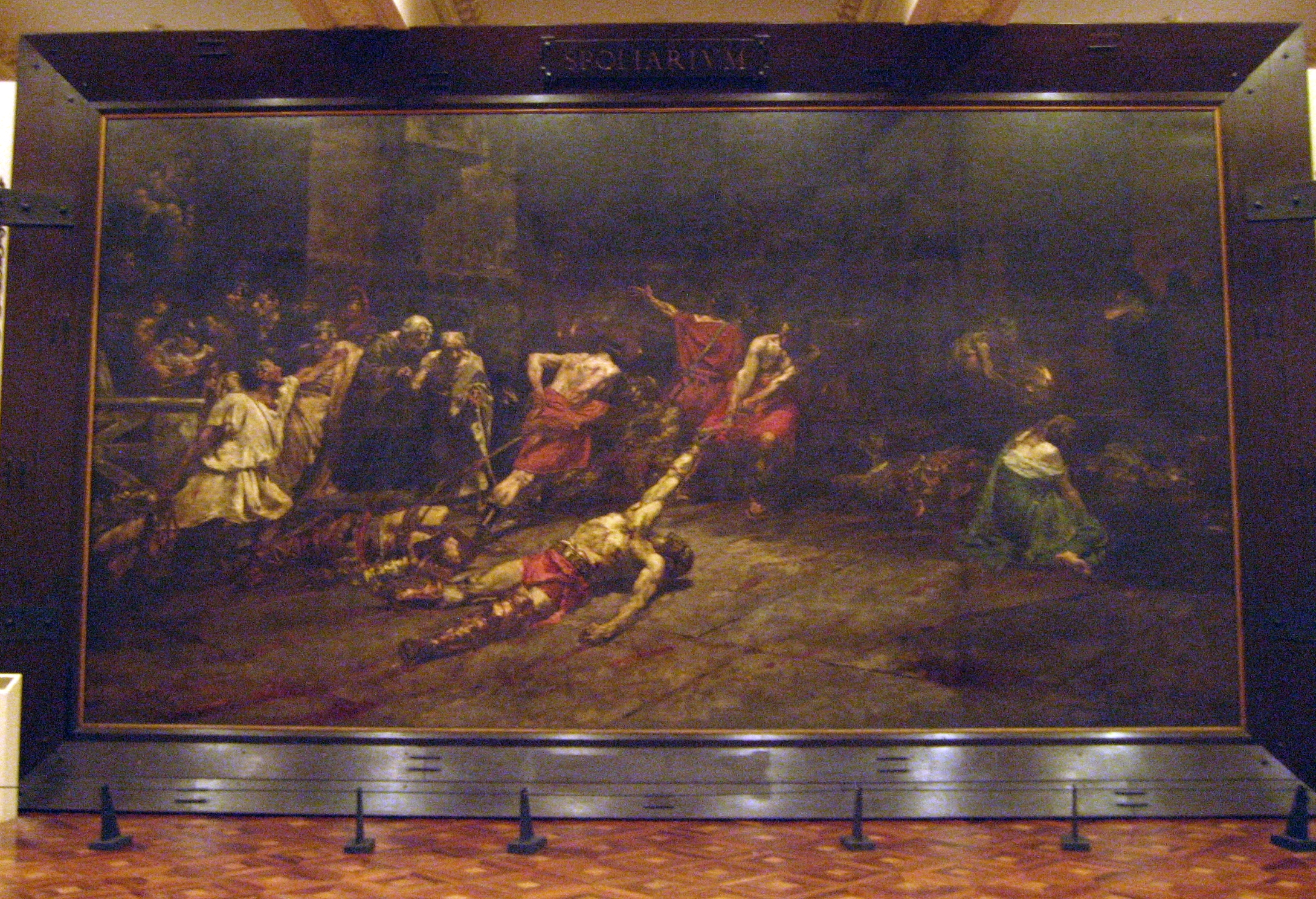
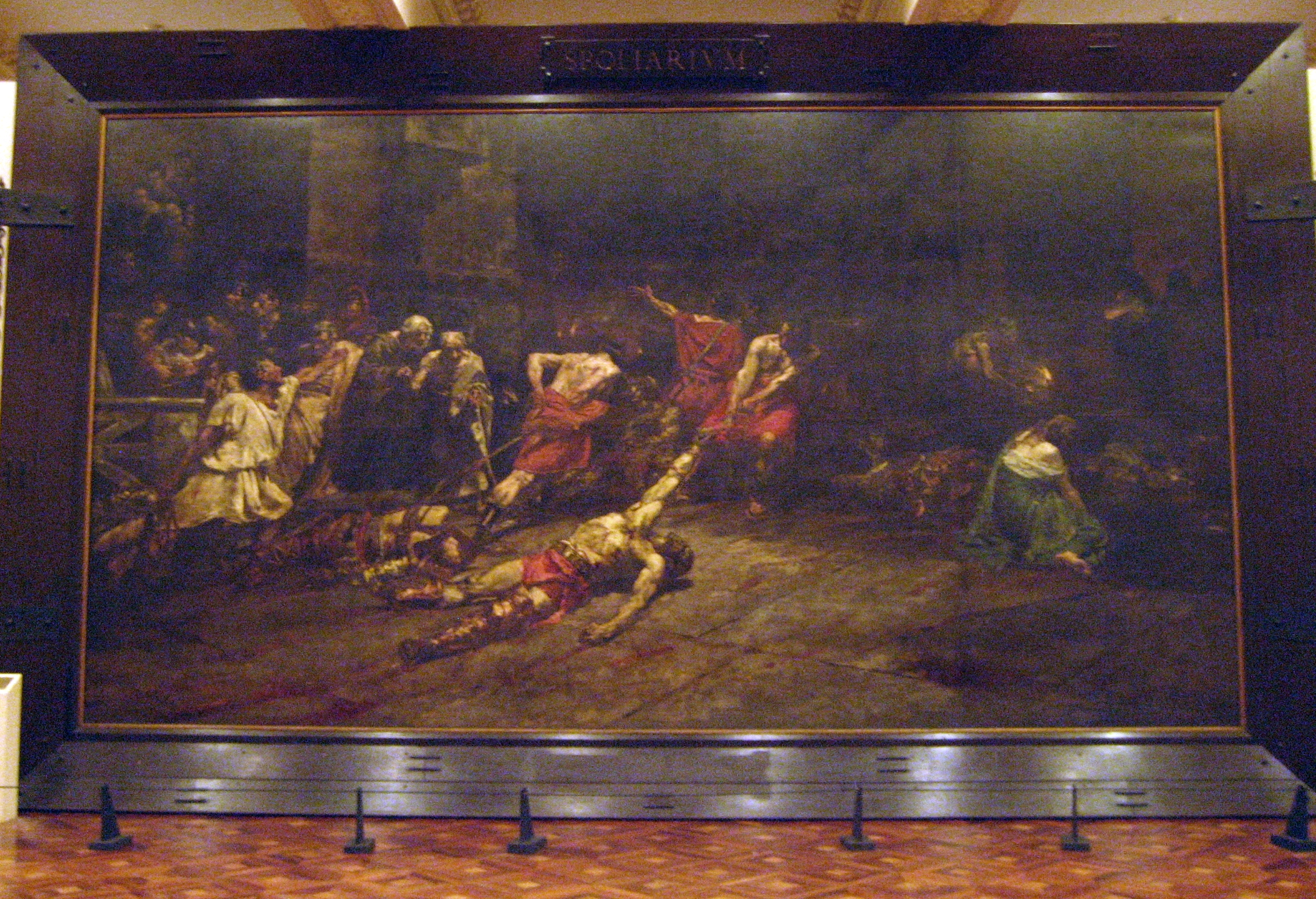
Such distinguished Filipinos. Estoy. Muy. Orgullosa! I. Am. Very. Proud. As were the Filipinos then based in Madrid who celebrated these Masters’ victories as Gold and Silver Medalists in the 1884 Madrid Arts Exposition. For Juan Luna, his Spoliarium earned him a Gold Medal. Felix Resurreccion Hidalgo earned his Silver for his “Las Virgenes Cristianas Expuestas al Populacho” (The Christian Virgins Exposed to the Populace), which showed a bunch of boorish looking males mocking semi-naked female slaves. A copy of this painting now hangs at the Metropolitan Museum of Manila. The original was destroyed in a fire at the University of Valladolid in Spain. A pity.


20121028-103035.jpg

Juan Luna’s Spoliarium


I visited the National Art Gallery and the Metropolitan Museum of the Philippines on separate occasions. Just a couple of days apart. I had the rare chance to stand in the middle of the Hall of Masters all by my lonesome self. And to get really close to Luna’s Spoliarium. My iPhone came in handy, though the shots could be better. Por supuesto! But ain’t complaining. I love how I can walk around unburdened by a camera slung around my neck.


20121028-103605.jpg

Felix Resurrecion Hidalgo’s “Christian Virgins Exposed to the Populace”


They had more restrictions at the Metropolitan Museum though. No photography allowed. Not even if you promise not to use flash. (Photo shown here was sourced from the Net. thank you, Google) Same restrictions apply in the Ayala Museum where a guard gently reminded me of such restrictions when I whipped out my iPhone in front of an Edades painting. I’m not complaining but it behooves me why different rules apply. In the case of Hidalgo’s Christian Virgins, I wasn’t even allowed to get within a couple of meters from the copy of this masterpiece. Yes, a copy. Yet, I was allowed to snap close-up shots of the original Spoliarium by Luna.


20121028-105412.jpg

Close Up Shot of Luna’s Spoliarium. National Art Gallery.


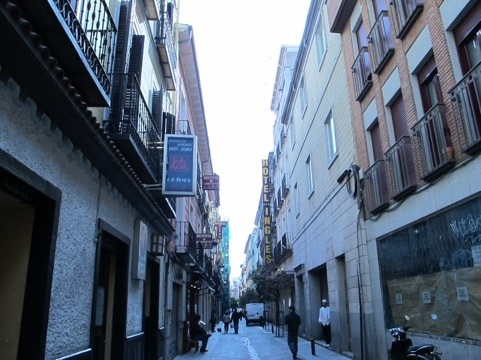
These 2 obra maestros by Luna and Hidalgo bagged Gold and Silver Medals in the 1884 Madrid Arts Exposition. A victory celebrated by Filipino patriots then based in Madrid, to include our very own Dr. Jose Rizal. The venue for the victory banquet still stands today in Madrid, in Echegarray Street just a few strolls from Puerta del Sol. In this banquet, our national hero β€” who’s said not to have eaten the whole day for lack of funds β€” gave more than a toast to honor Luna and Hidalgo. More like a speech. A speech so full of bravado and spunk, where Rizal frontally attacked the religious establishment. Perhaps a preview of the Padre Damasos and Padre Silvas in his Noli Me Tangere. If you ever get to Madrid, do check out Hotel Ingles and “stand proud” as forefathers did. And while you’re there, be sure to visit Rizal’s other favorite haunts.


20121028-105658.jpg

Hotel Ingles. Echegarray Street, just a few strolls from Puerta del Sol. Madrid.


If you haven’t been following my Madrid Blog Series, let me leave you with this excerpt from Rizal’s impromptu speech at the Hotel Ingles victory banquet. My man. Truly, Rizal’s Filipino pride shone through.

Β 

β€œLuna and Hidalgo are as much Spanish glories as they are Filipino. Just as they were born in the Philippines, they could have been born in Spain, because genius has no country, genius blossoms everywhere, genius is like the light, the air, it is the heritage of all”


HOME SWEET HOME


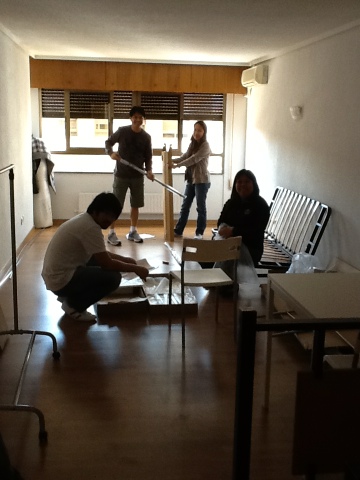
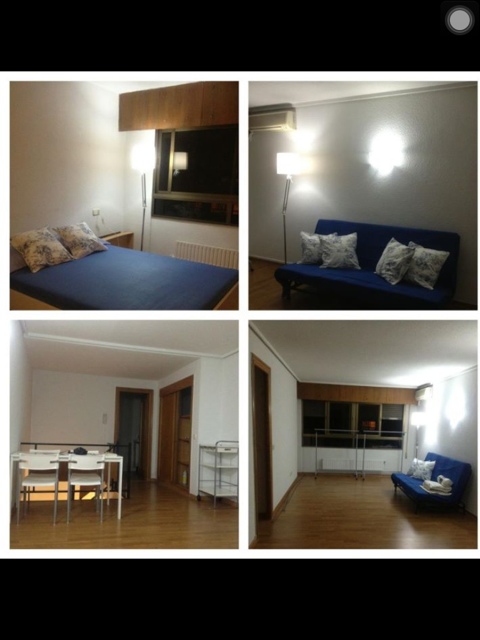
This is the moment where I take a break from travel blogging. Back home now after 2 and 1/2 months based in Madrid, after 42 blogs on WordPress and 5 more on TravelBlog. I was busy apartment-hunting with my niece, IKEA-shopping for furniture, waiting and wasting lotsa time for the delivery men, and getting serious with household chores. Well, sort of.


20120511-172001.jpg

20120511-172503.jpg


So, how was it? I never made it out of Madrid in the first 4 weeks. In fact, the first week spent in a hotel was most boring, while the 2nd week apartment-hunting provided the excitement. I did most of my Madrid walks during the first week as there wasn’t much to do in the hotel. Besides, wifi sucks in that hotel.


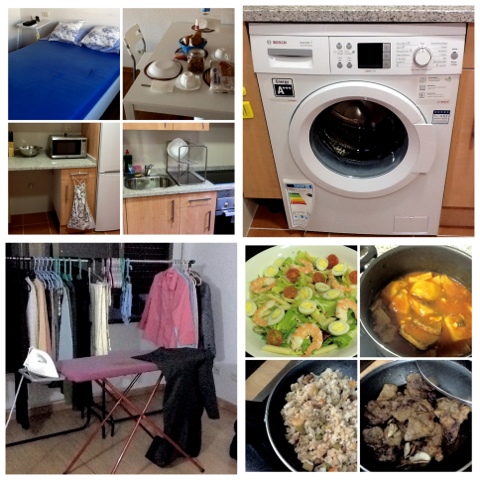
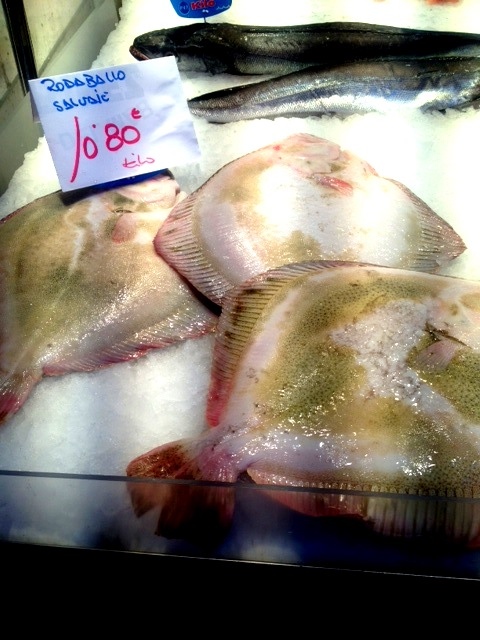
The 3rd and 4th weeks were devoted to furnishing the apartment, having the appliances and furniture delivered and assembled. I enjoyed this part. In between, my daily trips were largely to Carrefour, the palenque and the Chinese stores for food and little things like sandwich bags, detergents and other cleaning stuff.


20120511-173257.jpg

20120511-173844.jpg


By the 2nd month, we were nicely settled and welcomed our first batch of guests. All girls. No room for men guests as there is only 1 toilet and 1 bedroom. The sofa bed in the living room warmed many backs. My “survival cooking” survived. No one grew hungry, for sure. While we had no TV and wifi yet, we spent a lot of time chatting, laughing and eating.


20120511-174530.jpg

20120511-174905.jpg


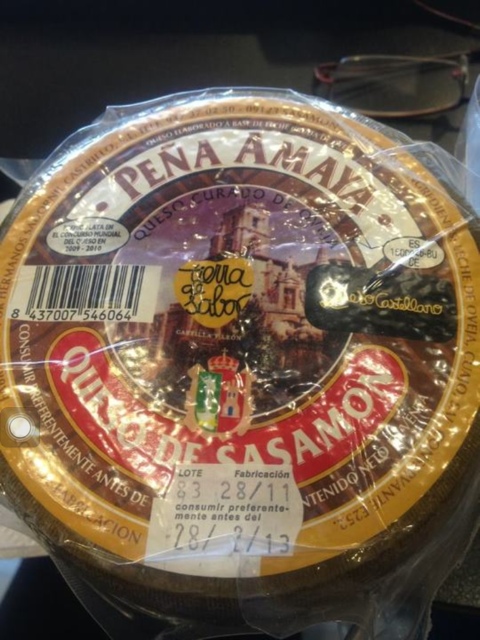
By this time, I have already mastered the metro system, the “free days and viewing hours” of most museums, the bus system and gained “Suki” from the palenque. My favorite vendor is this man who would always offer me a sliver of Jamon or Quezo to try. “Para prober” he always says. And I always gladly accepted. ☺☺


20120511-175210.jpg


I’ve spent Semana Santa in Andalusia, a long drive to Valencia and a last weekend in Barcelona. In between, there were day trips to Segovia, Avila, El Escorial, Valle de Los Caidos, Toledo, Aranjuez, and Alcala de Henares using the bus, the regional train, or the fast train. I experienced ALL seasons in the last 10 weeks. In Valencia, temp went from 7 Celsius to 27 Celsius in 8 hours. In Segovia, it snowed. Crazy, I know. I have been to Costa del Sol, Malaga and Granada before and felt no craving to revisit. Not yet. I would have wanted to see Salamanca again but there was no chance. Shopping for gifts to bring home took precedence. Perhaps next time.


20120511-175749.jpg


Now I’m home…. in sweltering heat. I miss my daily walks in cool weather. I miss dragging my “old lady’s” shopping trolley whenever I set out to do the groceries or marketing. I miss my pair of boots which I left in the apartment. Back to normal. Back to “Lola mode”. No more solo trips except to the beauty parlor. My elves waited too long and it’s time to catch up with one another.


Since I arrived, I have completed all my blogs on my Spanish “holiday” (or have I?) and stayed home most of the time. It breaks all newly- formed habits and patterns. I even miss our washing machine in Madrid! Oh well……..


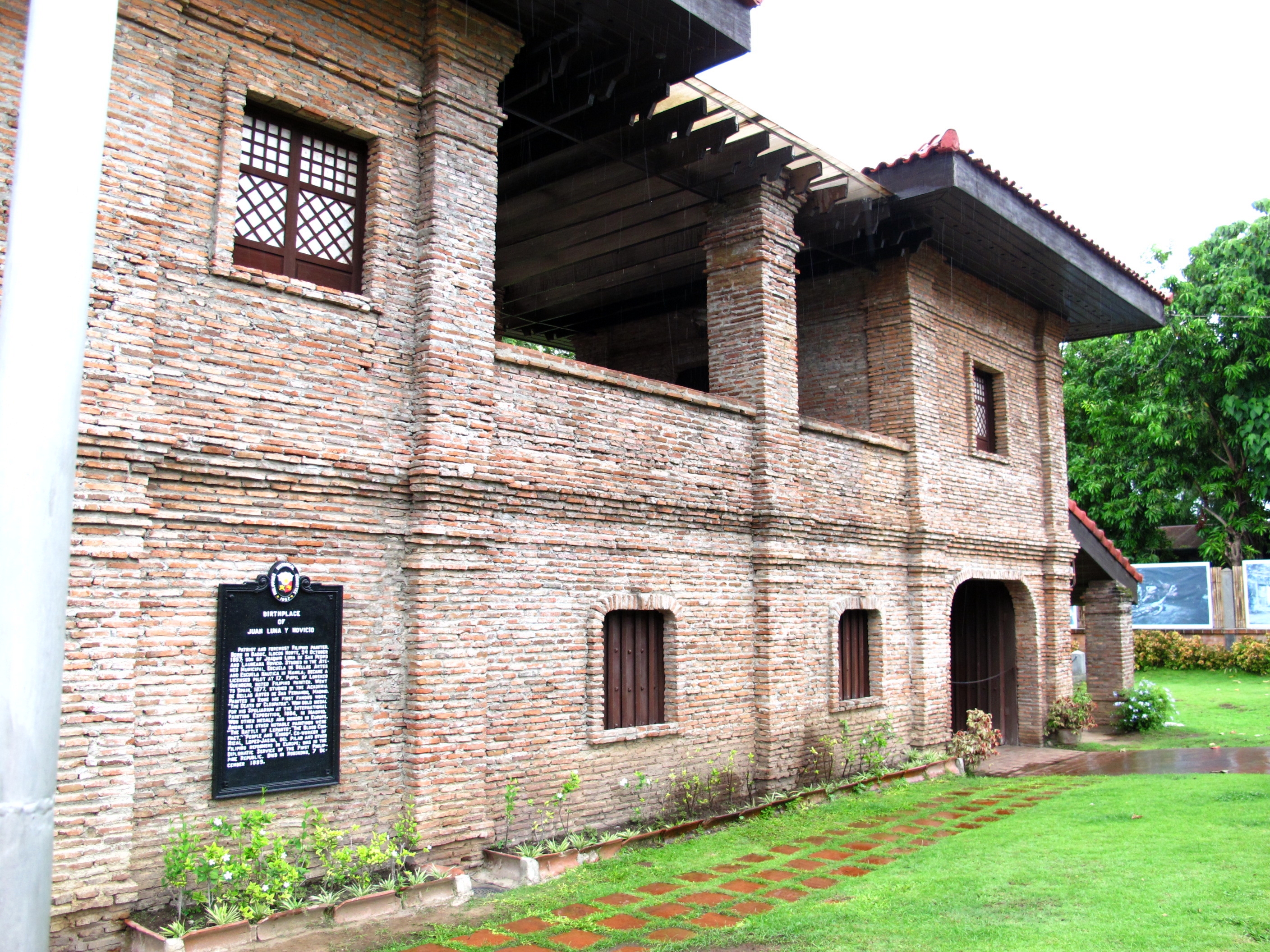
Having visited the Juan Luna Shrine in Badoc, Ilocos Norte last July seems to have driven us to search for more Lunas. Or rather, to dig deeper into the mind of this great patriot and artist. More than his art, there is that most interesting if not tragic side to this hero’s life.

Juan Luna Shrine in Badoc , Ilocos Norte

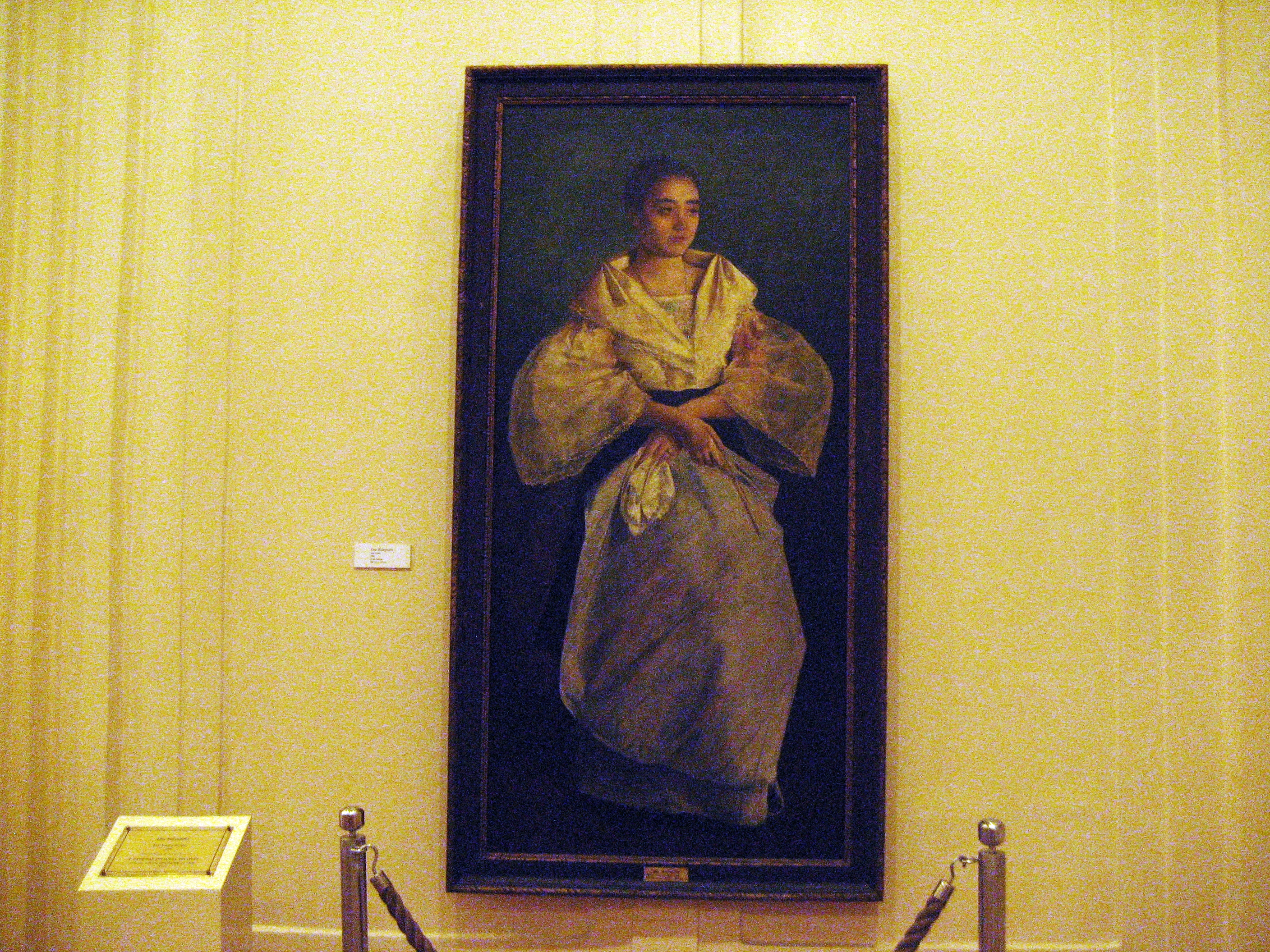
The tour guide here should be commended. Not easy to hold the attention of my 2 elves, aged 10 and 13, the whole hour we were here. I particularly liked how he presented Luna to us as the artist while talking of the gold award he won in a Madrid art competition with the masterpiece, “Spoliarium”. A copy hangs in this Shrine while the original adorns the Masters Hall in the National Art Gallery. Or Luna as a romantic with a painting of “Una Bulaquena” where the original painting used to hang in Malacanang Palace till it was transferred to the National Art Gallery.

The Original

The Original

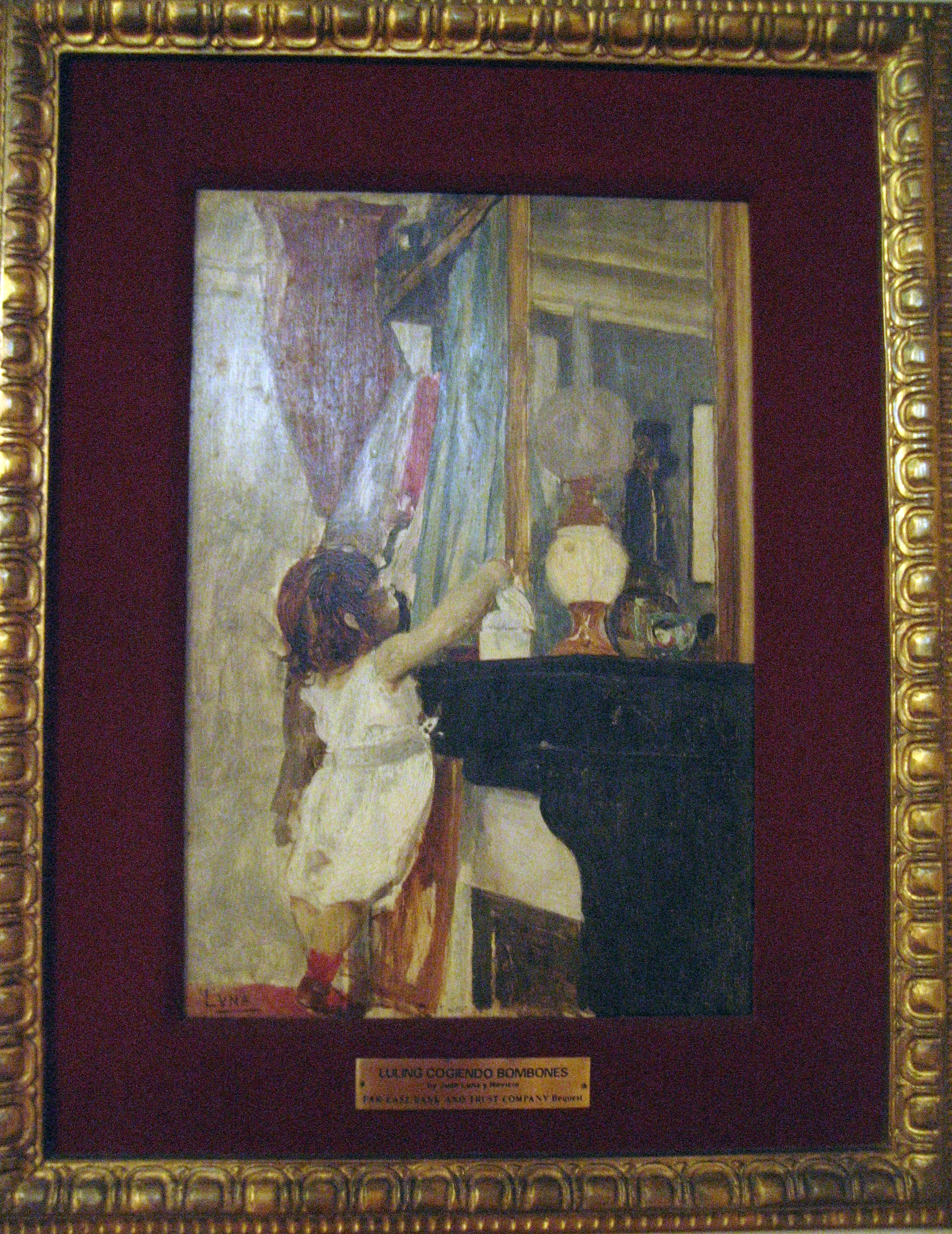
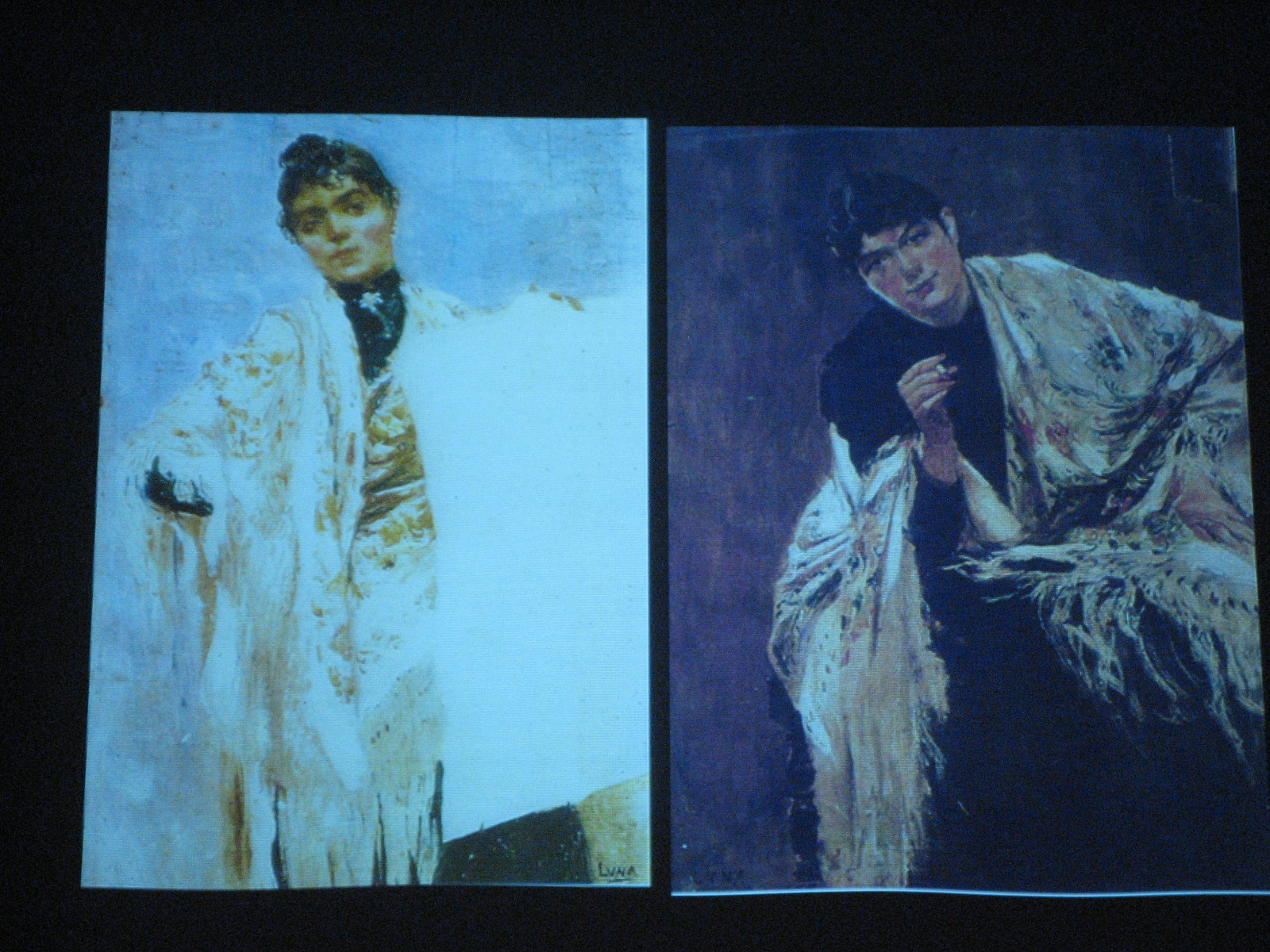
In one trip to the National Art Gallery, the Luna paintings showed how his art has evolved through the years spent in Madrid and Paris. But what caught my attention were some Luna paintings with no attribution. Was it Juan or Manuel who painted these? Jose Rizal once said Manuel , the brother of Juan and Antonio Luna, is the better painter but Manuel chose to study music instead.

That Little Girl Reminds Me of Someone Named Luna

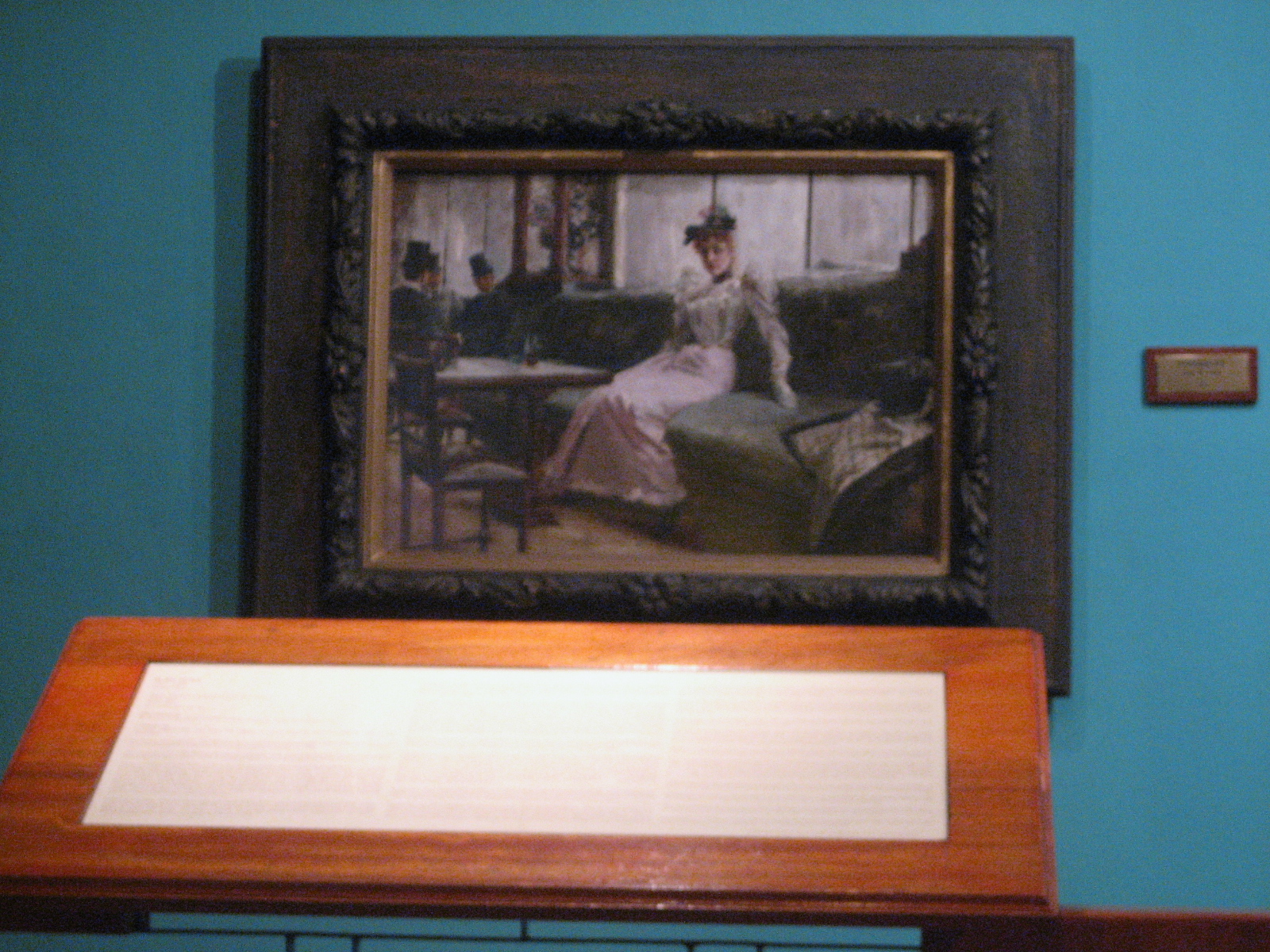
My search brought me to a Lecture Series on Juan Luna at the GSIS where its museum proudly hangs the celebrated GSIS investment in a Luna painting entitled “A Parisian Life”. Michael “Xiao” Chua gave the lecture which allowed us listeners to understand another side of Juan Luna. For the most part of the lecture, Xiao dwelled on the life and tragedy of this great artist. It is up to us viewers to relate these trivia to how his art has evolved. I am no art connoisseur but it is not difficult to differentiate the masterful but intense strokes exhibited in the “Spolarium” versus the softer, milder, even playful art gleaned from “A Parisian Life” .

The Parisien Life at the GSIS Museum. But not for long. Who is buying?

The Wife Paz......Tragically Shot by Juan Luna

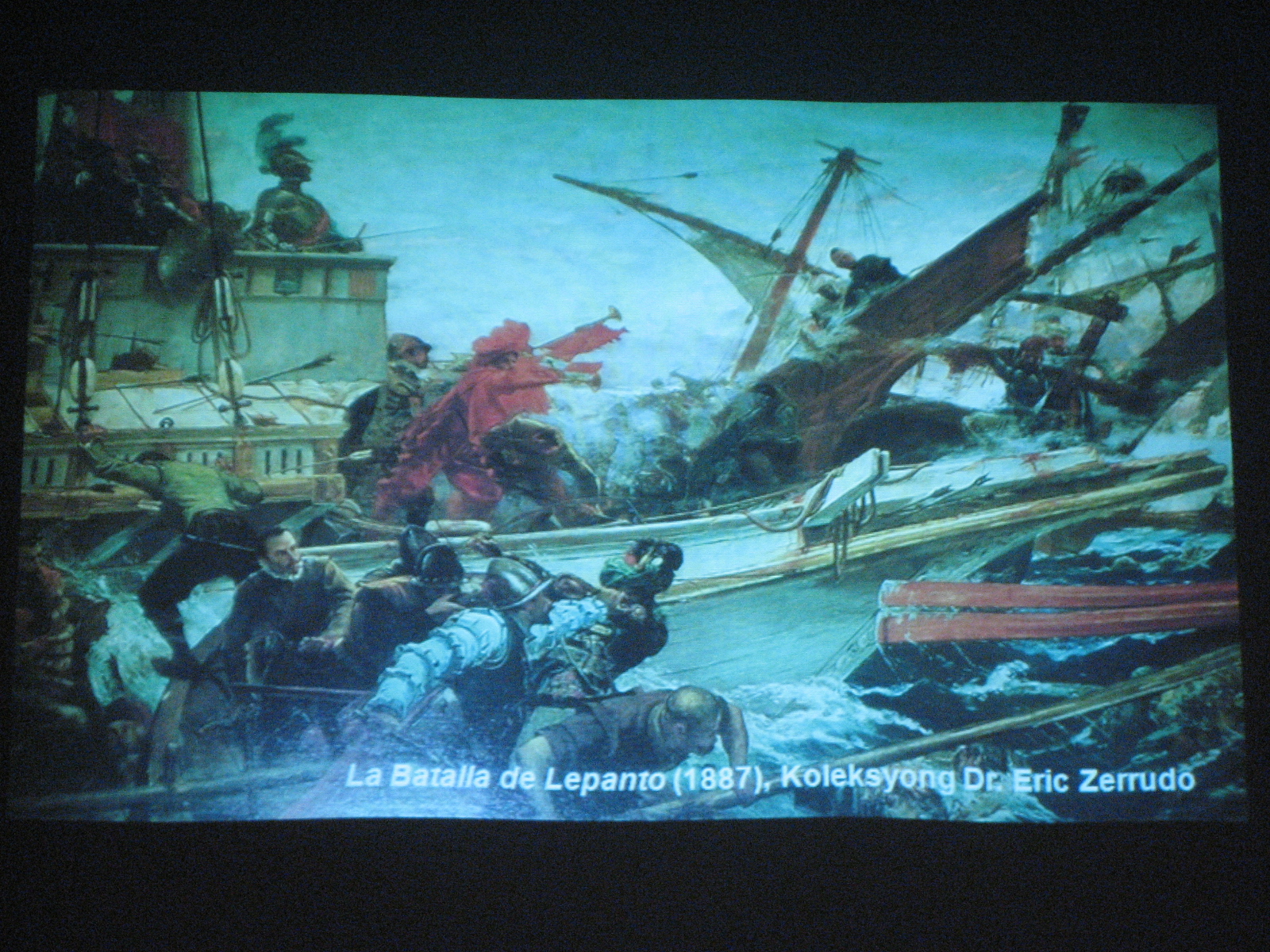
Xiao disclosed that the painting Parisian Life is up for sale. So, who is buying? It will be recalled that the sale and purchase of this artwork was so enmeshed in controversy in recent past. It has certainly gone a long way from the Bahay Nakpil-Bautista in Quiapo to the Hongkong auction house to GSIS Museum. In whose walls would it hang next? Xiao laments the possibility of having this painting stashed away in some foreign land. Much like the Battle of Lepanto, another masterpiece of Juan Luna, which has been hanging in the Senate walls in Madrid, Spain. So with the “Death of Cleopatra” which is on display at the prestigious Prado Museum in Madrid, Spain. Anyone care to shell out a hefty sum to keep this national treasure here at home where it belongs?

Battle of Lepanto @ Madrid, Spain.


One Brit. One Blog. One Airport. One “Hotel”. One Bad Coffee.

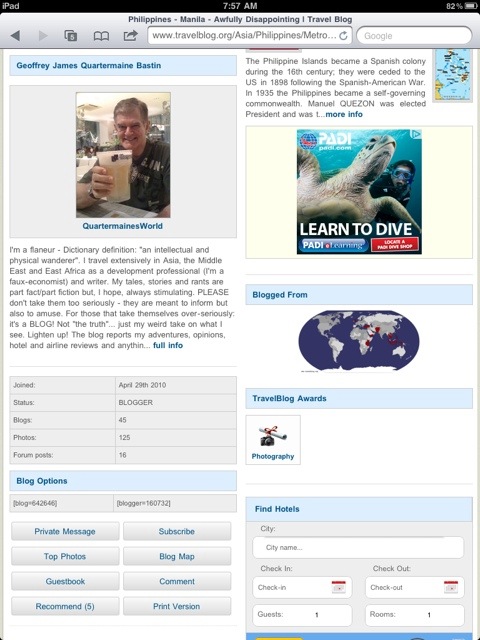
What’s wrong with Manila? Many things, obviously. What’s wrong with our NAIA Airport or Terminal One? Too many things, admittedly. But certainly not enough to trash Manila.

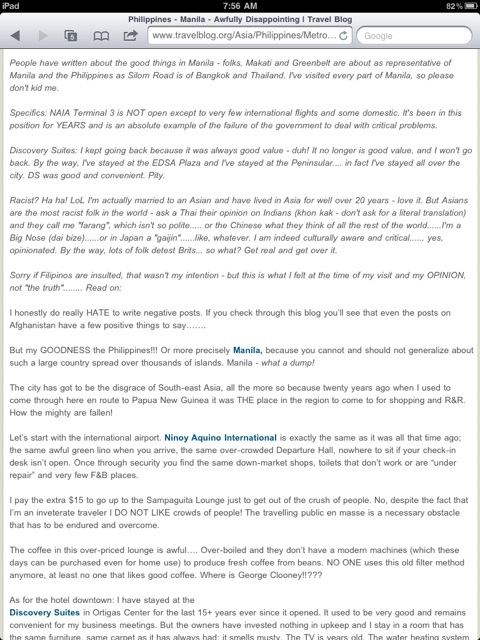
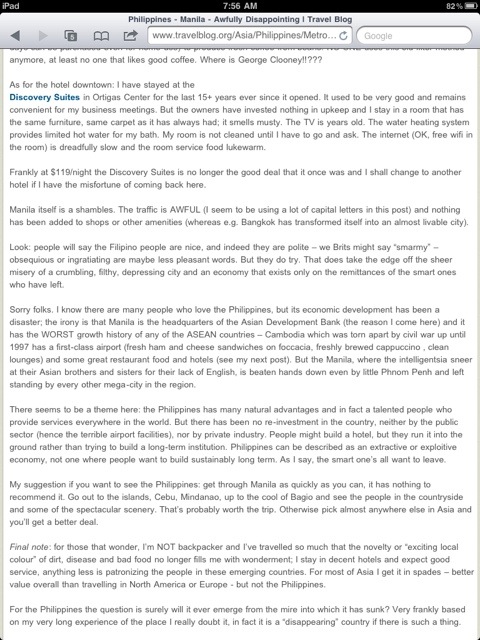
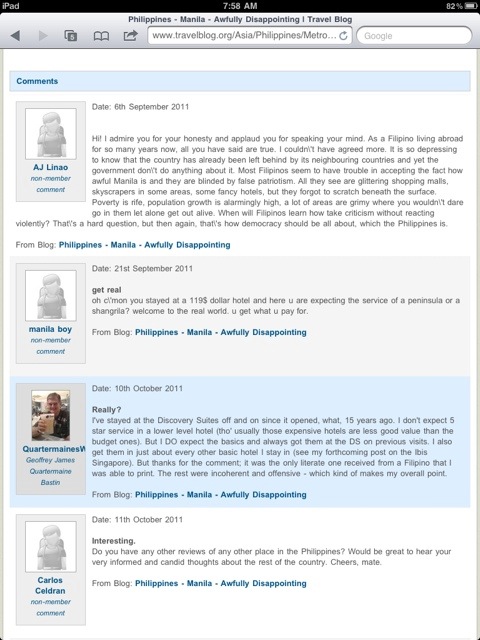
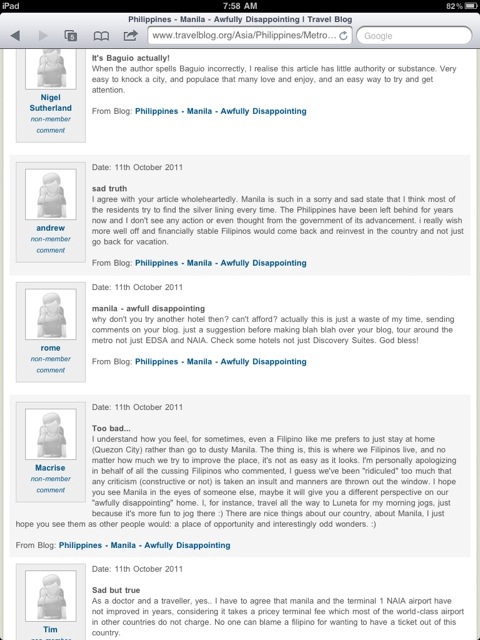
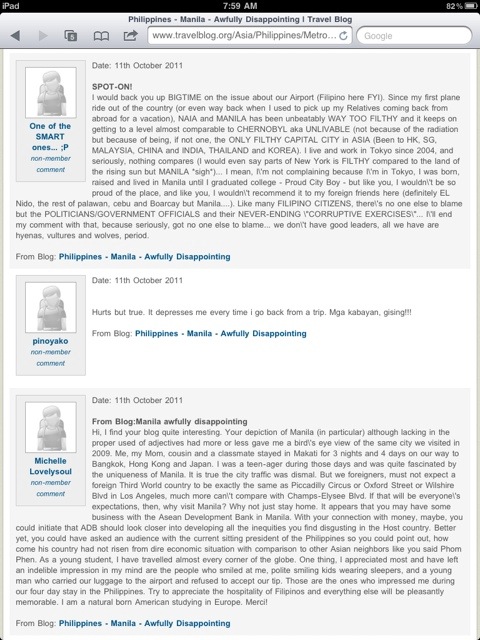
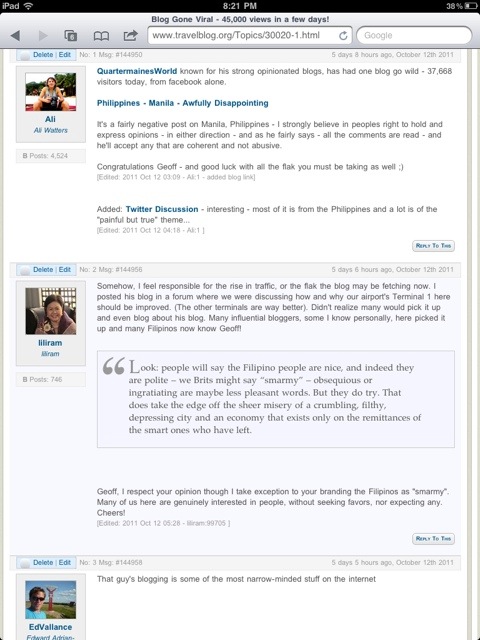
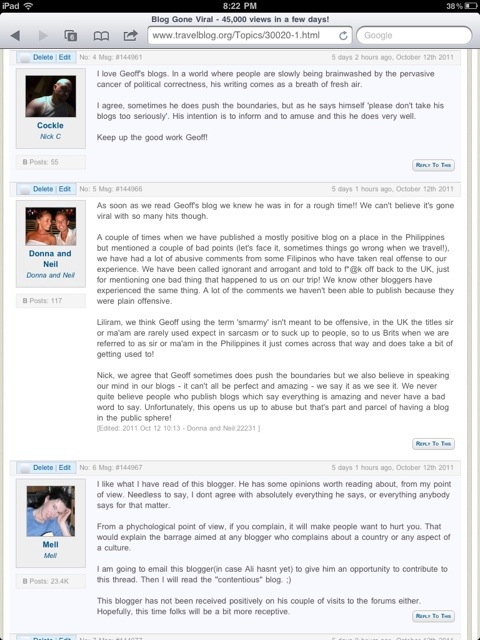
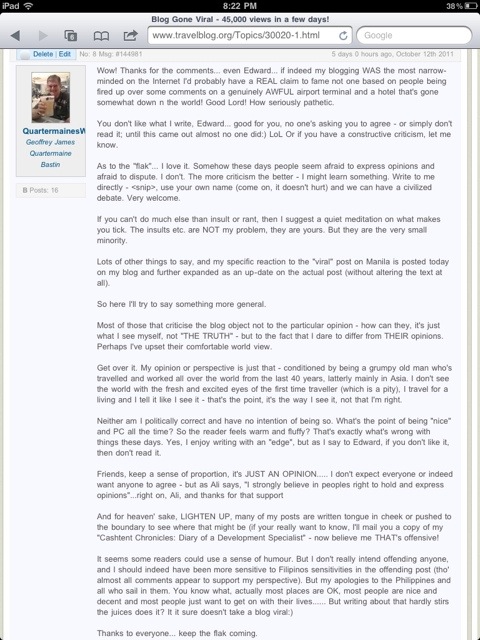
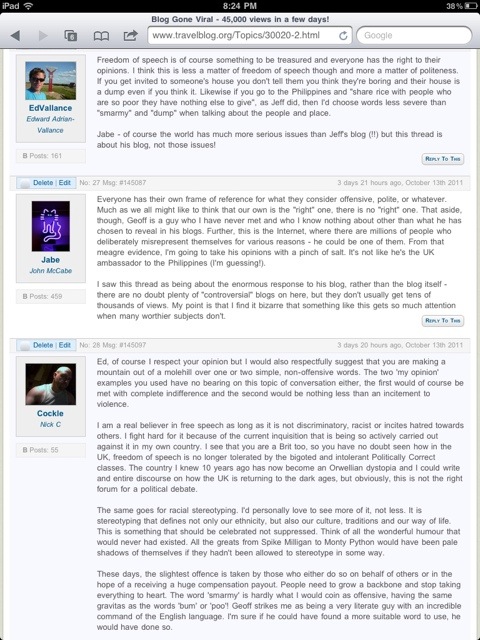
This blog by this Brit may have pointed out the sad state of our airport and the city such that it provoked serious discussion among Filipinos who:

1. Accepted the painful truth but took exception to the sweeping generalization.

2. Accepted the painful truth and added insult to injury by confirming how hopeless we are.

3. Are in denial of things wrong around us and attacked the blogger with abusive language.

You may want to read the blog written by this Brit who admits being a grumpy old man, but certainly a well-traveled one. Without going to his blogsite (and adding to his stats), you can view the pages here. Read on, and tell me what you think.

xxxxxxxxxxxxxxxxxxxxxxxxxxxxxxxxxxxxx

20111017-201359.jpg

20111017-201419.jpg

20111017-201433.jpg

20111017-201458.jpg

20111017-201541.jpg

20111017-201604.jpg

20111017-201614.jpg

And there’s more. In a discussion forum in same blogsite, the comments revealed how Brits can argue among themselves just as much as some Pinoys claim to be the smart ones who readily accepted how this Brit branded Filipinos as “smarmy”. (He later apologized for this, admitting it was harsh and said in irritation.) Very likely, those smart ones didn’t even know what the word meant, and simply focused on one grumpy old man’s rants vs the filth in Manila. Nothing worth photographing, in his own words. But there were also other non-Pinoys who found the blog nasty and offensive, even as they agreed about the poor state of NAIA Terminal 1.

20111021-203239.jpg

20111021-203301.jpg

20111021-203320.jpg

20111021-203335.jpg

20111021-203401.jpg

20111021-203416.jpg

At the end of the day, this whole exercise proved that controversy sells. The Brit blogger got it right about the airport and the dirt in many places. But should we accept that Manila is hopeless and where the Filipino character is concerned? Some Pinoys do, judging by the comments.

The grumpy blogger reactivated his twitter account and invoked his “readers” to add to his 8 followers. I suspect he would write more controversial blogs, egged on by the phenomenal hit record of this mediocre blog. He is even more active in the travel forum, behaving like a true troll. Best not to engage him. He gets all fired up when he finds someone to argue with. In other words, don’t feed this troll. If you’re curious, allow me to just post additional screenshots of his Royal Troll-ness. πŸ™‚


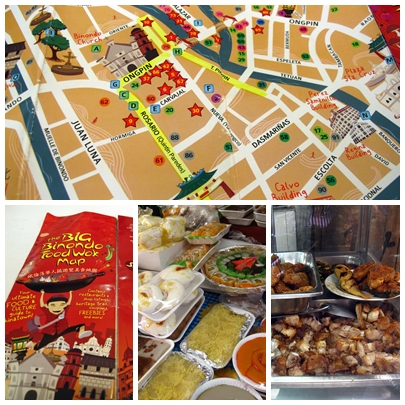
Siomai. Fried Siopao. Tea Eggs. Champoy. Lumpia. Hao Flakes. Hopia. Adults can easily be swayed to join you in this trip with the prospect of eating all these stuff, but how about the kids? Does Chinatown have the same appeal to them?
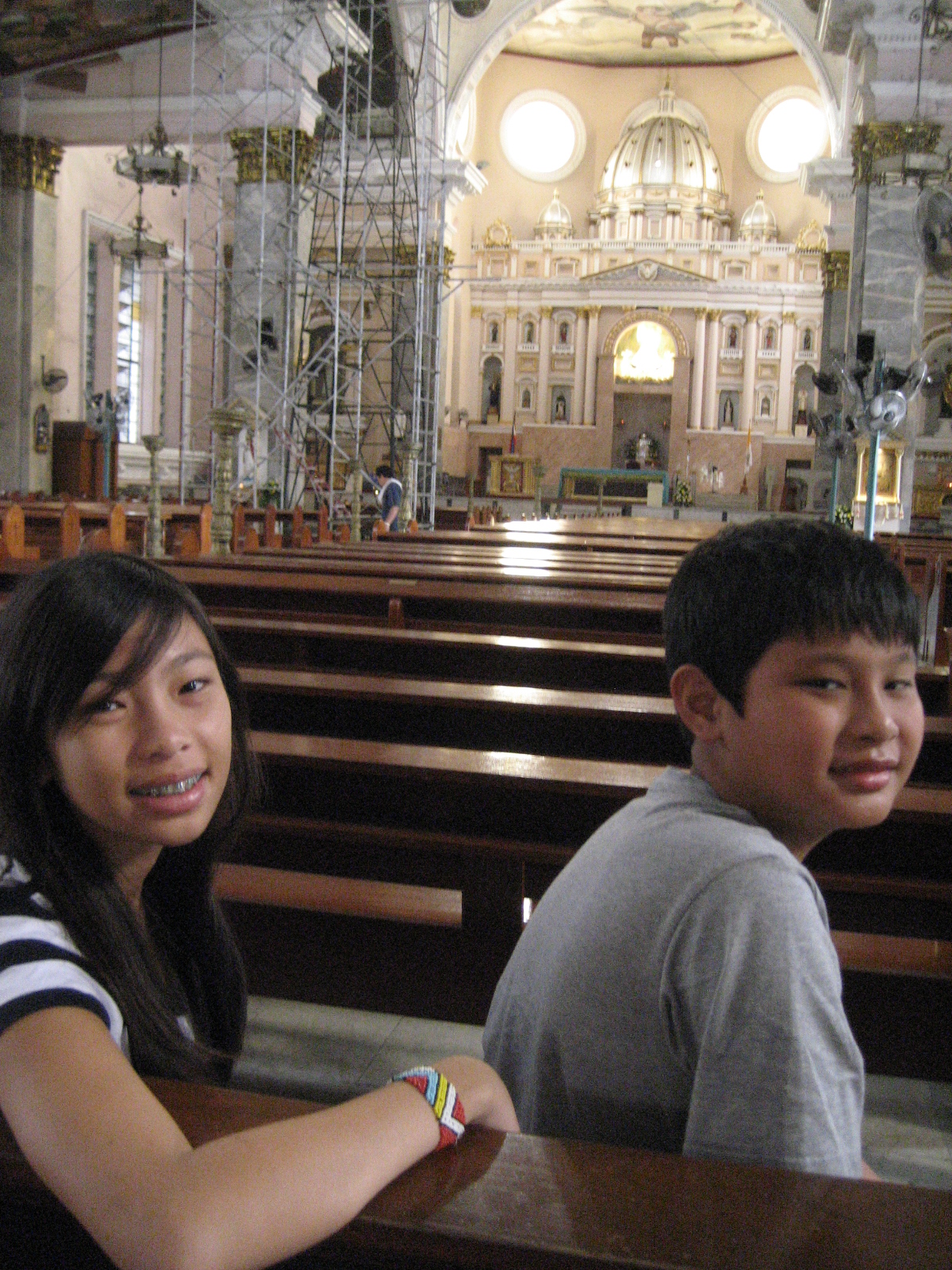
I started off with Chinatown being the oldest Chinatown in the whole world. Like the “Sangleys” or Chinoys of pre-Hispanic era living in the area now known as Intramuros. Then the Spaniards came, and the Sangleys were driven out of the Walled City to live across the Pasig River. Or how about the Binondo Church being where our very first Saint Lorenzo Ruiz served as altar boy? We started off with a visit to this Church and Mamu just had to have this trivia drilled into their heads. πŸ˜‰

Inside Binondo Church Where San Lorenzo Ruiz Served As Altar Boy

From Binondo Church, we stepped out and got ready for our walk. But not without pointing out the area (Masangkay) towards all those dilapidated ancestral houses where Rizal’s parents lived after having been evicted from their home in Calamba, Laguna. With that, I promised to stop with my history lessons. Three historical tidbits enough for this morning. Enough.

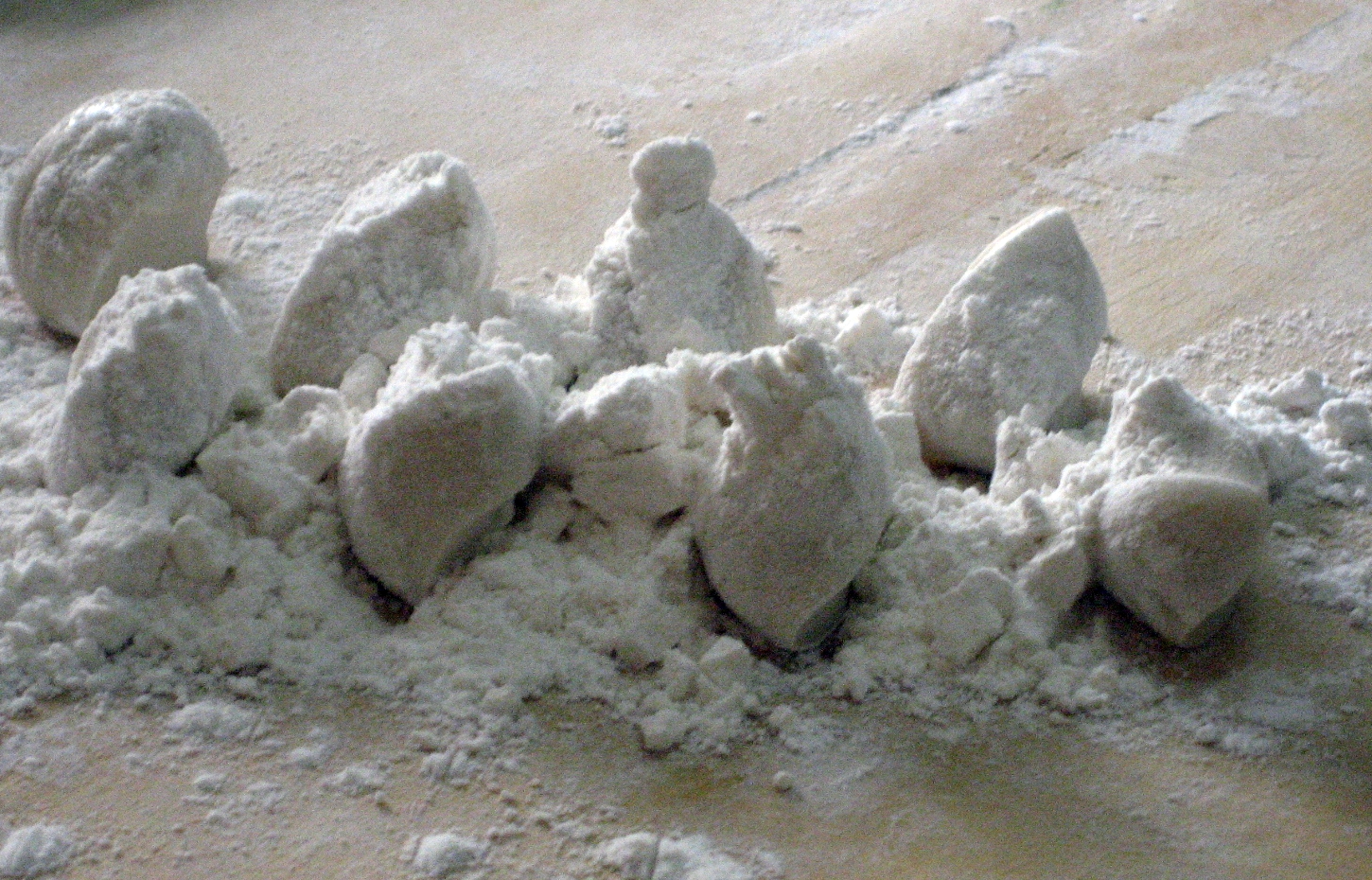
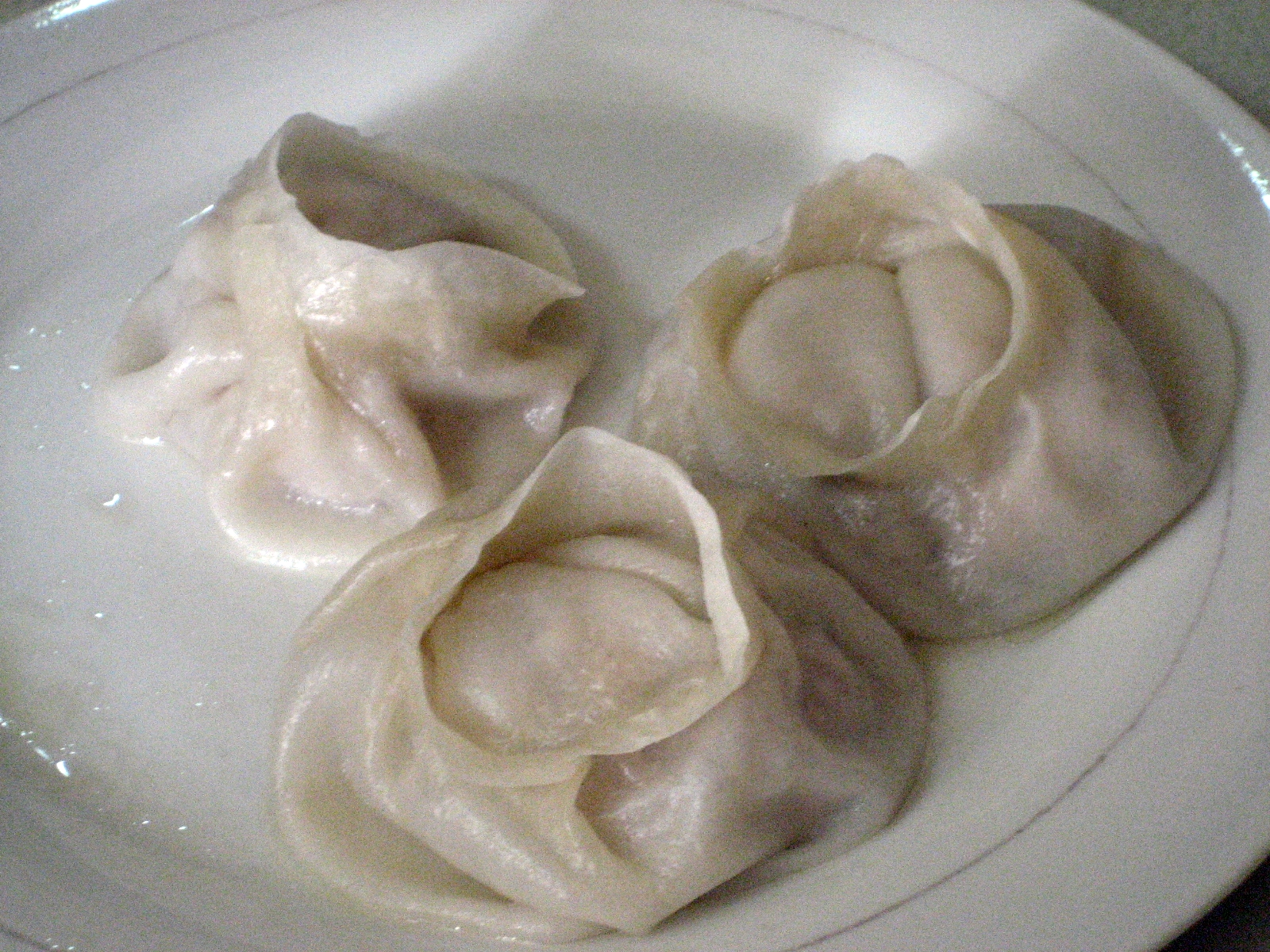
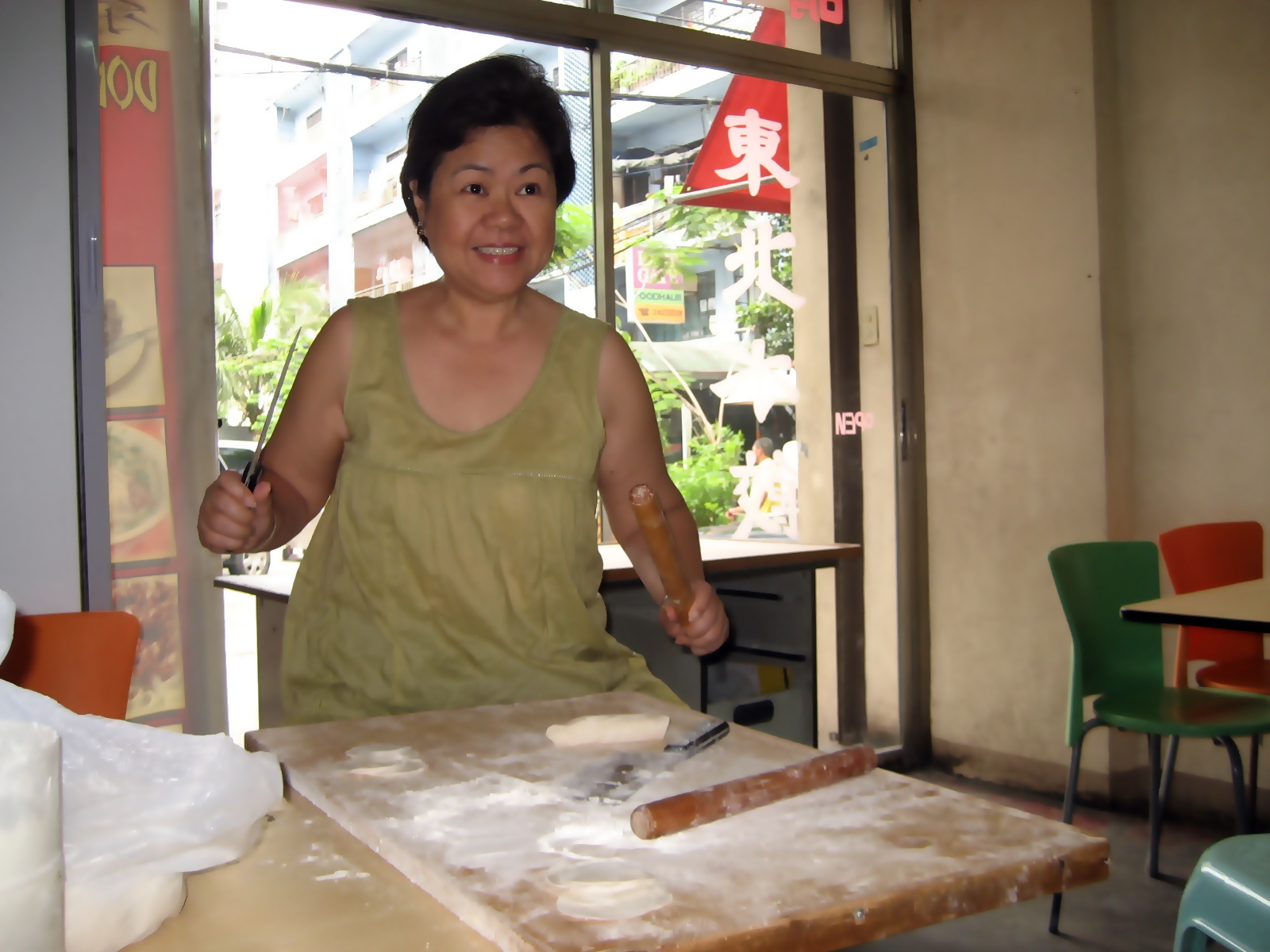
Dumplings from Dong Bei @Yuchengco Street off Ongpin

This is a food trip. And that’s a promise. First order of the day is to show the ‘elves’ that there are dumplings other than the ones from Hen Lin. πŸ™‚

Siomai at P80 for 10 pieces?

We were a few minutes too early, and had to wait for Dong Bei @Yunchengco Street off Ongpin St. to open at 10am. Hungry for our taste of Chinese food, we watched and waited. Those dumplings didn’t let us down πŸ™‚

Tried this myself, good buy for P35!

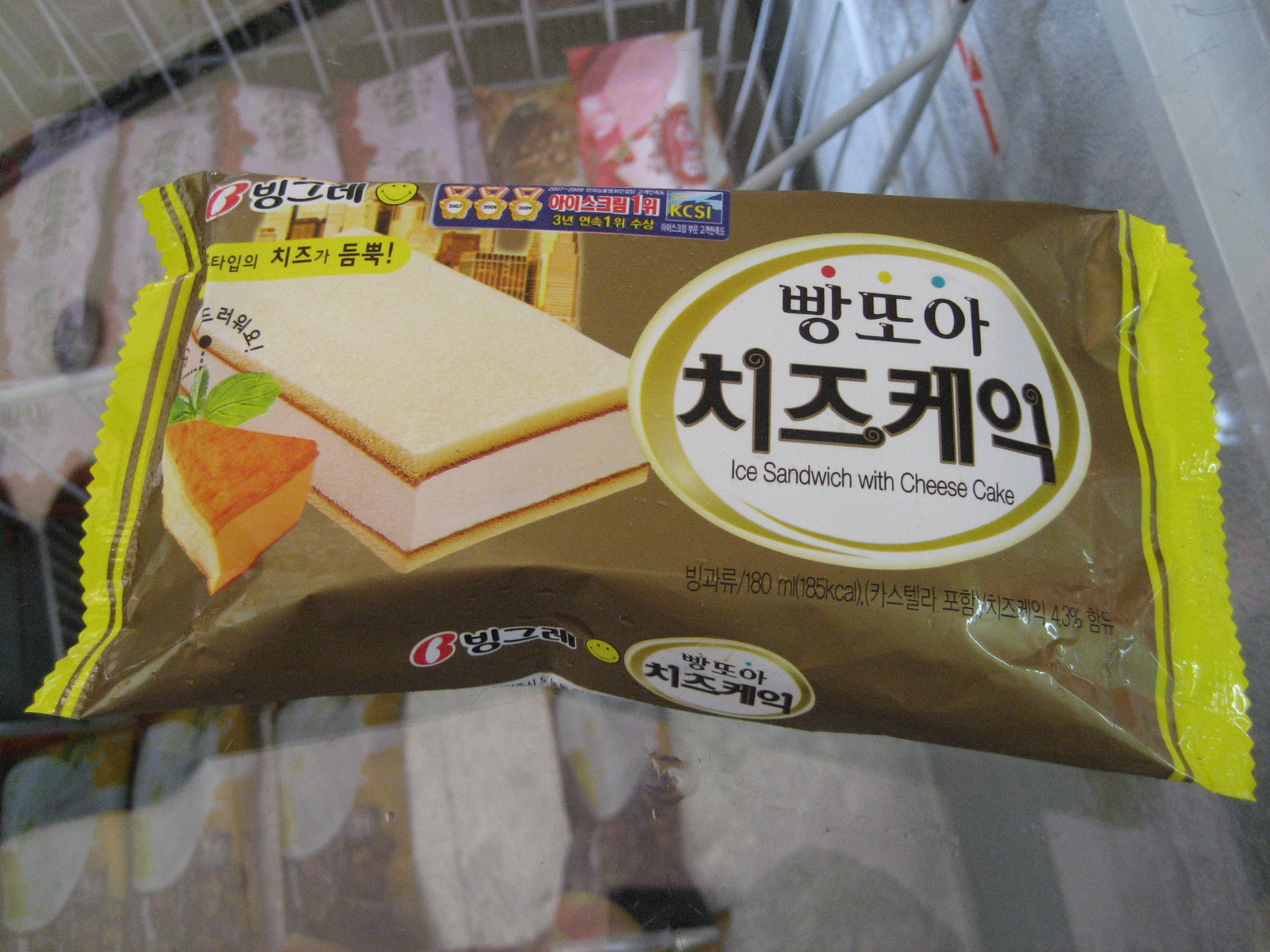
From Yuchengco Street, we trooped back to Ongpin Street where we passed this grocery store with frozen delights upfront for the elves not to miss. Korean ice cream, woo hoo! It wasn’t so hot this morning, but those ice cream sandwiches must have “cooled” them enough for the “wok”. The elves are happy.

Fried Siopao

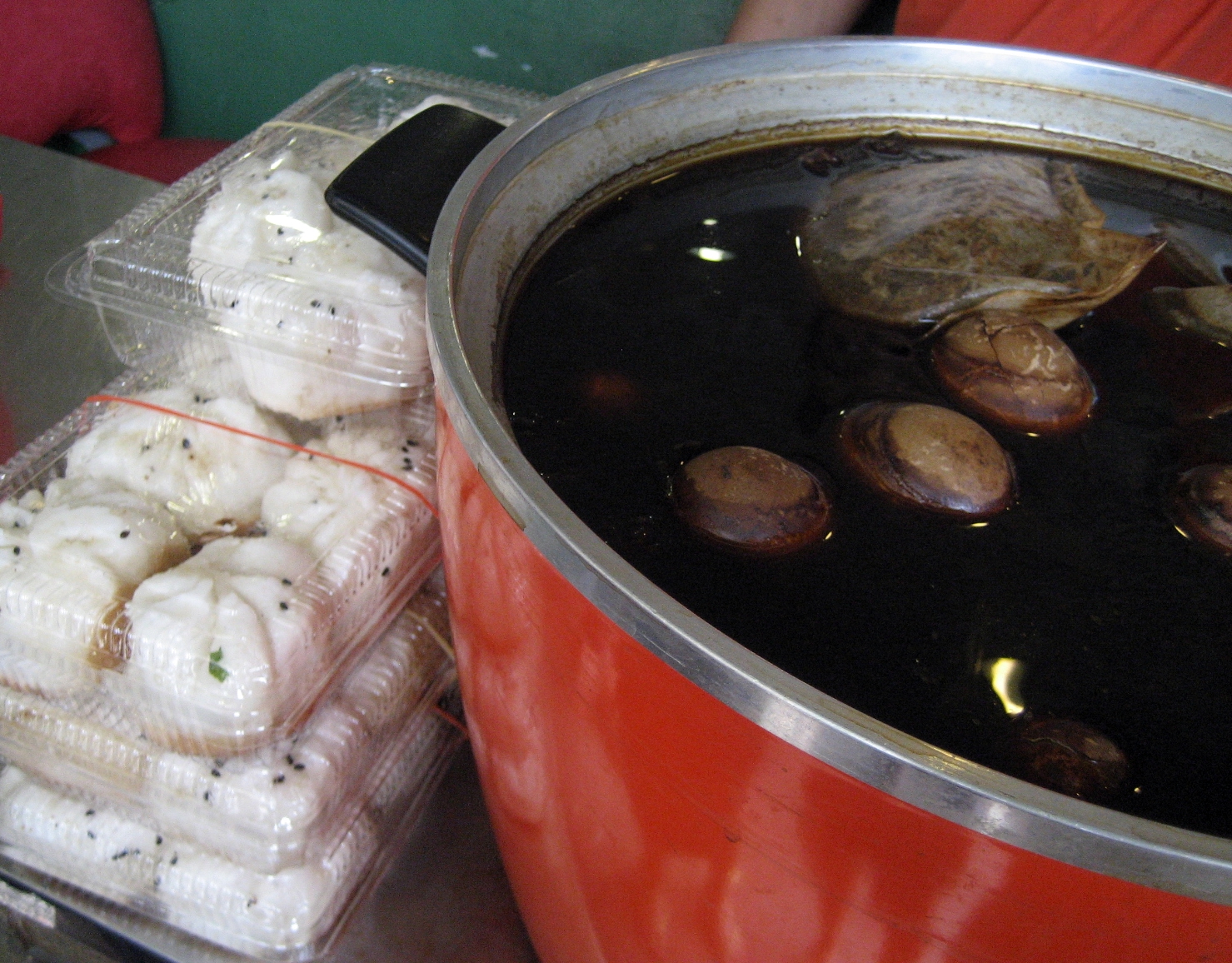
Tea Eggs & Siopao

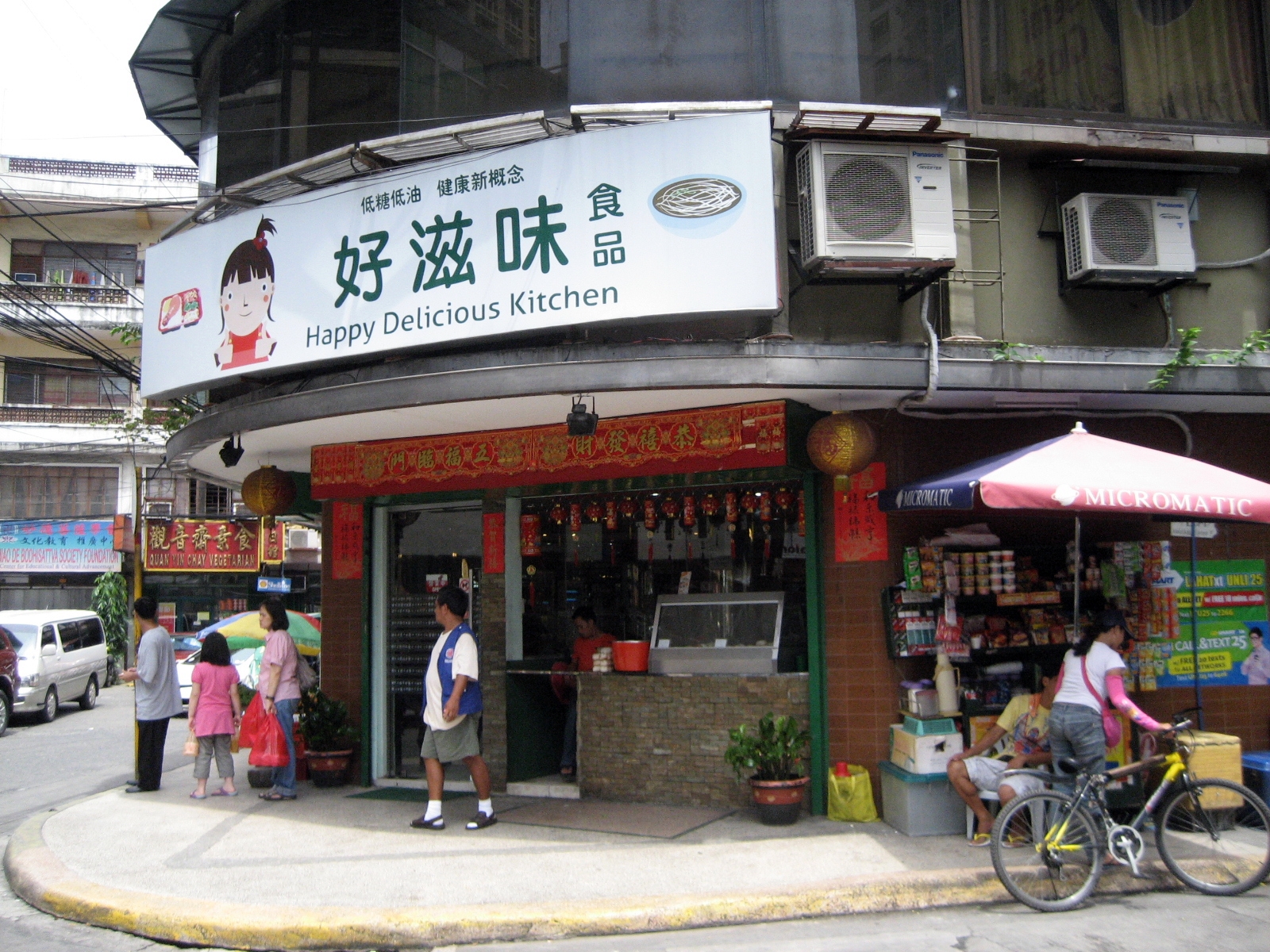
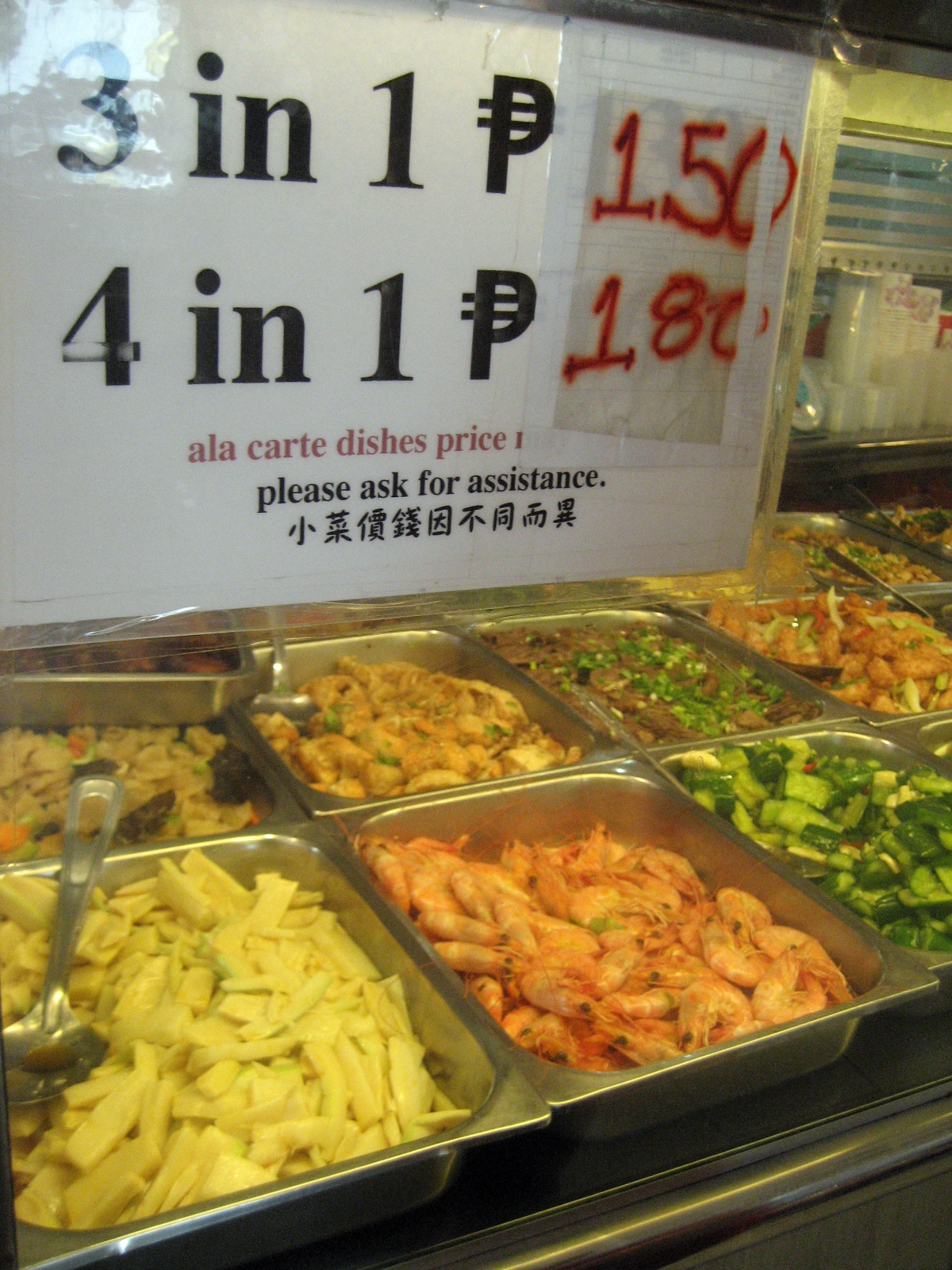
Turning left from Ongpin Street towards Benavidez, we found this corner restaurant selling fried siopao and more! No tea eggs for the little ones, but we went inside to check out what’s on offer for the P150-P200 lunch sets. 3-for-one means choosing 3 viands from the “turo-turo” spread, and your cuppa of rice. Not bad.

Happy to Find Happy, Delicious Kitchen!

3 viands for P150. 4 viands for P180. Simple enough.

Errr, which ones?

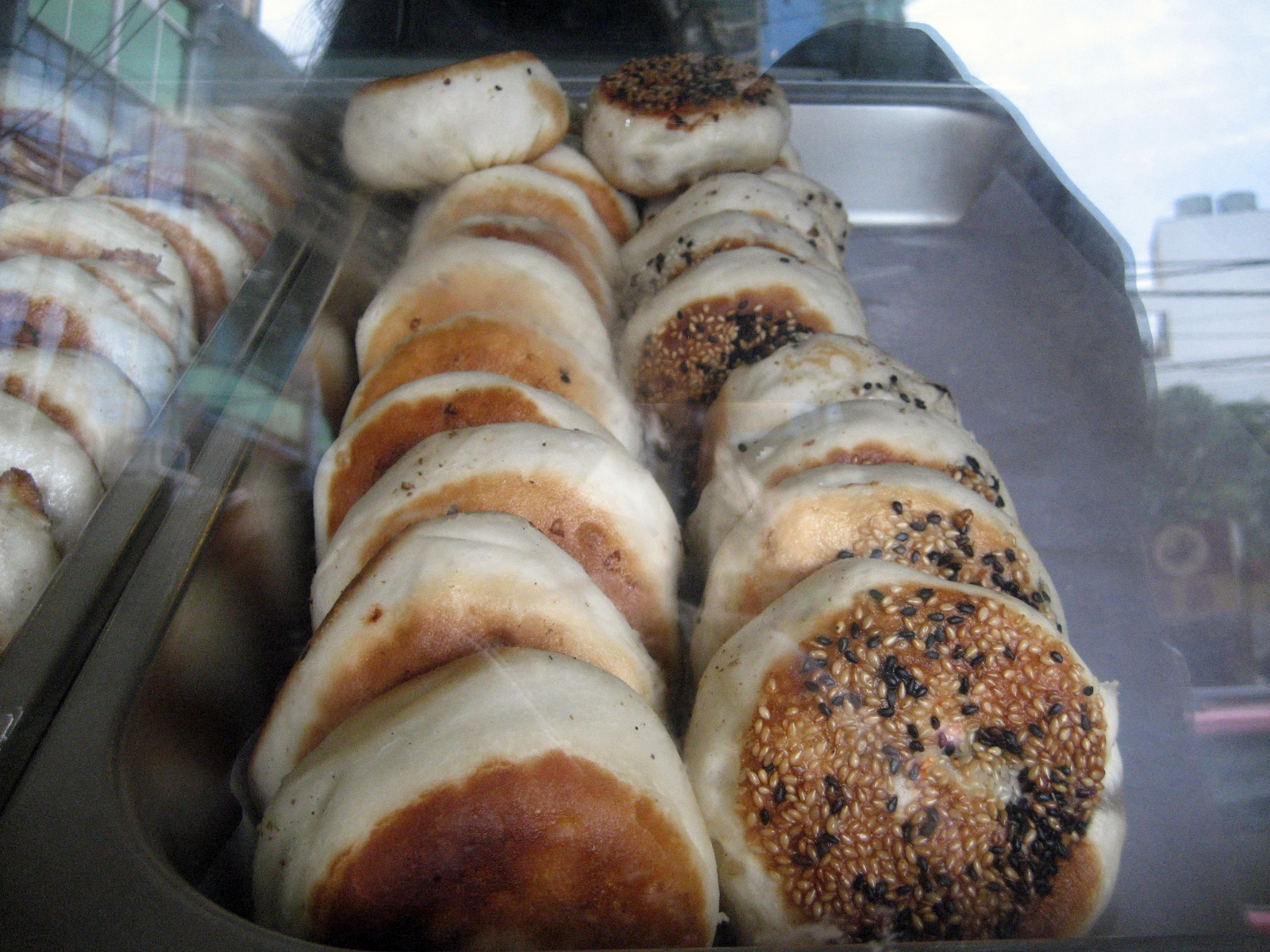
Walking some more, we found this bakery shop. You wouldn’t think this bakeshop is not somewhere in Makati.

Baked Goodies from Chinatown

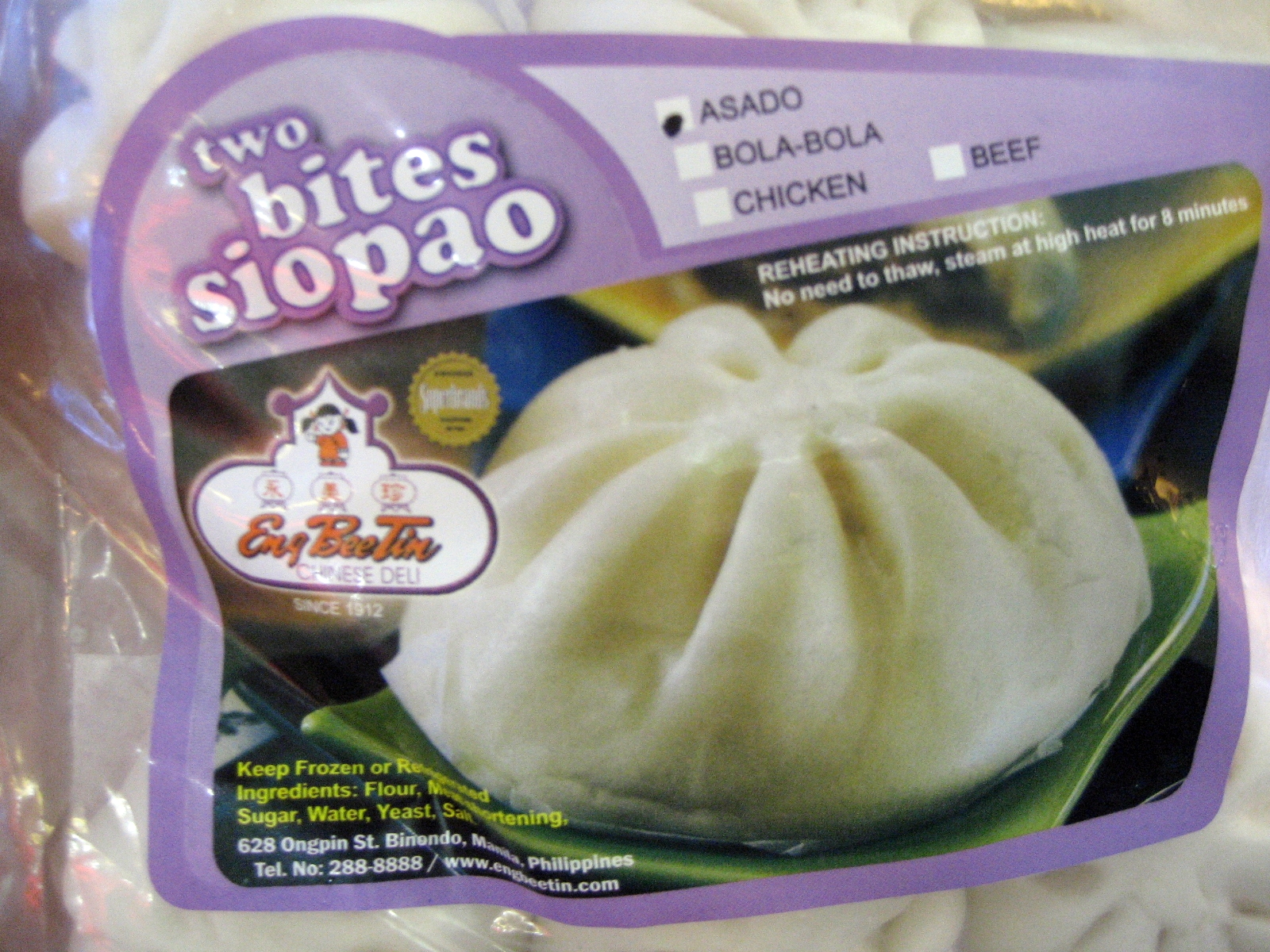
Then the must-stop pasalubong shop: Eng Bee Tin. Found a 2-bite siopao here, which Martin proudly claims he can turn into a one-bite siopao. Cute-sy.

One bite or Two-Bite Siopao?

We also passed some structures which have historical significance. Sadly, a major repair job is in order.

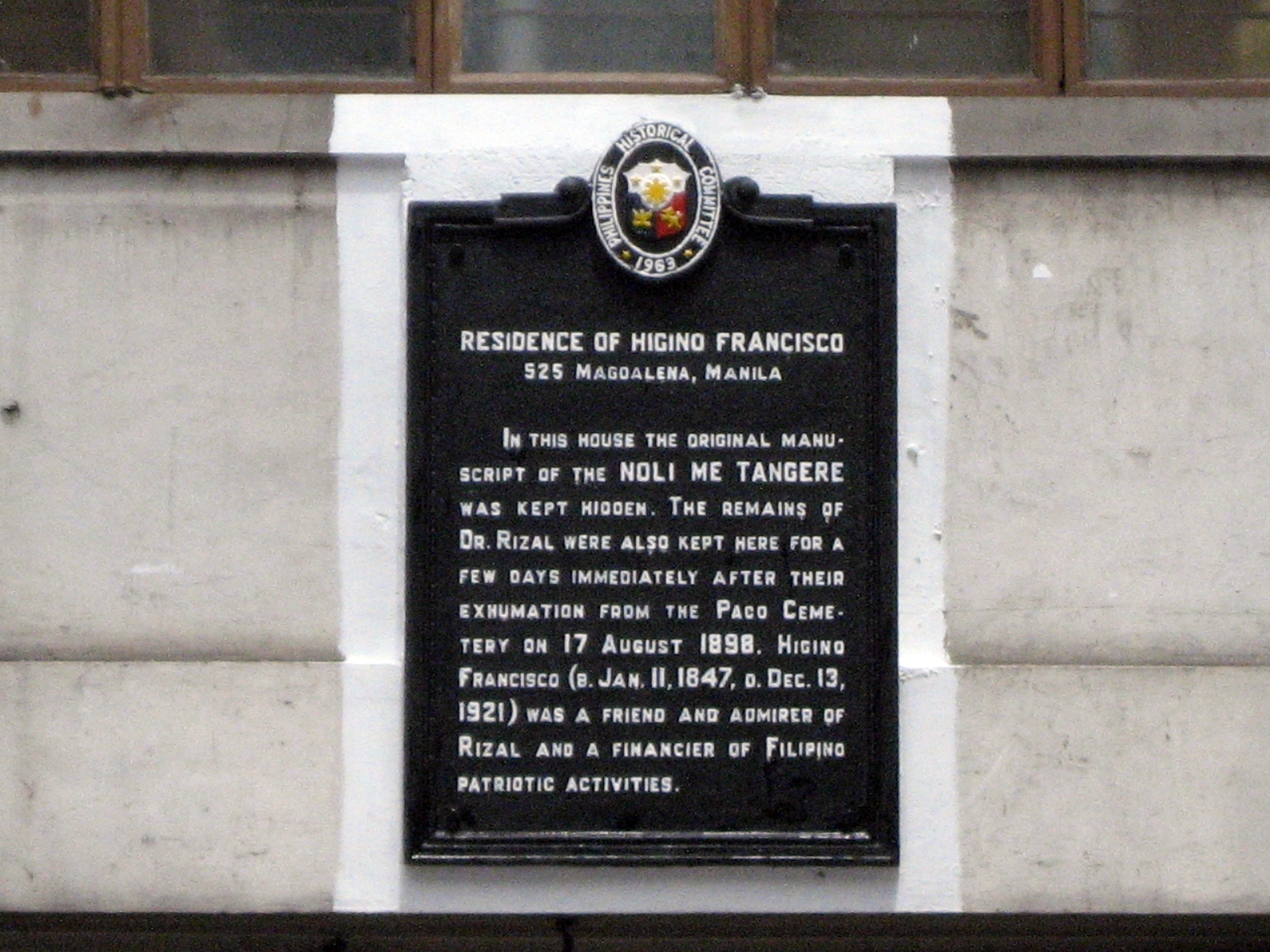
Residence of Higino Francisco

And this was a place where Noli Me Tangere was safekept?

Isn’t it awful? The authorities should do something about this. Higino Francisco is a revolutionary patriot who even plotted to rescue Dr. Rizal in the Bagumbayan execution. He was dissuaded of course, but for his friendship and patriotism, Jose Rizal gifted him with the original manuscript of Noli Me Tangere. Our national hero then thought that the manuscript would fetch a price later, but Higino chose to return the manuscript to Teodora Alonzo, the mother of our hero. Admirable. He died in 1921. But between you and me, who has heard of Higino Francisco?

Don

Now, that really gets me all mad!!!!

(Also check out an earlier blog on Chinatown. Just click on this link)

xxxxxxxxxxxxxxxxxxxxxxxxxxxxxxxxxxxxxxxxxxxxxxxxxxxxxxxxxxxxxxxxxxxxxxxxxxxxxxxxxxxxxxxxxxxx


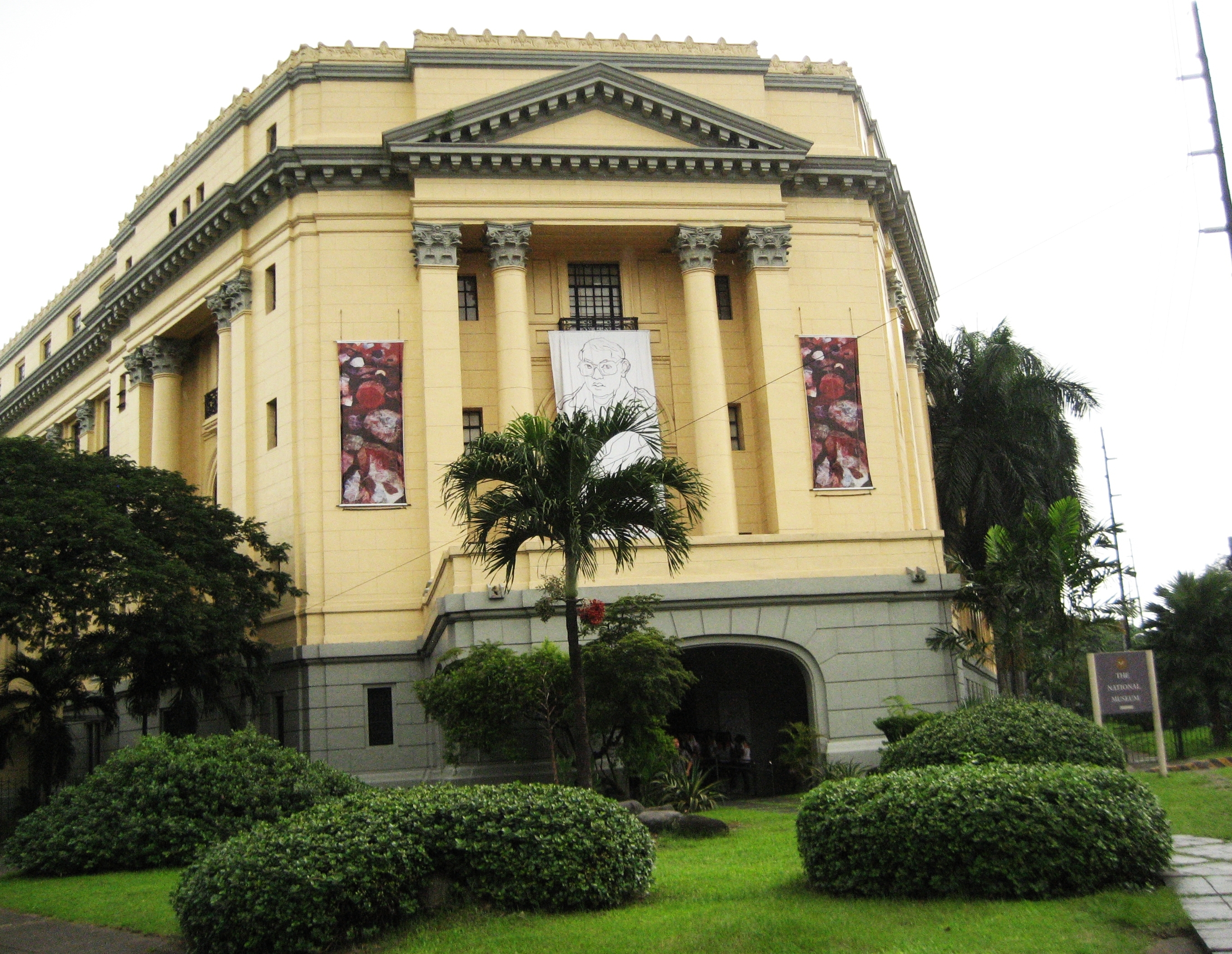
Let me ask……..when was the last time you visited the Museum?


Don’t look at me. It’s something I don’t do on a regular basis. But I would love to spend many afternoons there. And I continue to wish there is a good coffee corner somewhere within the building where I can take a break before pursuing a second run of the Gallery.


The National Art Gallery with the Balangay Diwata ng Lahi


As it turned out, I was good for just a couple of hours. No breaks. Glucose level drops in 2 hours after walking from Hall to Hall , up and down the 3 floors. And then I start longing for a cup of good brew and some munchies. Having said that, let me advise you to go in the morning after a good breakfast! Or in the afternoon after a good lunch πŸ˜‰


The Museum Of the Filipino People


When I got there, I decided to do the National Art Gallery first. The Museum of the Filipino People is good for a separate visit. “Slow by slow.” πŸ˜‰ Who says you can rush through a Museum? The best time is always a time when you don’t care about the time. Go slow. Read all those markers. Every piece of art has something to say. Either written or visual or sensed. If you’re like me who hardly picks up an art or history book, this maybe a fine time to brush up on art and history. You just have to trust that the most relevant information are encapsulated in all those reading materials and markers.


Juan Luna

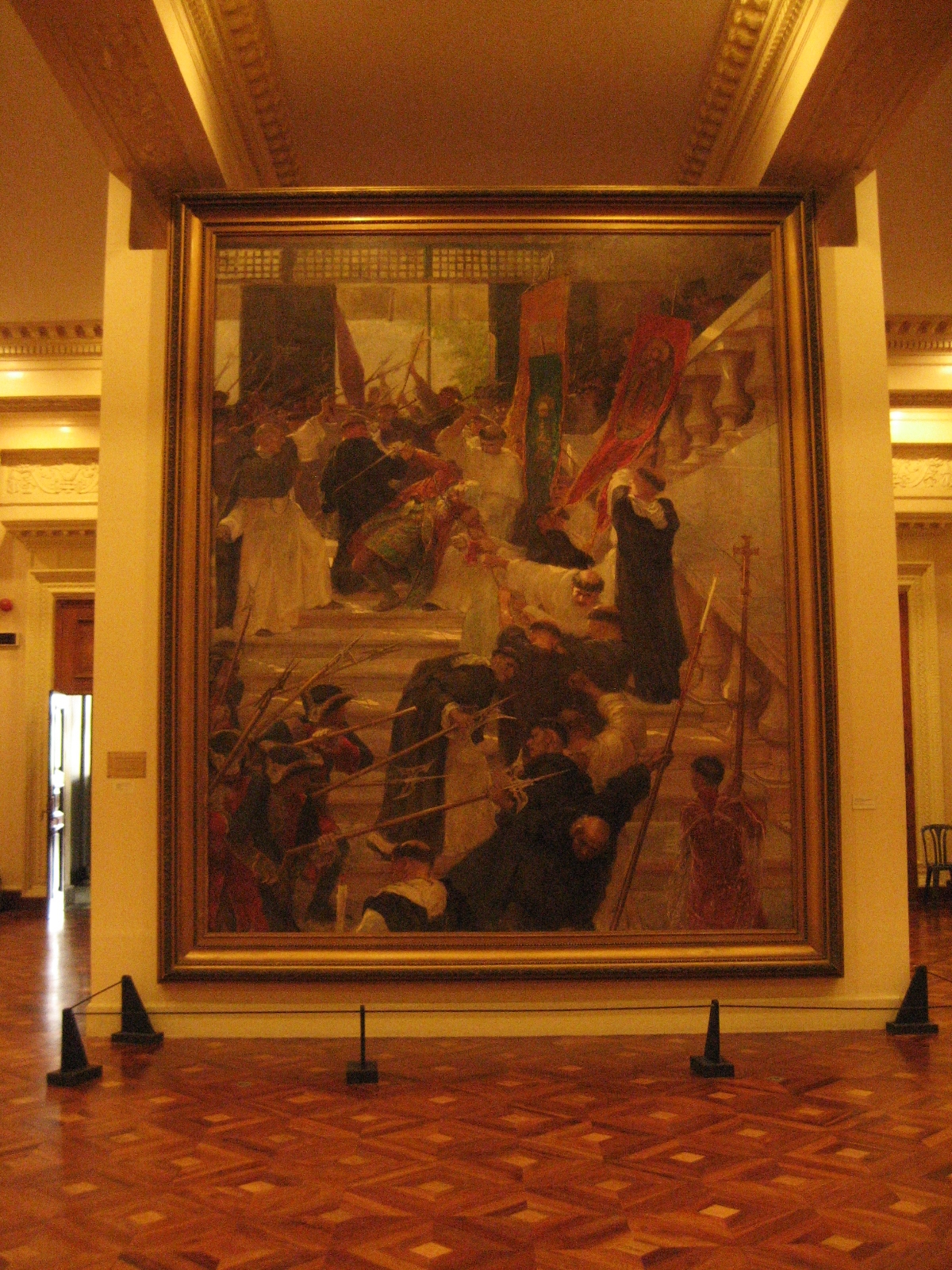
Felix Ressureccion Hidalgo’s β€œAssassination of Governor Bustamante”


You may want to start with the Hall of Masters. Be prepared to be blown away. Juan Luna’s “Spoliarium” has that effect on most people. On the other hand, Hidalgo’s “Assassination of Governor Bustamante” reveals a violent side of Spanish friars of that period. See it to know what I mean. Sly. Sly.


There are special halls showcasing the Museum collections of Juan Luna, Hidalgo, Amorsolo, Botong Francisco, Napoleon Abueva, etc. I cannot write about all of them, and would have to limit myself to a few favorites. After all, the “selection” is a very personal decision. No pretensions here. In my book, art assumes significance when these treasured pieces “talk” to me. Or “touch” me. I may misinterpret its message, or completely misunderstand it. But why and how the message was conveyed to me is entirely my own perception. Or sensation? This may sound like it takes too much away from the artist himself. But I dare say that the artists’ messages affect people in different ways. Happy, sad, empty, peaceful, anxious, relaxing, refreshing, uplifting…… we feel as we feel.


How lucky were those who posed for Amorsolo! They have been immortalized by this National Artist’s magical hands. Truly, a “Pamana” or inheritance. Amorsolo’s legacy lives through these masterpieces. Thank God for this prolific painter, our very first National Artist. From Philippine landscapes to traditional Filipino practices and everyday life , to these portraits, one is transported back in time as one takes in all those details of his artful strokes. For sure, his uncle Fabian de la Rosa, another great Filipino artist, must be so proud having mentored Amorsolo in his younger days when he and his family (Amorsolo’s mom is De La Rosa’s cousin) lived with them after Amorsolo’s father died.


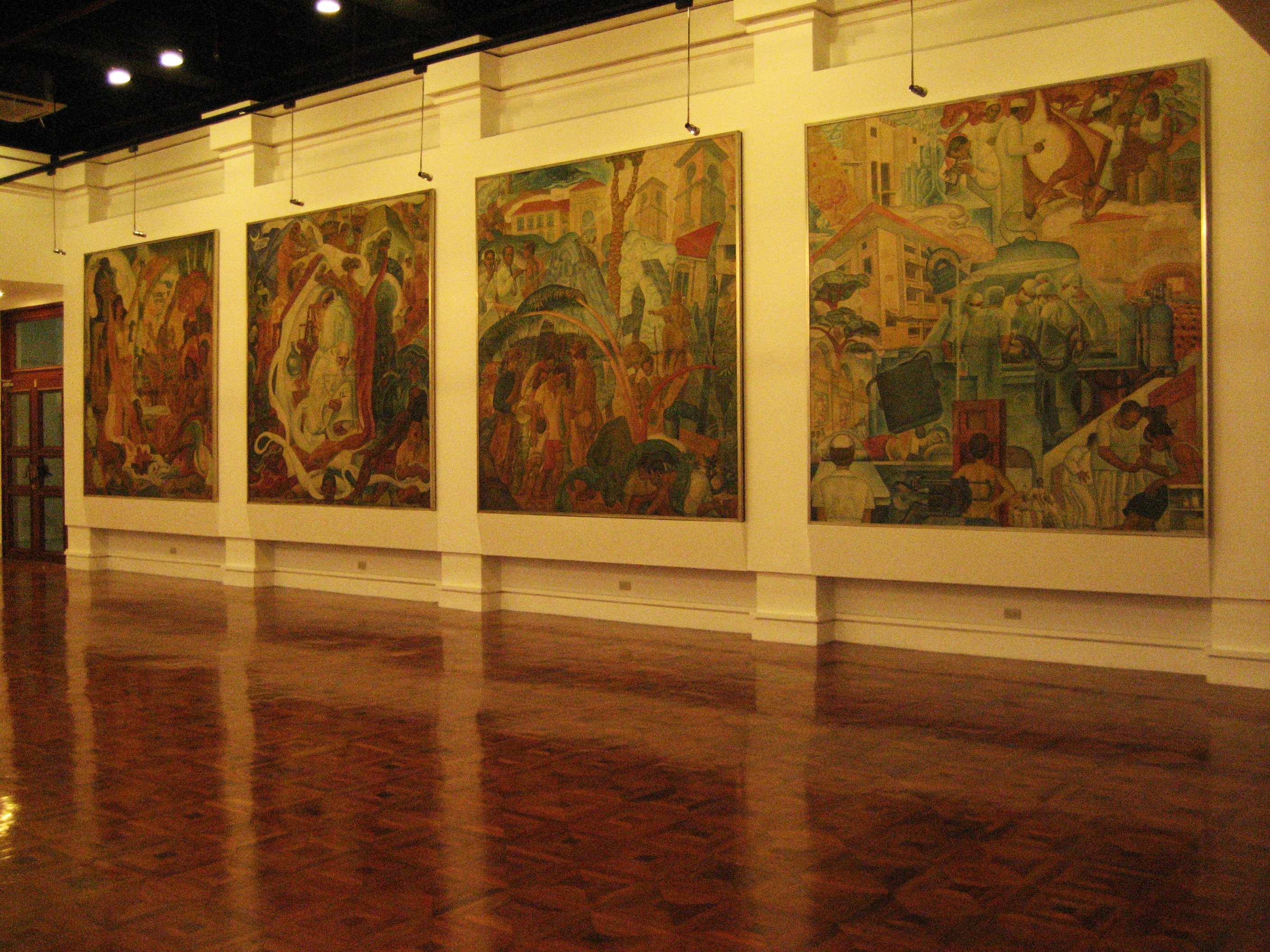
First off, I was very very happy to find the Museum Foundation Hall where one views Botong Francisco’s murals which were ‘rescued’ by the Foundation from Philippine General Hospital (PGH) where they were earlier housed. The murals represent the progress of medicine in our country, so it was fitting to have them in PGH. Over time, these art pieces hardly invited attention, much less admiration and respect, as PGH visitors had other mundane things in mind. Cleaned up, restored to its former glory, and accorded its due respect in a Hall focusing on the greatness of this National Artist is an answered prayer. Aaaaah. Those wooden benches looking like “hagabis” (were they? ) let one rest and simply take in all the beauty of the masterpieces.


Vessels of Faith. That’s what it says. Honestly? I don’t know one bit about this exhibit. So, I devoured all “lessons” to be learned right in this Hall. Remember what I told you? The good guys who made this exhibit possible would have read up on these art pieces, and like “Twitter” are constrained to write down/display all that information in as few words as possible. This is history “shortcut”, if I may call it that. And it is just what I need. Right then and there, I did my “cramming” as if I would have to pass an exam as I exit from the National Art Gallery.


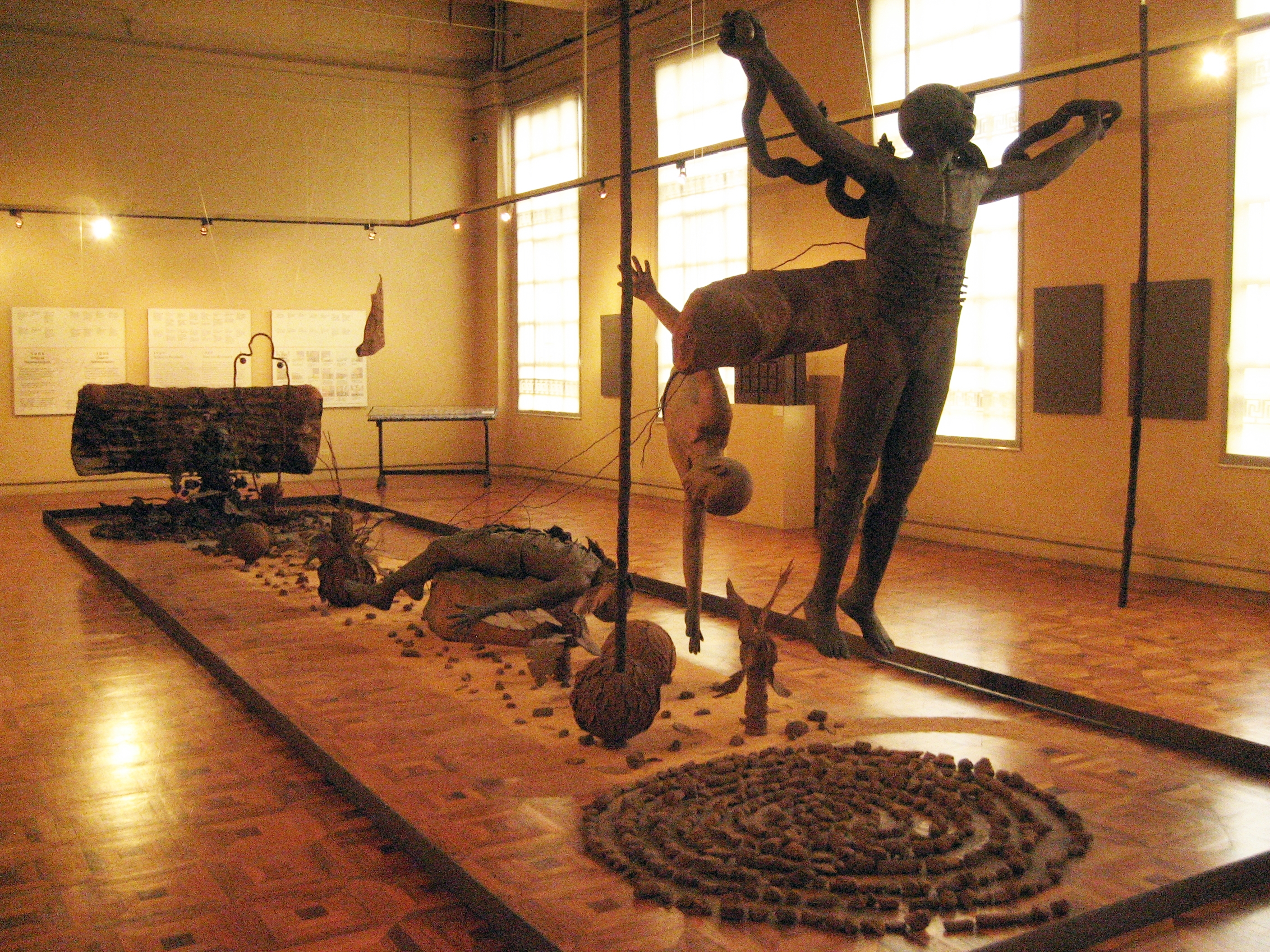
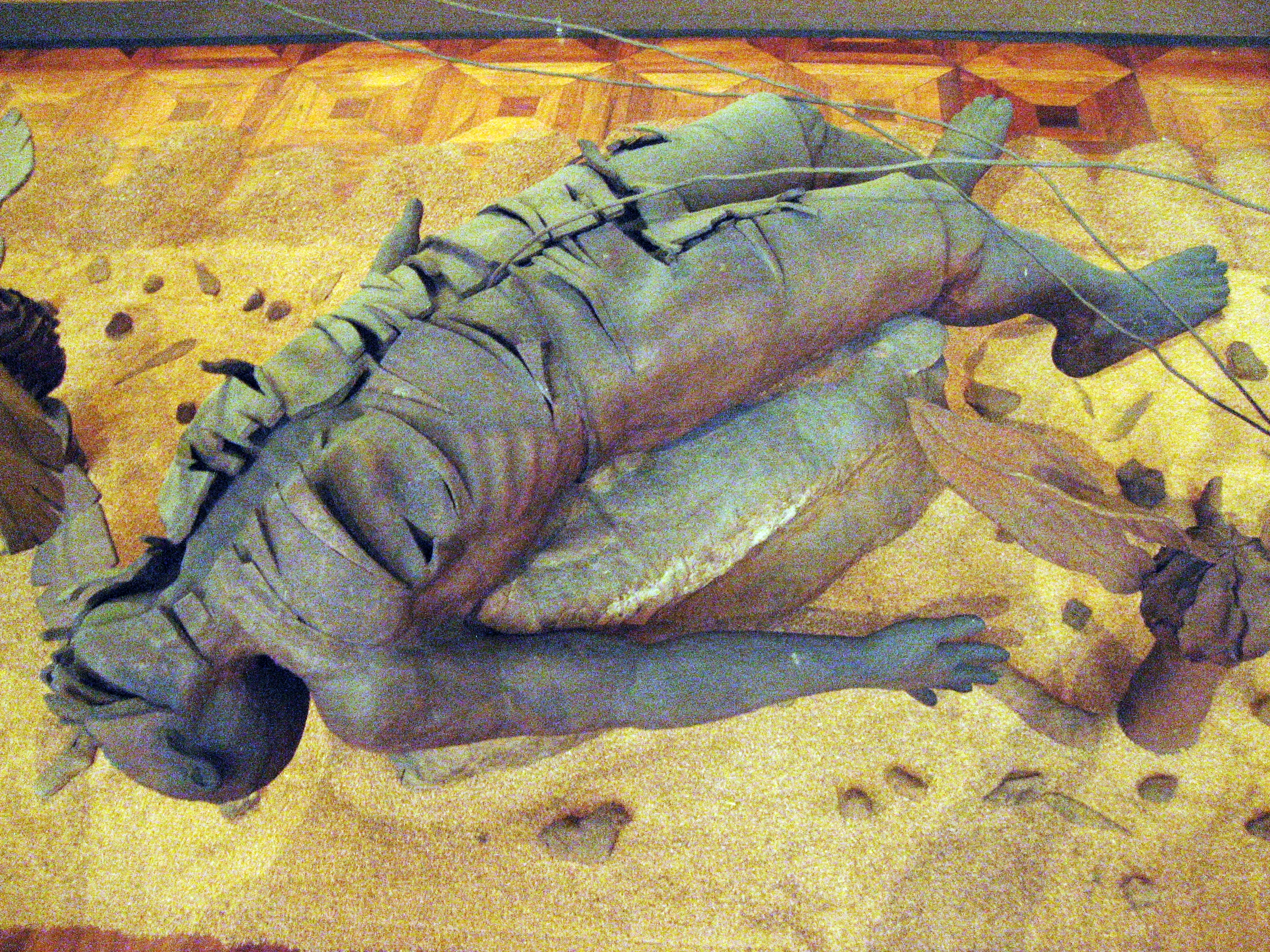
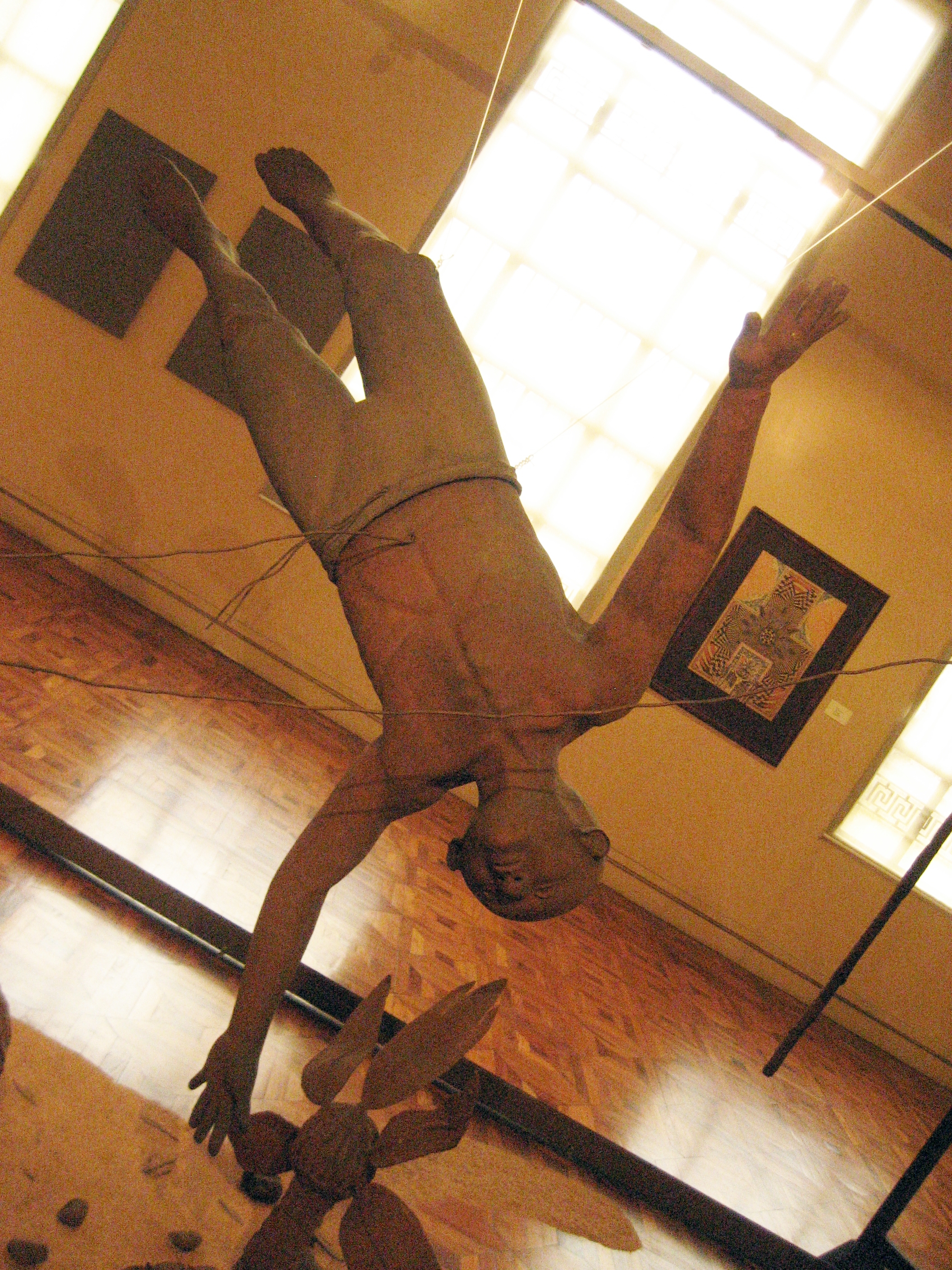
So, how much do we know of the Tau-Tao? A quick reading gives ample background on this Bagobo myth on afterlife. The myth is complete with all those colorful characters which reminded me of those Ramayana tales and Panday movies. Imagine Lumabat’s journey from earth, crossing the horizon to reach the skyworld. Meeting and vanquishing a snake with sharp teeth and a mouth that opens wide and shut to cut one person half, chasing a deer 9 times around the world, belly-opening procedures to take out one’s intestines to free Lumabat of his earthly desires (hunger)! Oh, this is part of our history — all those pre-Hispanic beliefs and myths comprising the Filipino spirituality!


I lament that I did not take my history lessons seriously. How I wish we had the equivalent of an Ambeth Ocampo (myIdol) in my student years! Now I cram. And it takes more than a few visits to really appreciate our heritage housed in the National Arts Gallery. So much. Too much. So I have decided on my “slow by slow” mode as my memory bank is not as efficient as it used to be. A few exhibits at a time. A few artists at a time. And once more, how I wish there is a Coffee Shop within the Museum! Caffeine-starved, my memory bank screams “full”. No storage space.


Talk to you later, guys!