Latest Entries »


Turumba or Tarumba? When you get to Pakil, Laguna either in search of Lanzones or woodcraft or Jose Luciano Dans’ century-old paintings, you can’t miss Pakil Church — official residence of the Virgen de Turumba. But what is Turumba? That was the first question we asked Brother Erning, the Church Marshall.


20130310-091746.jpg

Nuestra Senora de los Dolores or Virgen de Turumba

20130310-091943.jpg

Interior Shot. Altar with 14 icons behind in separate niches, veiled in purple satin this Lenten Season.


It was Lent that Friday we visited. All 14 icons in separate intricately carved niches behind the main altar, veiled in purple satin. Brother Erning drilled us on the Turumba or Tarumba Legend and toured us around the majestic San Pedro de Alcantara Church, sometimes referred to as the Church of the Nuestra Señora de Los Dolores or Virgen de Turumba. Built in 1767, the Virgen has been enshrined here since 1788 when it was fished out of Laguna de Bay. The legend goes that no one could lift the image till the parish priest came to bring it to this Church followed by locals singing and dancing in glee. The trance-like dance was called Turumba. Or Tarumba — literally meaning “natumba sa laki ng tuwa” or “tremble in great joy”. It is also the sound of drumbeats during the processions marking the feast of Turumba culminating sometime in September of each year.


20130310-093121.jpg

20130310-093341.jpg

Chapel of the Virgen de Turumba


I’ve done my research before coming here. But Brother Erning’s version is soooo much better. He regaled us with stories about the Virgin and brought us to this tiny, lovely Chapel where the image is enshrined. He reminded us to ask permission from the Virgin before taking any photos. Then he proceeded to tell us how a magical cloud floated over the 18th century church as US bombing squads hovered above during the Second World War. How many believed the Virgin saved the town with this miracle which inspired many to dress the Virgin’s image in intricately beaded gowns. The count to date per Brother Erning is 50,000 gowns donated by the faithful! (My earlier research pegged it at only 700) The Virgin changes gowns every 2 weeks, and each worn gown is cut up in small patches and distributed to the faithful. We were fortunate to go home with patches of these embroidered and beaded gowns.


20130310-094454.jpg

The Corridor Leading to the Collection of Gowns Donated By the Faithful

20130310-094623.jpg

50,000 Gowns! Only to be cut up in small patches after they’re worn.


Brother Erning is a legend himself. His love for the Virgin, this Church and his hometown is legendary. But he’s got a couple of stories which floored me. The first was how Pakil was spared from Japanese invaders who occupied neighboring towns. His story goes that the Japanese Army was not drawn to this town because of fear of being attacked by ants. Say that again? A.N.T.S. as in Lanzones ants! The other story has to do with Jose Luciano Dans’ 200 year-old painting of “Langit, Purgatoryo (or Lupa?) at Impyerno“. Heaven, Purgatory and Hell. When I asked Brother Erning why the painting depicted ONLY WOMEN in hell, his candid answer was to point out that the figures included both men and women except ……. that Dans didn’t want to be irreverent by painting men with their “hanging ornaments”. How’s that? Plausible, yes, but nevertheless a rib tickler. 🙂


20130310-095907.jpg

Inspired by Dante’s Inferno? This is Luciano Dans’ Langit, Lupa (or Purgatoryo) at Impyerno. Read below for a most interesting story. 🙂

20130310-101729.jpg

Brother Erning, the Church Marshall.


Before we left, Brother Erning brought us up the choir loft and bell tower. This time, he got us listening to some recent happenings in this church. The hit and ongoing TV series or teleserye “Juan Dela Cruz” shoots all its church and plaza scenes here. In fact, Brother Erning stars in some episodes! He reminded us to watch the next few episodes where he’s featured before we climbed down and marched out of the Church. In particular, he mentioned the scene where Juan dela Cruz battles the vampires! Really, we just love these stories and we love Brother Erning even more!


20130310-101858.jpg

Check out that Pieta painting. Looks so much like the famous and treasured Michelangelo’s sculpture, right?

20130310-101948.jpg

One last look at Pakil Church. Location shoot for the hit teleserye “Juan de la Cruz”.

20130310-102027.jpg

The rural town of Pakil, Laguna. 4th stop after Calamba, Pila and Paete in a roadtrip around Laguna de Bay. Try it! Very doable for a day trip south of Manila.


We should have started earlier. But NOT on empty stomachs. We had our fill by the time we left our meeting place in Don Bosco Pugad’s Coffee and Saints. It was also mid morning by the time we hit the road to visit the lake towns of Laguna around the Bay. You may consider it a Visita Iglesia, if you like. Three churches and a few other sites. Started with Pila, Laguna. Now off to Paete, the woodcarving capital of the country. (Chisel is “Paet” or “Ukit” in Tagalog) Lanzones Country. And birthplace of the yoyo.


20130308-101750.jpg

Taka or Papier Mache. Just like in Angono, Rizal.


The art of TAKA (paper mâché) seems big in this town. Much like what I saw in Angono, Rizal — another town rich in art, history and culture. It also happens to be the political campaign season so there were TAKAs around and along the main road leading to the beautiful church. Men and women figures sculpted out of paper peeking out from windows and balconies. By themselves, they looked interesting. But what really got our interest was the Paete Church with its lovely baroque architecture with floral bas reliefs.


20130308-101905.jpg

Saint James Church in Paete, Laguna


The Paeteños have preserved their centuries-old tradition of woodcarving. Inside the Church honoring Saint James, you’d find religious icons and centuries-old paintings by Paeteño artists including those by Jose Luciano Dans. It is said that this art flourished long ago that one shouldn’t be surprised to find locally-crafted masterpieces in churches, palaces and museums in other parts of the world. Besides, the same craftsmanship is displayed on buffet tables on many cruise ships as descendants of these Paeteño woodcarvers found another niche in ice sculpting! Can you beat that? Wood or Ice, there is no shortage of carving skills from this community.


20130308-104017.jpg

20130308-104145.jpg


There is no record of it but Paeteños believe that the yo-yo which is a Philippine invention actually began in Paete. I wouldn’t be surprised. The art galleries cum dining places we wanted to visit along Quesada Street were both closed, but we’ve seen enough woodcarved religious and not-so-religious icons to conclude that the art continues to flourish here.


20130308-105024.jpg

20130308-105245.jpg


And then there are the 200 year old paintings of Jose Luciano Dans. This Paeteño was commissioned by the Spanish friars to paint St. Christopher. Dans’ rendition of a St. Christopher with Oriental features didn’t meet with the friars’ approval and so the mural was replaced by another painting of the same saint with European features. The 2nd painting was on wood and installed over the mural. The discovery of the original mural was fairly recent when restoration work had to be done on the “European” saint. As it turned out, the mural was better-preserved.


20130308-213202.jpg

The original Dans painting of Saint Christopher with Oriental features.

20130308-213746.jpg

The 2nd Dans painting of Saint Christopher with European features.
Sourced from the Net.


We actually failed to see the 2nd painting since it was taken down for restoration works. We also failed to buy any Lanzones. Worse, the 2 art galleries cum dining areas along Quesada Street where we intended to have lunch were both closed. Hungry past noon, we ended up in Bengas, a local eatery serving home-cooked food. No pretensions, no frills. Just simple meals like lumpia and Pancit ulam. The latter is a very Pinoy thing. Like noodles are everywhere in Asia, but methinks only Filipinos eat noodles with rice. So it’s not surprising why Paeteños came up with Pancit Ulam.


20130308-214632.jpg

20130308-214739.jpg

Cape Quesada

20130308-214917.jpg

Pancit Ulam from Bengas. Yes, you eat the pancit with rice.


While in Paete, we hardly met any other tourists. Foreign or Local…… Zilch! A pity. No wonder the local carvers are seeking better pastures carving ice instead. Mind you, ice carving is actually more demanding. Unfortunately, each creation melts into insignificance unlike woodcarvings. Sigh. 😦


It’s another heritage town just a couple of hour’s drive south from Manila. Easily, a day trip that’s easily combined with neighboring towns in Laguna just as equally rich in art, culture and history. Many pre-Hispanic treasures enshrined in the Pila Museum attest to Pila being one of the earlier settlements in the country.

20130308-001156.jpg

Municipio

20130308-001311.jpg

17th century Pila Church


We were surprised to find this little-known Plaza Mayor in this old town. The colonial influence is evident here where a 200 year-old church, a Municipio (Town Hall), and several ancestral, heirloom houses and old trees line the Plaza. The National Historical Commission has declared Pila as a historical landmark in the league of Vigan (Ilocos Sur), Silay (Negros Occidental) and Taal (Batangas). It’s a wonder very little is known of the place and that this historic town is not top of mind among local tourists.


Mercifully, Pila was spared from the bombing raids run by US troops back in 1945 to flush out the Japanese Army. The Church, the Convent, and many of the old buildings and houses of illustrados and prominent families clustered around the Plaza remain standing to this day.


20130308-010102.jpg

20130308-010157.jpg


Who Knows Tomas Pinpin?


If you ask me, I only know it as a street in Binondo where a favorite and oldest restaurant is located. Yes, I’m talking of Toho Antigua Panciteria. (Another restaurant, Ambos Mundos, claims to be the oldest restaurant, but this is another story) I bet I’m not the only one in this sorry predicament.


So, who is Tomas Pinpin? This eminent Filipino is responsible for the country’s very first Tagalog dictionary. He ran a printing press in Pila, Laguna which printed the first local dictionary as early as 1613. Of interest is the fact that this printed material pre-dates the very first printed book in America. Truly, Pila has so much to be proud of!


20130308-011345.jpg

20130308-011532.jpg


From History Lessons To Amazing Race To Teleserye


Several scenes from the Amazing Race were shot here. Of late, the teleserye “Be Careful With My Heart” likewise shoots scenes here for this big TV series hit. In particular, the “San Nicolas” hometown of the leading character “Maya” is actually this quaint town of Pila, Laguna. Just off a corner from the Plaza is “Pards Chibugan” — the local eatery business ran by Maya’s family. For sure, these put Pila back on the map as many locals visit the place for its TV or teleserye value. 


Quite a sudden takeoff from all that history bit. 😉


20130308-011738.jpg

20130308-011853.jpg


About time we consider this listing. Makes life so much simpler.

Visa-Free Countries for Philippine Passport Holders:

ASIA
Brunei – Not Required for stay up to 14 days
Cambodia – Not Required for stay up to 21 days
Hong Kong – Not Required for stay up to 14 days
Indonesia – Not Required for stay up to 30 days
Israel – Not Required for stay up to 90 days
Laos – Visa can be obtained upon arrival up to 30 days
Macau – Not Required for stay up to 30 days
Malaysia – Not Required for stay up to 30 days
Maldives – Visa can be obtained upon arrival up to 30 days
Myanmar – Visa can be obtained upon arrival with pre-approval letter required
Nepal – Visa can be obtained upon arrival up to 150 days
Palestine – Not Required for undefined number of days
Singapore – Not Required for stay up to 30 days
Sri Lanka – Visa can be obtained upon arrival up to 30 days
Thailand – Not Required for stay up to 30 days
Timor Leste – Visa can be obtained upon arrival up-to 30 days
Vietnam – Not Required for stay up to 21 days

SOUTH AMERICA
Brazil – Not Required for stay up to 90 days
Bolivia – Not Required for stay up to 59 days
Colombia – Not Required for stay up to 180 days
Costa Rica – Not Required for stay up to 30 days
Ecuador – Not Required for stay up to 90 days
Grenada – Visa can be obtained upon arrival
Haiti – Not Required for stay up to 90 days
Montserrat – Not Required for stay up to 90 days
Peru – Not Required for stay up to 90 days
Saint Vincent and the Grenadines – Not Required for stay up to 30 days
Suriname – Not Required for stay up to 90 days

AFRICA
Cape Verde – Visa can be issued upon arrival
Central African Republic – Not Required for stay up to 7 days
Comoros – Visa can be obtained upon arrival
Djibouti – Visa can be obtained upon arrival up to 1 month
Eritrea – Not Required for stay up to 30 days
Ethiopia – Visa can be issued upon arrival
Madagascar – Visa can be obtained upon arrival up to 90 days
Mauritius – Not Required for stay up to 60 days
Morocco – Not Required for stay up to 90 days
Seychelles – Not Required for stay up to 30 days
Somalia – Not Required for stay up to 21 days
Togo – Visa can be obtained upon arrival up to 10 days at Lome airport
Zambia – Visa can be obtained upon arrival

PACIFIC ISLANDS
Cook Islands – Not Required for stay up to 31 days
Fiji – Not Required for stay up to 120 days
Micronesia – Not Required for stay up to 30 days
Nauru – Visa can be obtained upon arrival
Nieu – Not Required for stay up to 30 days
Palau – Visa can be obtained upon arrival up to 30 days
Pitcairn Islands – Not Required for stay up to 14 days
Samoa – Not Required for stay up to 60 days
Tuvalu – Visa can be obtained upon arrival up to 30 days
Vanuatu – Visa can be obtained upon arrival up to 30 days

EUROPE
Andorra – Not Required but only accessible via Spain or France that require visa.
Azerbaijan – Visa can be obtained upon arrival up to 30 days
Kosovo – Not Required for stay up to 90 days
Liechtenstein – Not Required for stay up to 90 days
San Marino – Not Required for stay up to 21 days

This data is updated as of February 2012. Visa requirements may change in the future so it is advisable to double check also before making your travel arrangements. You would also need to check whether a transit visa will be needed if you will travel through countries that require visas for Philippine passport holders. For those territories where you can get your visa upon arrival, make sure to check the required documents prior to arranging the trip.

HAPPY TRAVELS EVERYONE!!! 🙂


CPR. Naaah, not the medical/first-aid procedure. Long before initials became the norm in addressing bosses, the entire Philippine nation had CPR. CARLOS Peña ROMULO. My generation still remember those history quizzes back in Grade School where United Nations, Gen. MacArthur’s landing at Leyte and liberation were associated with CPR. As when I remember my father’s generation refer to him as Mr. United Nations. Always, with Filipino pride.


20130223-111429.jpg

Sourced from the Net. This photo inspired the bronze statues representing the Leyte Landing of General Douglas MacArthur, then President Sergio Osmena, then Brig. Gen. Carlos P. Romulo , etc.

20130223-111503.jpg

From the staircase to the private function room (good for 80 pax) on the second floor, this portrait of CPR would greet the visitor.


Mr. United Nations, impressive orator, diplomat, soldier, Filipino patriot, journalist and author. An achiever at a very young age, he was no ordinary teenager. Wet behind the ears, he was already a reporter at age 16, a newspaper editor by age 20, and a publisher by age 32. He is also the co-founder of the Boy Scouts of the Philippines. During the Japanese Occupation, he made sure the Philippines was not forgotten, chronicling the plight of Filipino fighters, his voice heard by as many Americans while he agonized just thinking of his family back in the Philippines. But more than all these, his legacy extends to this Filipino restaurant — Romulo’s Cafe.


20130223-113211.jpg

Bangus Pate. Bangus is milkfish, flaked and made into a pate that are served as appetizers with Crostinis.

20130223-113245.jpg

This Tuna Sisig is ideal for vegetarians and vegans.


You can start and end with the appetizers and NOT feel cheated. The Bangus Paté and Tuna Sisig are must-try appetizers. No pork in your Sisig? No liver pâté? I’m telling you. You won’t miss your pork and duck liver. Filipino ingenuity at work here.


20130223-113913.jpg

Crispy Squid. Oh this is a favorite!

20130223-113949.jpg

Fish Rolls


And there’s the crunchy squid and fish rolls. I can down these appetizers with a cup of steamed rice and wear a smile all night. All 4 appetizers so savory, and healthy. No guilt pangs. YET. 😉


20130223-114303.jpg

Fried Tilapia

20130223-114339.jpg

Pinakbet with Bagnet. A Northern Philippines (Ilocano) dish.


We TRIED staying healthy, but not for long. The deep-fried, splayed Tilapia served with 3 sauce dips is both a gustatory and aesthetic delight. The BAGNET in the Pinakbet stole the scene from the shrimps adorning the veggie dish. Too tempting. It broke all resolve to have a Meatless Friday — of course, others were dead set early on to break the rule 😉 — and so came the Crispy Pata and the Lengua .


20130223-114843.jpg

Can’t stay away from meat? Try the Crispy Pata.

20130223-115147.jpg

Lengua. (Ox Tongue)


Good company, good food, good service and a place so charming. The high ceiling, black-and-white motif, and tastefully-designed interiors all combine perfectly to highlight the framed photos hanging on the walls. Each one a lesson in history. CPR giving a speech — this little man standing tall amidst prominent Americans and other foreigners in the audience. CPR in a family photo, in earlier times and late in his years. CPR doting on his grandchildren. What a legacy!


20130223-115923.jpg

Suman Con Latik. A very Filipino snack food with a twist!

20130223-115948.jpg

Framed photos such as these are each a lesson in history. CPR is very much a part of the Philippines’ wartime and post war history.

20130223-120258.jpg

A doting grandpa, more than anything else.


Back at the National Museum to attend the Museum Foundation’s Lecture Series on Batanes. No less than Architect Toti Villalon gave the lecture with a few prominent residents of Batanes in the audience. But we were more than an hour early for the lecture. So we found ourselves meandering from hall to hall, trying to avoid the student crowds who filled the Hall of the Masters.


20130217-081412.jpg

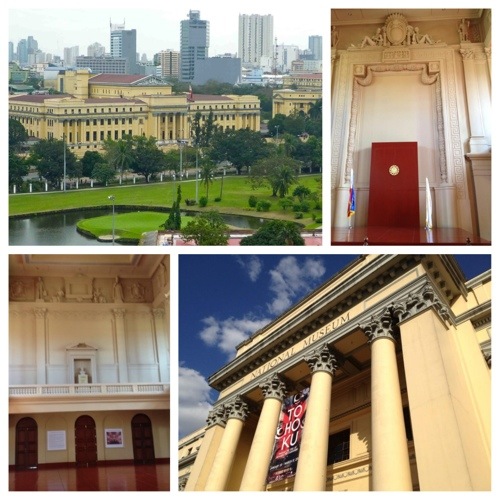
The National Art Gallery/ National Museum with the Clock Tower of the Manila City Hall in the background.


We were drawn to the Amorsolo portraits — thinking how lucky those high society people were to pose for this National Artist. But one particular portrait got our full attention. Having just visited the newly-restored Old Senate Hall within the National Art Gallery (the same building used to house the Legislature), we were pleasantly surprised to find a hunk of a statesman in the twice-elected Speaker of the House.


20130217-082146.jpg

Guess who? No less than the Speaker of the House (twice elected) Jose B. Laurel Jr.


With those looks, it’s tempting to think the Legislature consisted mainly of women. But this Presidential son (he is the eldest of 9 children of ex-President Jose P. Laurel) and Vice-Presidential brother (Doy Laurel, the man who withdrew his presidential ambitions in favor of Cory Aquino to run and win as Vice President) earned every laurel (pun intended) on his head. He made a bid for the Vice Presidency himself, but lost to Diosdado Macapagal, who went on to become President and whose daughter likewise became President. These days, they call it political dynasty. But the Laurels have all proven their worth, and for a “political clan”, remains low-profile and unassuming. Surely, their patriarch, President Jose P. Laurel, knew how to raise a BIG family.


20130217-084045.jpg

Died not too long ago. Lived a quiet life though his family remained in the political limelight.

Originally intended as a public library but subsequently built to house the Legislature, this magnificent building designed by Juan Arellano was a casualty during the Battle of Manila in 1945. It was reconstructed in 1946 based on the original plans and remained the august halls of the Senate of the Philippines until it moved out in 1996. It took nearly a decade to transform this architectural treasure into what it is now: the official repository of national arts, treasures, archaeological finds and historical relics. The National Art Gallery of our very own National Museum.


20130218-102942.jpg

The Old Senate of the Philippines. Fully restored!

20130218-103039.jpg

Check out this hall where many statesmen of old (a rarity now) used to walk!


Whenever I visit the Museum, I always start with the Hall of Masters. It’s like paying your respects to geniuses the likes of Juan Luna and Felix Resurreccion Hidalgo. If that P150 (US$4) admission fee entitles one to a viewing of Luna’s Spoliarium and Hidalgo’s Assassination of Governor Bustamante ALONE, it would have been worth it. But there’s more. LOTS MORE. One visit won’t be enough.


20130218-103304.jpg

The ornate ceiling in the Old Senate Hall within the National Art Gallery.

20130218-103332.jpg

The Marker of the Old Senate Hall of the Philippines.


The Old Senate Hall has been completely restored. Here, where many revered statesmen walked the very floors and whose walls echoed many speeches from statesmen whose names now grace many street signs, shrines and monuments. Thank you, National Museum for allowing us to reconnect with our past. Thank you, Jeremy Barns, Museum Director, and everyone else who made this possible.


20130218-103537.jpg

How many National Anthems were played in this Hall?

20130218-103558.jpg

The Entrance to the National Art Gallery.

20130218-103623.jpg

Lovely Building. Next up: Museum of Natural History. In the same area!


WHO IS JONES? Why was this oldest bridge in the Philippines named Jones Bridge?


20130218-102048.jpg

Puente de Espana, then Jones Bridge, to honor the man behind the Jones Act granting independence to the Philippine Islands.


WILLIAM ATKINSON JONES. Member of US House of Representatives from 1891 to 1918. Right about the same period when the US bought the Philippines from Spain for $20 million. Imagine that. US$20Million for 7,107 islands.


20130218-102222.jpg

The Post Office Building and the Jones Bridge. Two landmarks rich in history.


Back to the question — why was the bridge named after Rep. William Atkinson Jones? Used to be called Puente de España since it was built in 1701 spanning over Pasig River and connecting Binondo to the core of the capital city of Manila. Originally done by Juan Arellano in the Neo-Classical design but destroyed and renamed Jones Bridge by the US Colonial Government in 1916 to honor the man who sponsored the bill, later enacted into law, granting independence to the Philippines. Bombed out in World War II, this formerly ornate arch bridge was yet again rebuilt but in simpler design after 1945. The oldest bridge in the country.


20130218-102557.jpg

Not my copy. Credits to Old Manila Nostalgia.


When Jones died in 1918, the Philippines paid for the marker on his grave in gratitude for the Jones Act which granted Philippine Independence. So much history behind this bridge across Pasig River with a bonus grand view of yet another landmark, the Postal Office of Manila. Next time you head for Binondo or Chinatown and cross this bridge from Plaza Lawton, think Philippine Independence. 😉


Many would remember it as that restaurant where Pinoy, Chinoy, and Tisoy cuisines merged, and which became a landmark off Echague Street. While it has since moved to 750 Florentino Torres near C.M.Recto and Soler Streets, the aura remains the same. It helps that the furniture exudes the same illustrado character, where an Amorsolo-ish painting hangs on one side of the wall  and where menu offerings are written in chalk on boards hanging on another side.


20130213-223320.jpg

And there’s that lone boar tied to the door…………. Could that be “Liempo” or “Pork Chop”?

20130213-223403.jpg

Ambos Mundos. Claims to be the oldest resto in the Philippines. 1888


The “best of both worlds”. East and West? Ambos Mundos. I can imagine men in tailored suits (yes, they really dressed up back when Recto Avenue was still called Azcarraga) dining here. Perhaps feasting on either Paella Ambos or Morisqueta Tostada. Or would it be Lengua or Buntot Estofada? Many Filipinos think of Callos and Morcon as “fiesta fare” — special dishes served whenever there is reason or an occasion to celebrate. In the same breadth, Filipinos likewise drool over their favorite local food, and by that, I mean favorite local Filipino and Chinese food. Crispy Pata, Bulalo, Lumpia Ubod, Pancit Bijon, Asado, etcetera!


20130213-224331.jpg

That menu is a real fusion of Chinoy, Pinoy and Tisoy Cuisines.

20130213-224400.jpg

Chinoy or Pinoy or Tisoy Cuisine in Ambos Mundos. 1888


Is it really the oldest restaurant in the country?  Both Ambos Mundos and Panciteria Toho Antigua claim to be the oldest, having operated since 1888. Who’s to tell? Both were my childhood favorites, by the way. But where Toho appears like many other old Chinese restaurants, Ambos Mundos has an altogether different charm. Very old world. Complete with pot-bellied black pigs tied to its front doors! (A recent addition, I suspect) Some keep pet dogs. Or pet kittens. But pet boars? We’re told they’re there for good luck. There must be a grain of truth in that. After all, they’ve been around since 1888!


20130213-224647.jpg

My 2 amigas eagerly wait for our order of Morisqueta Tostada, Lengua Estofado and Patatas con Giniling.


See you again, “Liempo” and “Pork Chop”! We weren’t very happy with the Morisqueta Tostada, Lengua Estofado and Patatas con Giniling that we ordered — not as good as I remember 😉 — but we’re willing to try the other dishes next time we visit. 😉 OINK OINK


20130213-224743.jpg

Another set of pet boars just across the street in Wah Sun, same owners. A Gaudinez married into the Leung Family who owns this Chinese resto since 1955.

20130213-225105.jpg

They say you can order from either/both menus of Ambos Mundos and Wah Sun across the street. Same owners.


Addendum: This is even more interesting. Thanks to Teresa Gaudinez-Martinez, I now have a chance to straighten out some “kinks” and misinformation in this blog. Foremost is that THIS IS NOT THE AUTHENTIC AMBOS MUNDOS RESTAURANT. “Both Worlds” (Ambos Mundos) refer to Spanish and Filipino cuisines. NEVER INCLUDED CHINESE CUISINE. Huh? And there was NEVER A PET BOAR outside the restaurant. Huh again! Teresa, I have read all your blogs and sympathize with your legal woes. Obviously, there’s a long story fraught with family, legal, proprietary rights issues here. Thank you for taking the time to make the corrections. To our readers, here’s the link to Teresa’s Ambos Mundos blogs.


Food is an integral part of my travels and yes, you may say food defines many of my adventures. The passion to search for certain kinds of food is serious business. Going to great lengths for a food particular to the area builds the excitement as much as checking out the local attractions. So, here’s a compilation. It is a living, breathing list as I intend to add more as I get busy celebrating life. A few inches more on the waist, on the hips won’t hurt 🙂

20130208-090839.jpg

EATING AROUND THE PHILIPPINES

It all starts at home. While the Philippines has national dishes like adobo, sinigang, Kare Kare and lechon, there are regional cuisines that are must-try eats. Check these out.

Philippine Cuisine

Regional Cuisine: Northern Philippines

What and Where to Eat in Laoag and Vigan

As Spicy As It Gets in Bicol

What To Eat In Batanes

Eating Frogs and Crickets From the Philippines’ Culinary Capital

DINING101 in AFRICA

Boma Dinner and the Exotic Meats of Africa

South African Cuisine

BUEN PROVECHO EN ESPAÑA!

Eating Around Spain

Best Churros Con Chocolate

FOOD PORN IN BANGKOK

EATING AROUND BHUTAN

PHÔ & MORE IN HO CHI MINH

BEYOND NASI GORENG IN INDONESIA

FOOD COMA IN KOREA

SUBJECT TO ADDITIONS, NO DELETIONS.