Latest Entries »


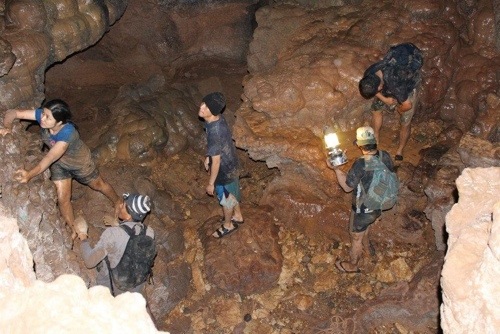
Here’s one for the books. No, I wouldn’t call it spelunking. Not even caving per se. In my book, it’s pure and simple curiosity and blind courage that found me at the mouth of SUMAGUING Cave in Sagada one late afternoon and mindlessly saying “yes” to this adventure. After all, so many of my young blogger-friends have blogged about it. So, I was naturally curious. AND ….. adequately challenged. ๐Ÿ˜Š


20121205-133535.jpg

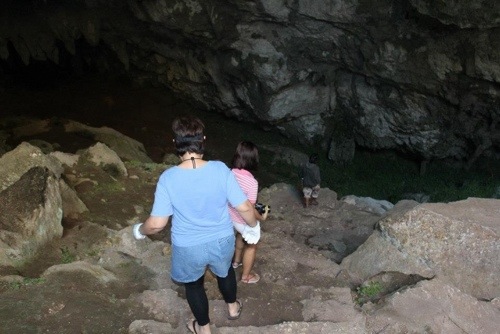
The Descent.

20121205-133717.jpg

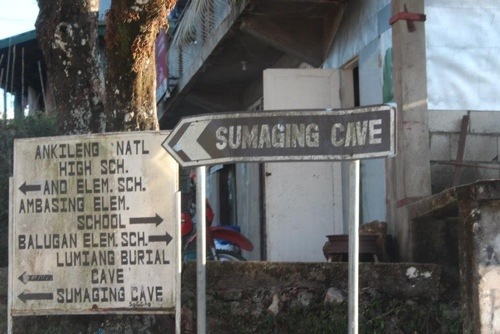
Directional Sign to Sumaguing Cave


I’ve been to many caves and had my fill of stalagmites and stalactites. You can say I didn’t have much by way of expectations. My only concern is to get out of it before nightfall as it was already 4pm when we began our descent. James, our guide, looked nonchalant seeing there’s a not-so-young adventurer in his group of 5 pax. I looked around and concluded I must be among the oldest, if not THE oldest, with the curious lot of caving enthusiasts that late afternoon.


20121205-134443.jpg

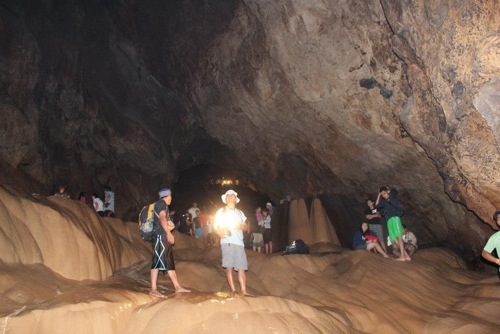
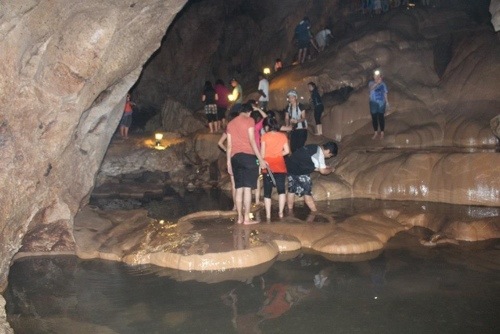
Interior Shot. Traffic Inside the Sumaguing Cave! Sagada.

20121205-134557.jpg

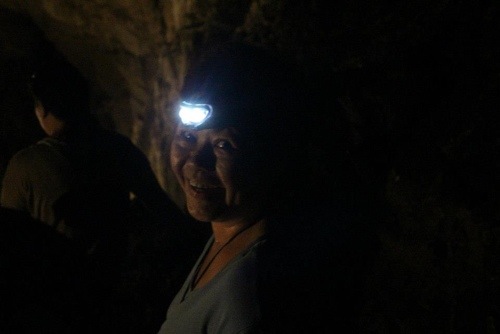
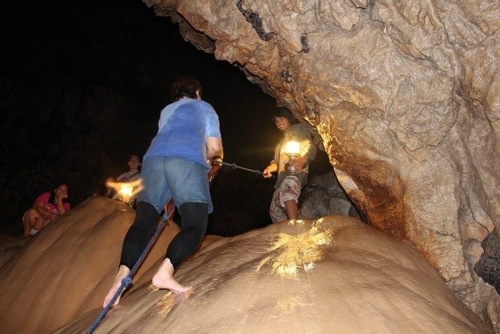
That headlamp was a brilliant (pun intended) idea!


The cave was packed with youngsters who shared the same not-so-brilliant idea with us to spend the long weekend in Sagada. The crowd meant long waits as the group of descending first-timers wait for a line making way to climb up and out of the cave. The extended waits made me rethink my intentions. And as I pondered, I knew this was more a challenge rather than a sightseeing adventure. One look at our guide James competently balancing a lamp between his thigh and left hand while offering his right hand to me, and I knew I just had to get this over and done with.


20121205-135450.jpg

More Traffic Down Below, Inside the Sumaguing Cave.

20121205-135552.jpg

Getting All Muddied Up Inside Sagada’s Sumaguing Cave


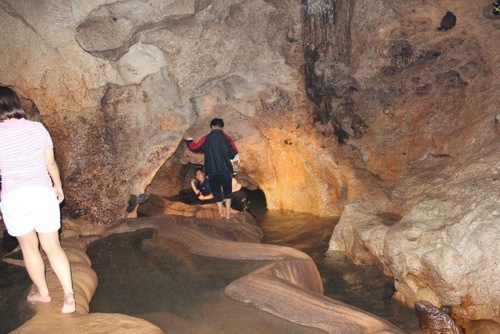
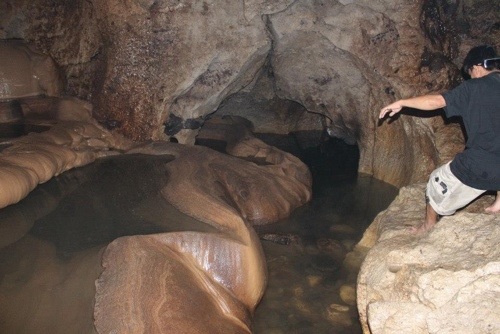
I was ready. With a headlight and gloves, I made my way down. The initial descent was over slippery rocks. I felt more confident when we did away with footwear, gripped our soles over rocks around pools of water, and slowly, carefully dipped our toes, then our entire legs in cold waters. All the while, I refrained from asking James how much further we should go let I lose heart. I knew the options were quite limited. James had to go with the group and should I choose not to continue, it’s either I go with another group climbing out or I wait for our team. Besides, I was actually growing confident myself, even excited!


20121205-140648.jpg

No Way To Go But Barefoot Inside Sumaguing Cave

20121205-140724.jpg

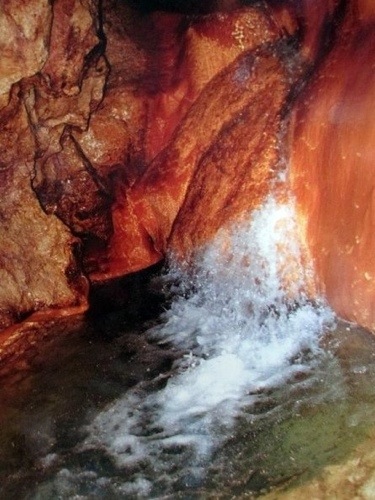
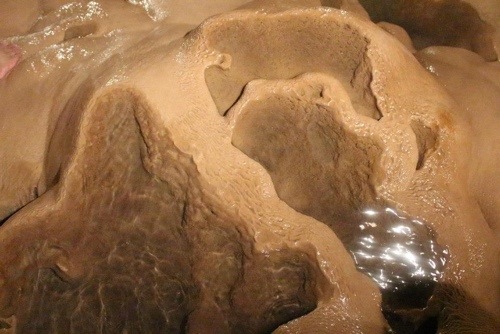
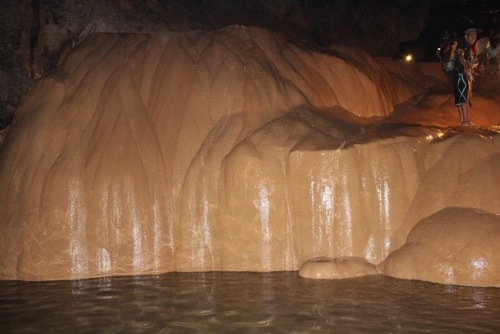
A Natural Beauty @ Sumaguing Cave


This rock cavern gave me a most memorable souvenir when I stubbed my big toe as I nearly slipped climbing up. It was nearly 7pm by the time we got out of the cave. But that was not really the exciting part. Nor was climbing up a rope. From the cave bottom, our guide James positioned himself in a way where he can actually pull us up with one hand through huge rocks a la Jackie Chan. I grabbed his hand, made big strides up and over the rocks but couldn’t pull myself over! Knowing James couldn’t hold my full weight, I didn’t waste more seconds. One hand held by James, I straddled my left leg over the rock and……… ROLLED! Oh yes, even James wasn’t sure what I was doing! But….. I made it.


20121205-142024.jpg

Yee Haw! I made it!

20121205-142127.jpg

Now, Where’s the rest of my group? (Lost Inside Sumaguing Cave)


ROCK AND ROLL, indeed! Surely, that made my day. Aching calf, thigh muscles and sore shoulders, the pain remained long after my uber-dirty, muddied clothes were washed and dried. Oh my, what was I thinking then???


20121205-143118.jpg

Close Up Shot. Inside Sumaguing Cave.

20121205-143152.jpg

Cold waters inside the Sumaging Cave

20121205-201953.jpg

Cold. Slippery. At times, Slimy.


When one speaks of La Loma, 2 things easily come to mind. LECHON. And the old cemetery.


I joined a guided tour organized by the Museum Foundation of the Philippines with no less than Architect Manuel Noche guiding us through the flamboyant architecture and interesting history of this urban cemetery.


20121129-092629.jpg

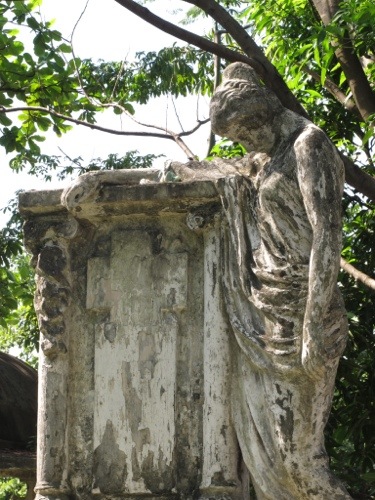
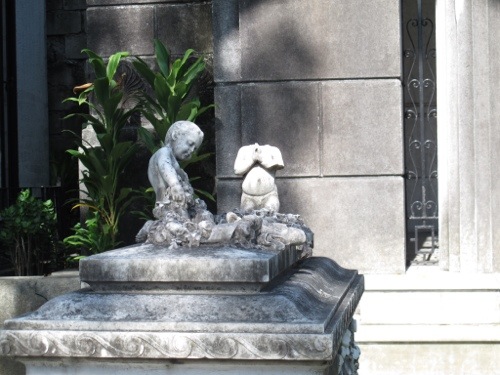
Little Monuments in the Old La Loma Cemetery


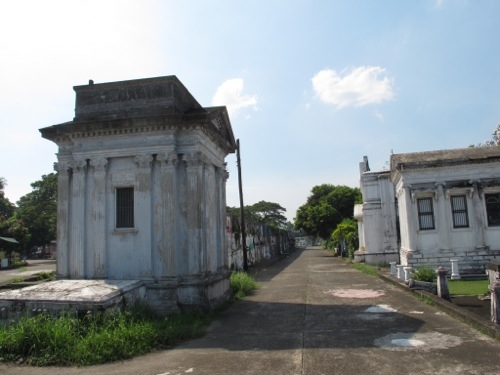
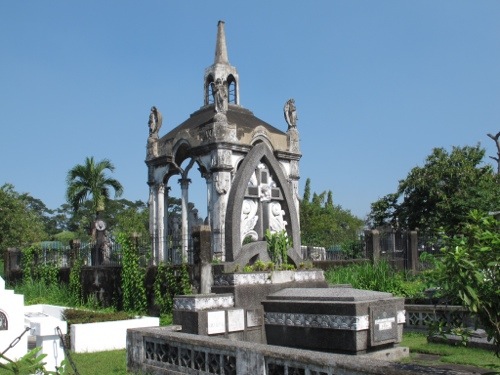
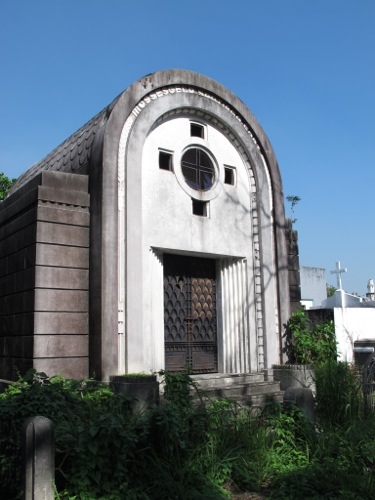
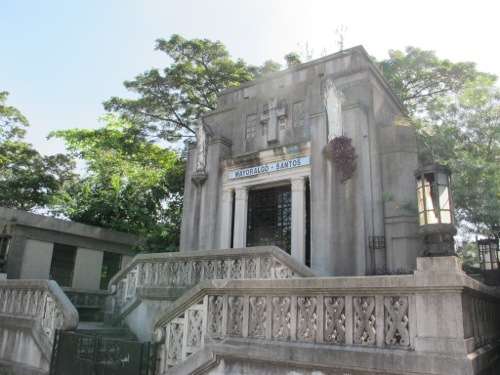
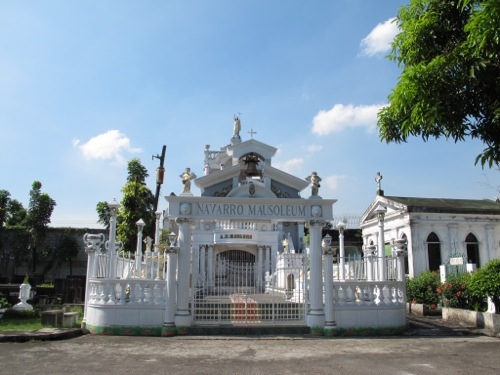
The great divide between rich and poor is very evident here. In death, as in life, the rich enjoy the prominence, the grandeur, the prime slots. One “street” in this city of the dead counts a number of mausoleums big enough to house several of the squatter-families of Manila. Prominent family names adorn the fronts of many of these flamboyantly designed mausoleums for the rich and famous. It’s like a “who’s who of Philippine High Society”.


20121129-093640.jpg

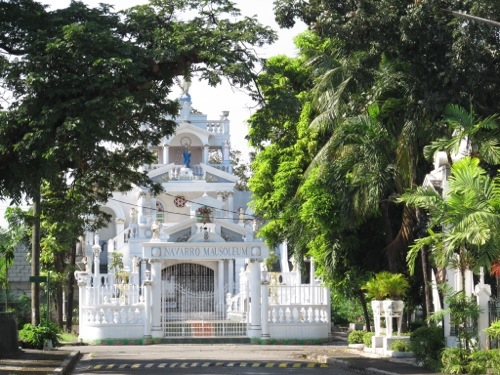
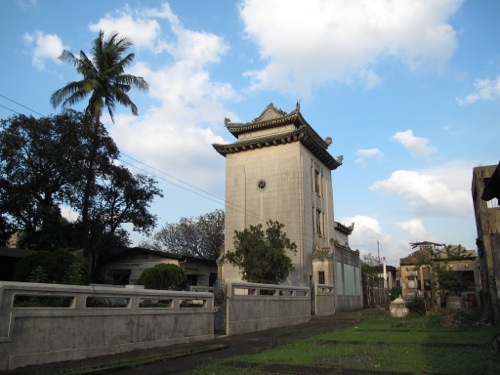
No. It isn’t a church. It’s a Mausoleum.

20121129-093802.jpg

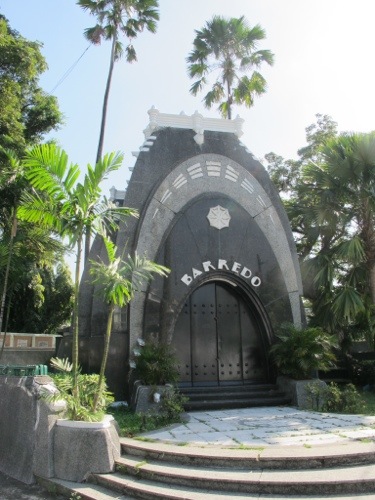
Another Mausoleum for the Barredo Family. La Loma Cemetery. Quezon City.


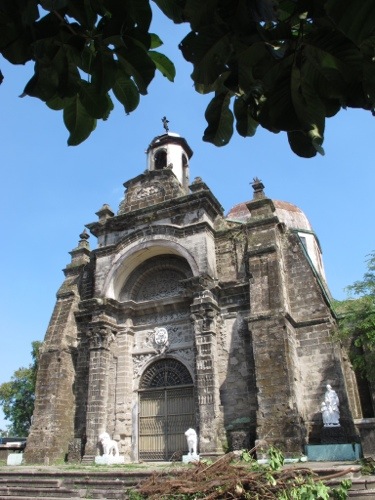
A big pseudo-baroque chapel dedicated to Saint Pancratius within the cemetery which served as its funerary chapel from 1884 to 1962 ย is now fondly called “Lumang Simbahan” (literally translated “Old Church”). ย Rich and famous dead lying side by side in their private, marbled resting havens – – truly a city for the dead spanning 54 hectares of land in this former capital (Quezon City) of the Philippines. Spared from the ravages of war where much of Manila was bombed out during the 1945 Battle of Manila, but not spared from serving as execution site during the Japanese occupation. Just the same, Campo Santo de La Loma is a significant link to Philippine history and architecture. After all, this 2nd oldest cemetery (1884)counts among its buried citizens the important icons of history, the old rich and famous, religious leaders and the simply famous. And yes, you read that right. 1884. Second oldest public cemetery, according to Architect Noche. Paco Cemetery spanning only 4 hectares IS the oldest (1822).


20121129-094603.jpg

Lumang Simbahan or Chapel of Saint Pancratius within the grounds of La Loma Cemetery. Served as funerary chapel from 1884 to 1962.

20121129-094808.jpg

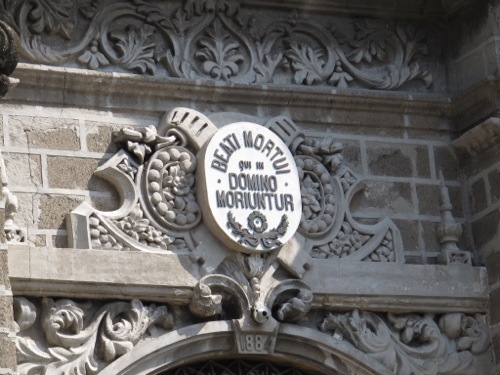
Details of the funerary chapel which has been abandoned and closed since 1962. Except for the sign “Epistula”, we found no other marker to explain its history.


Despite the heat, we trudged on dripping with enthusiasm and sweating with history lessons from our architect tour guide. If it were any cooler, i dare say these photos may remind one of the old cemetery tours done in Paris, Buenos Aires, and New Orleans.


20121129-100956.jpg

This is NOT an ordinary street. It cuts across the La Loma Cemetery, lined on both sides by old mausoleums belonging to prominent and old elitist families in the Philippines.

20121129-101146.jpg

Quite a sight. Who would have thought this is in the Philippines? Or that there’s 54 hectares of cemetery property within the Metropolis?


All of 54 hectares within the metropolis. You’d think one should find better use for this land in this time and age. But it is an important piece of our history. I’m sure the hoi polloi would be interested to read up on the history of some of the prominent families interred here. Them are some of the aristocratic families of old. The illustrados. The hacienderos. Viejo familias. Their names ring familiar as many industries, companies, schools, even streets are named after them.


20121129-103705.jpg

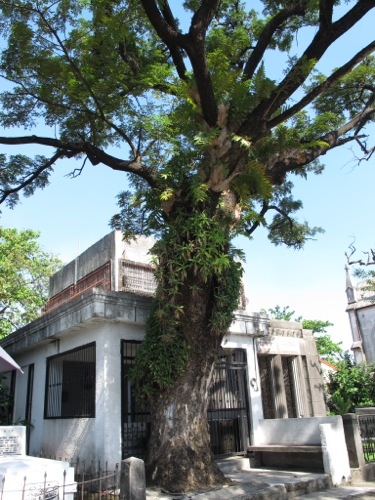
Must be an old tree growing out of a Mausoleum.

20121129-103843.jpg

I can only imagine Dona Victorinas coming to light candles and offer flowers in many of these Mausoleums. ๐Ÿ˜‰


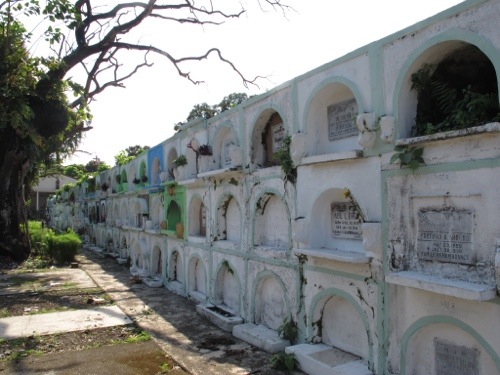
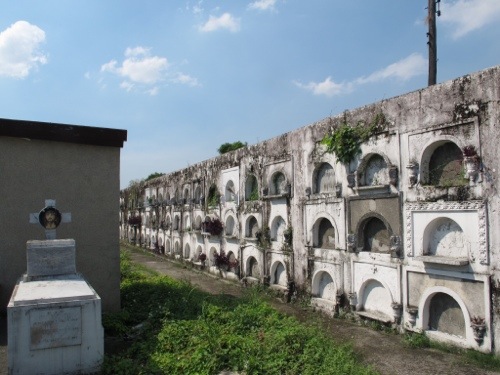
As we moved from mausoleum to mausoleum, from one gravesite to the next, we can’t help wonder how squatter-families live here. As we stood in awe viewing the grandeur of some architectural designs and sculptures, we also didn’t miss the empty gravesites where little children play nearby and where laundry hangs from a rope loosely hung between 2 trees. Mixed emotions here. I feel for these impoverished families, yet I lament that this “open air museum” seems to have been taken over by illegal occupants. I really hope our government finds a suitable relocation site where these families can resettle.


20121129-104739.jpg

This one looks rather NEW. All of 3 storeys high. Looks a bit tacky to me.

20121129-104853.jpg

There were many interesting statues and monuments. Architect Manuel Noche said he brings his architectural class to these cemeteries every now and then to study art and architecture. Well, history too.


I know there are some who go visit on their own, but guided tours are best if one wants to appreciate the place’s historical and architectural significance. You may google all you want but you may miss out on some historical tidbits. Besides, it’s good to visit as a big group. It’s more fun!


20121129-105621.jpg

Another Mausoleum for the Rich and Famous.

20121129-105749.jpg

……….while others are interred in another part of the cemetery.


“And if travel is like love…it is mostly because it’s a heightened state of awareness, in which we are mindful, receptive, undimmed by familiarity and ready to be transformed. That is why the best trips, like the best love affairs, never really end.” ~ Pico Iyer


20121122-150312.jpg


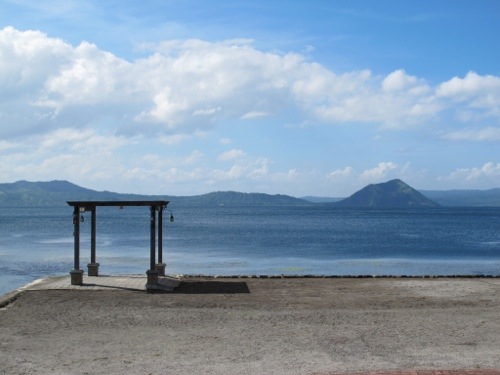
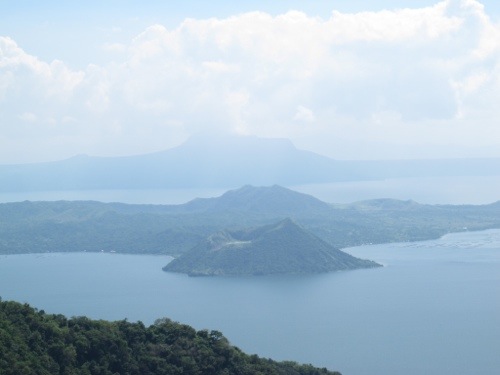
As I’ve earlier blogged, I never grow tired of Tagaytay. Neither of Taal Volcano. Whether it’s viewed from the lakeshore in Talisay, Batangas or from the Tagaytay Ridge. With guests, we drove south from Manila at exactly 8am and back by 1pm. Just a short 5 hour day trip to view the world’s smallest active volcano.


20121122-151028.jpg


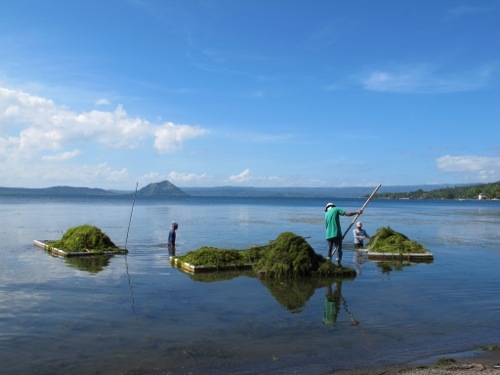
The lakeshore scene from Club Balai Isabel included men fishing out seaweed from the waters by the shore. And then plunking them back down somewhere farther. Don’t ask me why. But it made for a lovely morning vista for city people like us. The men were still there even while we had a simple lunch of bulanglang soup and club sandwiches at the Club’s Terraza Cafe.


20121122-151433.jpg

20121122-152212.jpg


It’s always good being back here. I so love the place here I’m longing to spend a long weekend with my family here again. Yes, again. And again.


Soon after lunch, we negotiated the 9 kilometer uphill drive towards Tagaytay City. This time, we entered the Taal Vista Lodge for the view of the same volcano from the ridge. Hard to imagine this ridge used to be part of the volcano which collapsed in a major eruption centuries ago. By this time, so much has changed in Tagaytay. I long for the rustic feel which is fast fading — what with all the high rise structures under construction.


20121122-152308.jpg

20121122-153654.jpg


So, let’s hope the local authorities in Talisay, Batangas and Tagaytay City remember to preserve the charm of these small city and town. I’d be terribly saddened to see these places ruined as they are being “built up”. Taal Volcano may look the same, but the “old charm” adds to the ambiance, the romance of viewing this small monster from the lakeside and from the ridge.


20121122-154113.jpg


I know. I know. Sounds morbid. Even cruel. But can’t help thinking THAT while walking the “streets” within the hallowed grounds of La Loma, North and Chinese Cemeteries in Manila.


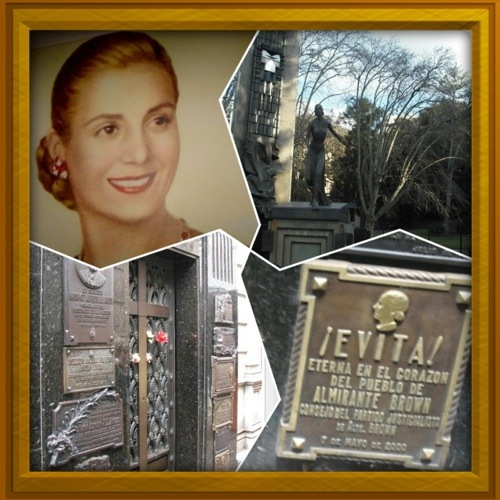
The architect/tour guide mentioned how Evita Peron’s grave in Recoleta Cemetery draws in millions of tourists and yield tourism moolah for Argentina. Yes, Evita of that Broadway musical fame. The same lovely lady who married Juan Peron just a year before Juan became President of Argentina. The same lady who tried to run as Vice President of the same South American nation.


20121120-074045.jpg


Evita. Don’t you feel like breaking out to sing “Don’t Cry For Me, Argentina”?ย ย That musical has forever etched this Argentinian First Lady into our minds and pop culture. Many believe she’s the inspiration for a local ex-First Lady who similarly held political posts while the husband was President. The latter has inspired many comedy acts and invariably, the plays emphasized her flamboyant lifestyle and alleged “obsession” with shoes. Given the flamboyance displayed in these urban cemeteries, the architect/tour guide is spot on when he quipped “Wait till xxxxx dies……”.


20121120-075418.jpg

20121120-080211.jpg


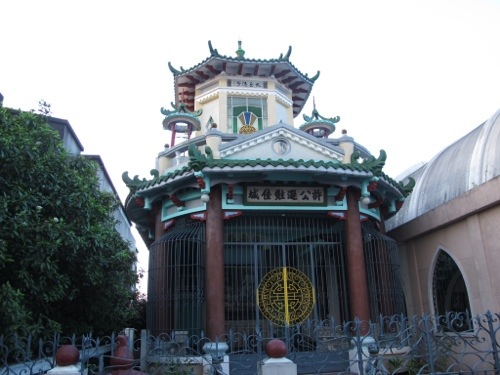
Some of those mausoleums are even bigger than village churches I’ve been to. Really, in death as in life….. the disparity between rich and poor is very evident. The affluent within high society made sure their family names are immortalized in the “city of the dead”. Spanning many hectares of land, I am amazed to find how vast these cemetery parks are. I visited 3 in a day. La Loma, North and Chinese Cemeteries. Each deserving to have their stories told.


20121120-081117.jpg

20121120-081237.jpg


Even now, these cemeteries are drawing in tourists. It is just lamentable that the authorities are unable to deal with the squatting problem. If you ask me, these squatters have grown out of control. The very reason why I didn’t have the courage to “tour” on my own. I joined a tour organized by the Museum Foundation of the Philippines and was only too happy to have the brilliant Architect Manuel Noche and the hilarious, ever-energetic Ivan Man Dy walk us through history as we walked around the mounds and mausoleums, some of which are as high as 3 storeys.


Watch this page for sequels!

20121120-082034.jpg

20121120-082128.jpg


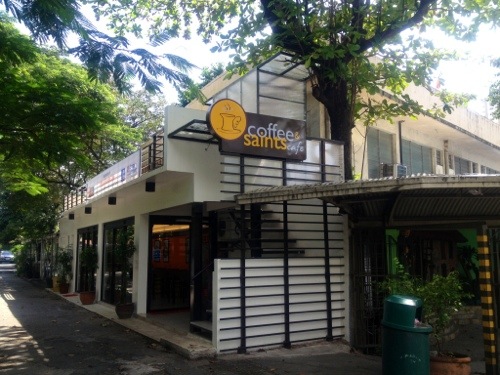
Coffee & Saints is a coffee shop run by the Don Bosco PUGAD, a project for migrant youth from all over the country. Other projects include bread making and water filtering stations where young men aged 17-21 gain technical skills and self-worth.


20121108-205813.jpg


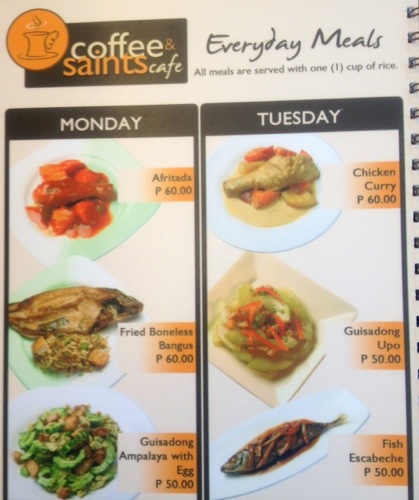
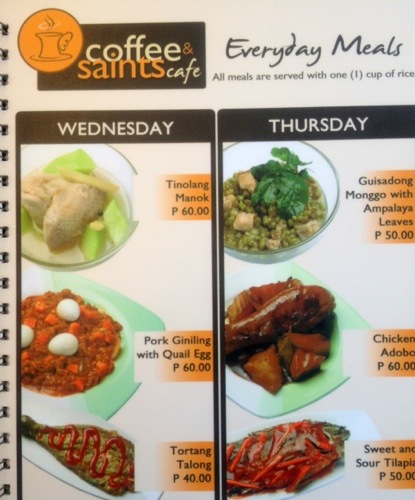
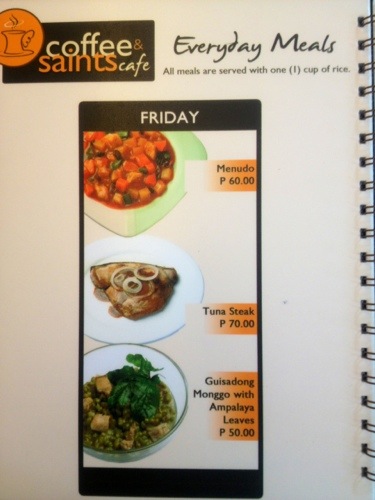
You’d find the coffee shop right beside the Don Bosco Church and within the church compound and parking lot. In my earlier blog, I wrote about a few of its simple menu offerings. Today, the tiny coffee shop now offers home-cooked meals at very affordable prices. Check out these daily offerings through the photos below.


20121108-210711.jpg

20121108-210747.jpg


Remember how we used to troop to Amicรญ just outside the church compound after hearing mass? At the time, it was just a simple “carinderia” with great pasta offerings and many gelato flavors. Well, Coffee & Saints is no trattoria and no, they only offer Pinoy everyday meals. But from the “Silog” series come these comfort food at prices well within one’s budget. Who says you can’t enjoy home-cooked comfort food while staying frugal? Plus the tiny dining place is tidy, packed with ambience, and manned by eager to please migrant youth.


20121108-212025.jpg

20121108-212108.jpg


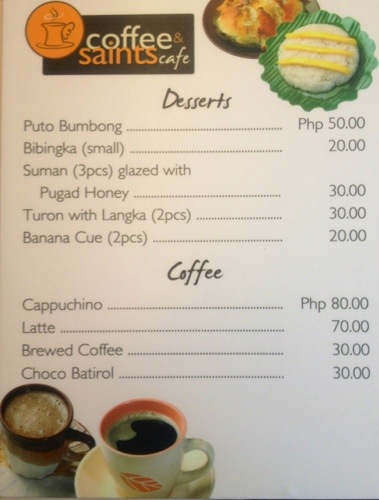
And if you’re still stuck with Coffee & Saints’ original “Silog series”, they’re still available. EVERYDAY. Same with their desserts, except that some of the “Kakanin” are available only at certain hours of the day. Me? I promise to try a new dish every visit along with my “standard daing na bangus”. And if you don’t care for their desserts, ask for the Pugad cookies priced at P20 each. There are cookies flavored with malunggay or ashitaba leaves. The same leaves you’d find in your ginisang mongo and dinuguan dishes.


20121108-213138.jpg

20121108-213227.jpg


And oh, don’t forget to try their Barako coffee or the chocolate batirol. The Pugad boys will cheerfully serve them while you’re waiting for your orders. Bless these boys. God bless you too for patronizing this place!


20121108-213502.jpg

20121108-213538.jpg

20121108-213624.jpg

WHY WE PHOTOGRAPH


In this day and age, photography has taken hold of nearly every young adult’s life. DLSR or P&S, a camera slung on someone’s neck has now become part of the wardrobe. One photo — which I’m borrowing from the Net — speaks volumes about everyday life now.


20121031-133023.jpg


We take photos of places we’ve visited, restos we’ve dined in, food we’ve eaten, celebrities we’ve seen, or just about anything or anyone we found interesting. “Found interesting?” —- OR very candidly, something we wanted to share with others. “Something we wanted to share……?” — or quite honestly, something we wanted OTHERS to know about us. ๐Ÿ˜ƒ๐Ÿ˜€๐Ÿ˜Š


20121031-134001.jpg


Social networking like Facebook, Twitter, Instagram, etc. render it almost obligatory to “document” our everyday activity. Our circle of friends et al get updated with our not-so-private lives through our status updates and photos we post. In my time, we wrote on our diaries. Now, some of us BLOG. Still others feel free and absolutely unrestricted with the ways they wish to express themselves. Then as in now, we were provided ways to express ourselves. But the rules have changed. What we wrote on our diaries then stayed a secret. These days, what we blog is available to everyone including strangers. Same Same, but different.


20121031-135743.jpg

20121031-135932.jpg


Whatever the reasons or motivations, I’m happy I don’t have to shell out a big chunk to get my films developed. I’m glad I need not scrimp on my shots, that i can in fact “experiment”, and that a bad shot can so easily be dismissed with one click. I’m overjoyed that I can do my “diaries” complete with photos that make them great memory aids! And that I can even share them with others. Really, isn’t it amazing we can do all these things now?


20121031-140650.jpg

20121031-142110.jpg


Sure, there are those who really go overboard. The camwhores who truly think others are genuinely interested in them, what they do, and how they look. (Yeah, forget the VIEW, just check out my jumpshot!) Or they are exhibitionist-wannabes. As for moรญ, I need my memory aids. That, plus I do love it that I continue to learn something new. For someone who has not had a camera until her early 30’s, you can say I’m a late-bloomer. After all, self-expression is available to everyone of all ages.


20121031-143350.jpg


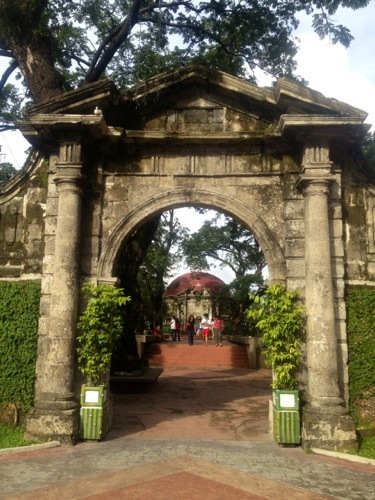
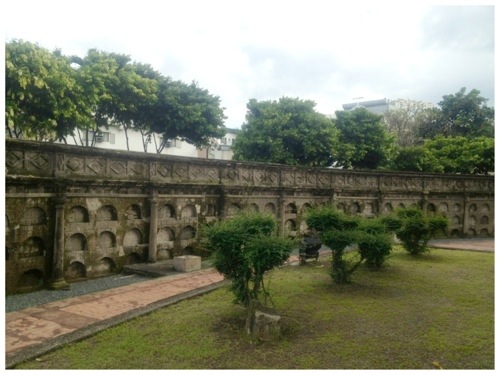
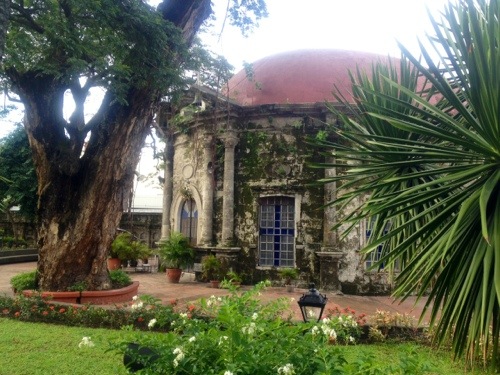
Another one of those afternoons. No cams. Not even a Point & Shoot. Just Siri and Me. Just another hour to “waste”. So here we are, revisiting Paco Park. That lovely, tiny, circular chapel. And the cemetery that could have, SHOULD HAVE earned more attention, respect and recognition other than as a popular wedding venue. ๐Ÿ˜ฆ


20121028-163445.jpg


I confess to my own ignorance too. Not that I lacked interest. More like I truly feel there is something grievously wrong about how our history has been written and our own education and school system. Whatever I know of Philippine history, I gained from the books I bought and read. What I learned from school hardly went beyond Rizal’s martyrdom. Let’s admit this. Many history lessons stopped with Magellan’s death courtesy of Lapu-Lapu (so, what happened to Lapu Lapu after? Any guess?), or with Rizal’s martyrdom in Bagumbayan (where was our national hero interred following the 1896 execution?). Or how many Philippine heroes can you name and how much do we know of each? If we hardly know Rizal our national hero, I do not expect we can say much of Bonifacio, Mabini, Fathers Gomez, Burgos and Zamora.


20121028-164322.jpg

20121028-164349.jpg


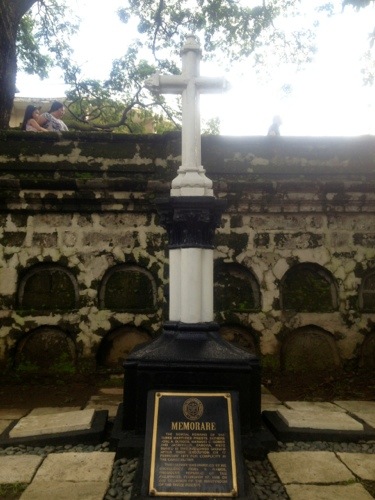
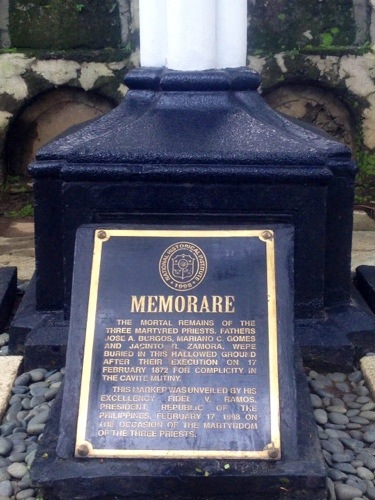
For some, if not many, it would come as a surprise that the 3 martyred priests are actually buried here. It may even surprise some that their execution in 1872 inspired our national hero to write El Filibusterismo.. Today, this marker may not spark as much enthusiasm and evoke much significance among many locals. How sad.


20121028-164826.jpg

20121028-164851.jpg


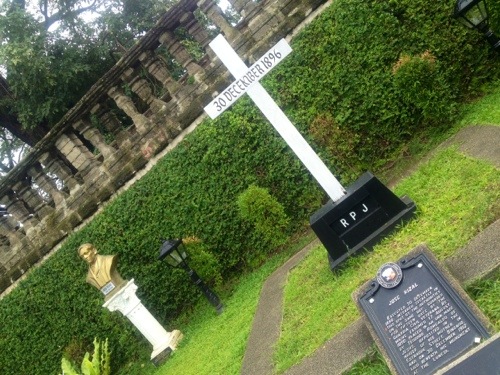
Circling the same Paco Park, a patch of land bears another marker. This is the very spot where our national hero was SECRETLY buried soon after the December 30, 1896 execution in Bagumbayan. Zoom in on that marker to know more! ๐Ÿ˜‰


20121028-165404.jpg


We didn’t plan on being here. We met for early lunch hoping to simply chat the afternoon away. But why not chat while driving around Intramuros, much like those joy rides we used to enjoy when we were kids?


20121028-151351.jpg


Then the calesa passed right in front of us. It’s 2 o’clock in the afternoon and those riders didn’t seem to mind the heat nor the sun. Well, it wasn’t particularly hot this afternoon. Pleasant enough to get off the car and walk into Baluarte de San Diego here in Intramuros. It’s a better option than the more open spaces in Fort Santiago. More shady trees too.


20121028-151843.jpg

20121028-151942.jpg


For only 75 pesos (less than US$2), one can get in to enjoy the “park with some history”. There were kids running around with their dog in the shady part of the Baluarte. Not many tourists. Many of them must be in Fort Santiago or San Agustin Church and Monastery. Yet this is one of the oldest stone fortifications in the whole length of the Intramuros walls.


20121028-152515.jpg

20121028-152544.jpg


The old stone steps lead up to the walls from where one views this circular stone formation, the length of the walls, and the Manila Hotel and other modern skycrapers surrounding the walled city. I remember being here years back when I attended a wedding of a friend’s daughter where I stood as sponsor. I would have wanted to walk atop the walls, but my long gown got in the way ๐Ÿ™‚ Today, there is no such restriction.


20121028-153055.jpg

20121028-153120.jpg


Will someone please tell me how these circular stone formations were used? Surely, the good Jesuit priest who designed it back in the 16th century had some purpose in mind. I mean, I do know they’re there to defend the walled city but my simple mind can’t understand the many circular formations. From what I gather, this part of the Walls went into disrepair and were in fact only rediscovered in the 70s. Forgive my ignorance, but I’m most certainly eager to know how that circular design work.


20121028-153733.jpg

20121028-153823.jpg

20121028-153851.jpg


These days, the Baluarte (Baluarte means bastion or fortification) is more popular as a wedding reception venue. I wish it could be more than that. The place has so much history and is, in fact, a lovely “park” which children would enjoy. The only drawback is it could be really hot during summer here. I sure hope the Intramuros Administration consider late afternoon and dusk tours here and around Intramuros. It will require some investment in good lighting and better security, but I’m sure tourists and even locals would enjoy the place better as the day approaches sunset and at night. Play some good music too (like in Paco Chapel and Cemetery) and you’d turn the Baluarte more magical!


20121028-160741.jpg

20121028-160827.jpg

20121028-163359.jpg


Such distinguished Filipinos. Estoy. Muy. Orgullosa! I. Am. Very. Proud. As were the Filipinos then based in Madrid who celebrated these Masters’ victories as Gold and Silver Medalists in the 1884 Madrid Arts Exposition. For Juan Luna, his Spoliarium earned him a Gold Medal. Felix Resurreccion Hidalgo earned his Silver for his “Las Virgenes Cristianas Expuestas al Populacho” (The Christian Virgins Exposed to the Populace), which showed a bunch of boorish looking males mocking semi-naked female slaves. A copy of this painting now hangs at the Metropolitan Museum of Manila. The original was destroyed in a fire at the University of Valladolid in Spain. A pity.


20121028-103035.jpg

Juan Luna’s Spoliarium


I visited the National Art Gallery and the Metropolitan Museum of the Philippines on separate occasions. Just a couple of days apart. I had the rare chance to stand in the middle of the Hall of Masters all by my lonesome self. And to get really close to Luna’s Spoliarium. My iPhone came in handy, though the shots could be better. Por supuesto! But ain’t complaining. I love how I can walk around unburdened by a camera slung around my neck.


20121028-103605.jpg

Felix Resurrecion Hidalgo’s “Christian Virgins Exposed to the Populace”


They had more restrictions at the Metropolitan Museum though. No photography allowed. Not even if you promise not to use flash. (Photo shown here was sourced from the Net. thank you, Google) Same restrictions apply in the Ayala Museum where a guard gently reminded me of such restrictions when I whipped out my iPhone in front of an Edades painting. I’m not complaining but it behooves me why different rules apply. In the case of Hidalgo’s Christian Virgins, I wasn’t even allowed to get within a couple of meters from the copy of this masterpiece. Yes, a copy. Yet, I was allowed to snap close-up shots of the original Spoliarium by Luna.


20121028-105412.jpg

Close Up Shot of Luna’s Spoliarium. National Art Gallery.


These 2 obra maestros by Luna and Hidalgo bagged Gold and Silver Medals in the 1884 Madrid Arts Exposition. A victory celebrated by Filipino patriots then based in Madrid, to include our very own Dr. Jose Rizal. The venue for the victory banquet still stands today in Madrid, in Echegarray Street just a few strolls from Puerta del Sol. In this banquet, our national hero โ€” whoโ€™s said not to have eaten the whole day for lack of funds โ€” gave more than a toast to honor Luna and Hidalgo. More like a speech. A speech so full of bravado and spunk, where Rizal frontally attacked the religious establishment. Perhaps a preview of the Padre Damasos and Padre Silvas in his Noli Me Tangere. If you ever get to Madrid, do check out Hotel Ingles and “stand proud” as forefathers did. And while you’re there, be sure to visit Rizal’s other favorite haunts.


20121028-105658.jpg

Hotel Ingles. Echegarray Street, just a few strolls from Puerta del Sol. Madrid.


If you haven’t been following my Madrid Blog Series, let me leave you with this excerpt from Rizal’s impromptu speech at the Hotel Ingles victory banquet. My man. Truly, Rizal’s Filipino pride shone through.

ย 

โ€œLuna and Hidalgo are as much Spanish glories as they are Filipino. Just as they were born in the Philippines, they could have been born in Spain, because genius has no country, genius blossoms everywhere, genius is like the light, the air, it is the heritage of allโ€


My afternoon was suddenly freed up, so how best to spend the time? The sun’s out and a walking tour is out of the question lest I feel like having a heat stroke. Shopping is not an option. I’ve also met my quota of 2 movies max in a week. I don’t feel like reading a book as the one I’m reading now is way too serious, too profound for my taste but nevertheless deserving of a read. I’m not hungry (yet) and I’ve been considering a walk in Chinatown when the heat is more bearable. Between NOW and a dimsum and lumpia fix in Chinatown, there’s the National Art Gallery.


20121024-010752.jpg

Juan Luna’s Spoliarium

20121024-010828.jpg

Felix Resurrecion Hidalgo’s “Assasination of Governor Bustamante”


In my first entry, I advised going to the Museum on a full stomach. This time around, I did the rounds while my stomach constantly reminded me of kutchay dumplings in this “hole-in-the-wall” dimsum place” off Ongpin Street. Without breaking a stride, I walked up the stairs to the Art Gallery. Sans camera. Sans bag. What I needed filled my pockets.


20121024-011003.jpg

20121024-011049.jpg


Siri was good company when I was strolling around Madrid as it is here within Museum walls. There was no crowd so I was able to spend as much time in the Hall of Masters Luna and Hidalgo. Almost mindlessly, I walked right up to the center of the hall between Luna’s “Spoliarium” and Hidalgo’s “Assassination of Governor Bustamante”. With each masterpiece, I inched closer, as if I’d find new meaning as I view the painting up close. I took my time snapping photos with my iPhone camera. Easily, I spent 10-15 minutes in this single hall. It’s not everyday after all that you find yourself ALONE in the Hall of Masters. No crowds. No student groups. No noisy chatty teenagers! No DLSR-toting tourists. ๐Ÿ™‚


20121024-011156.jpg

20121024-011223.jpg


Both masterpieces have so many characters and it is quite interesting to read the facial expression, mannerism, body language and “aura” of each character. Now, that’s coming from a layman. I have neither the aptitude nor the training for art but I see what I see. Whatever and however the painting makes me feel is completely my own. Regardless of who painted what, I derive a certain sense of meaning. Intended or not by the artist, this is WHAT or HOW this and that painting made me feel.


20121024-012154.jpg

20121024-012230.jpg


I dare not share my sentiments and personal interpretations with anyone. No pretensions here. Both Luna and Hidalgo intended those masterpieces to convey a message. Whether i did get that message or not is my problem. But some may wish to dwell on the “separation of Church and State” or lack of it upon viewing Hidalgo’s “Assassination of Governor Bustamante”. Or how Luna’s very Roman scene in Spoliarium may invite discussions on human rights violations or the Filipinos’ sufferings during that time. The serious artists may deliberate on the significance of the red shade and the dominance of bodies throughout the painting, the interplay of light and shadows or whatever sounds artsy. I have no interpretation. I asked Siri and Siri delivered a well-researched Wikipedia spiel. Then I snapped away. So what I have to share with you are these close up photos from my iPhone cam. Tell me what you think!


20121024-184605.jpg

20121024-184644.jpg